dailynewsnblog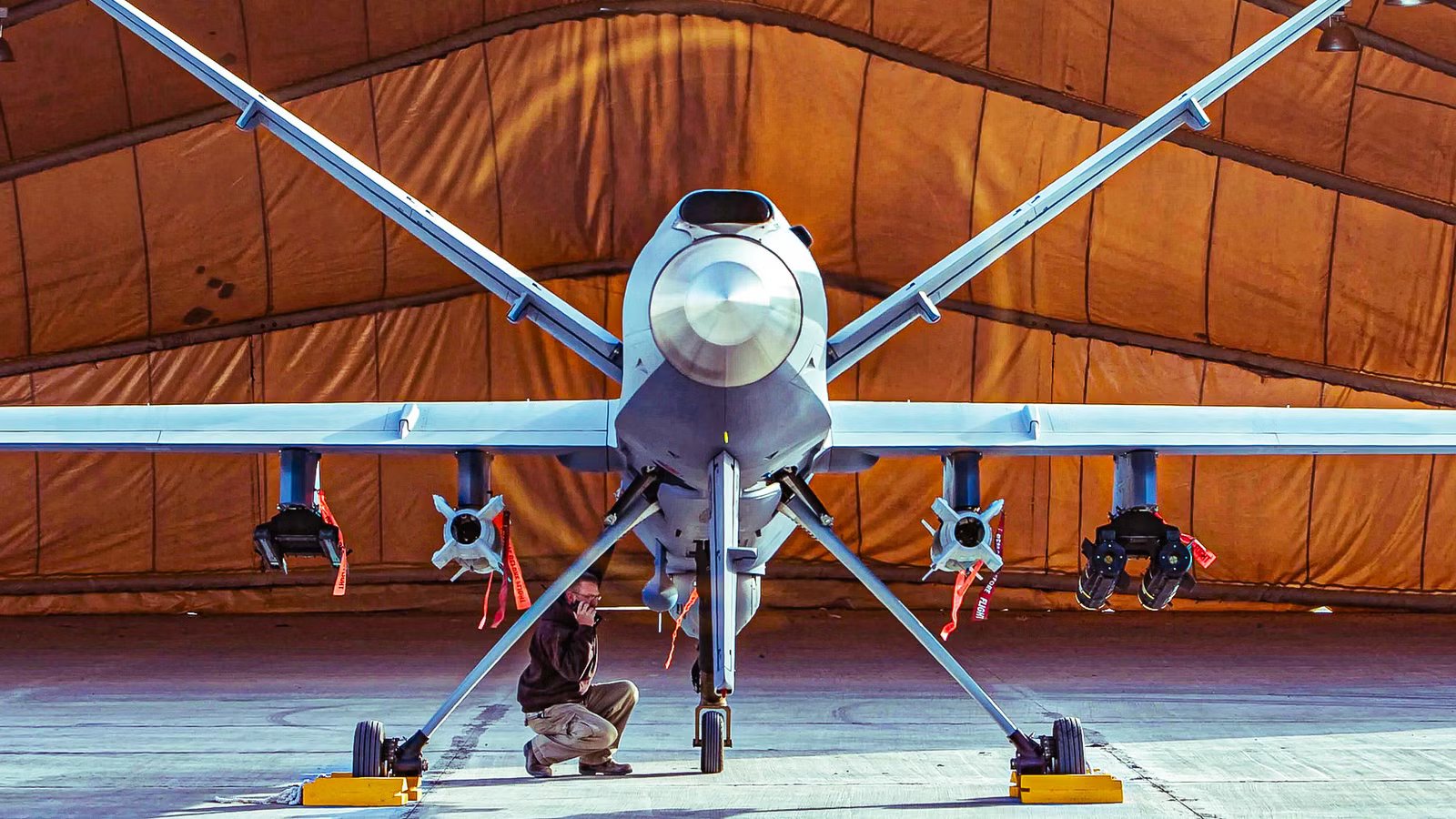
Uncrewed Aircraft, or drones, have been steadily growing larger and more capable for decades. Today, there is a wide range of Unmanned Combat Air Vehicles, (UCAVs) that range in size and complexity to accomplish a long list of missions for militaries around the world. These drones range in price from $1 million to over $100 million. The simplest models use piston-powered propeller engines to survey the battlefield and provide air support. The most ‘exquisite’ examples have jet engines wrapped in stealth airframes to support fifth-generation fighter jets deep behind enemy lines.
General Atomics MQ-9 Reaper
The global benchmark for UCAVs

The Reaper was the first hunter-killer drone successfully built to integrate persistent surveillance and precision-strike capabilities into a single uncrewed platform. Its combination of extreme loiter time, massive payload capacity, and battle-tested engineering has set the standard that every modern drone program tries to replicate. The powerplant in the MQ-9 has nearly tenfold more power than its predecessor and can remain airborne for up to 27 hours. Some specialized variants even have the endurance to fly continuously for as long as 48 hours.
The MQ-9 has now logged millions of flight hours with the US Air Force, Royal Air Force, as well as the militaries of France, Italy, India, and Japan. Compounding this incredible capacity for persistent intelligence, surveillance, and reconnaissance is a greatly expanded arsenal of aircraft. When the MQ-9 succeeded the MQ-1 Predator, it introduced a payload capacity 15 times higher, dramatically increasing its mission capability. Its seven hardpoints can deploy highly destructive, precise weapons, including Hellfire missiles, GBU-12 laser-guided bombs, and Joint Direct Attack Munitions.
The Reaper cannot only strike targets with extreme accuracy and hard-hitting munitions, but its operating envelope allows it to soar to altitudes far beyond the reach of many conventional anti-aircraft threats. The drone can fly up to 50,000 feet (15,000 meters), which has also lent it well to evolving mission sets. Initially optimized for asymmetric, low-threat counterterrorism operations, modern variations are adapting the airframe to carry long-range standoff weapons and cruise missiles.
The General Atomics XQ-67A Drone For The US Air Force: What To Know
The XQ-67A is set to redefine what unmanned combat drones are capable of and deliver a new kind of weapon system to the USAF.
Baykar Bayraktar TB2
Turkey’s do-it-all drone

Turkey’s Bayraktar TB2 represents an excellently balanced system designed to fulfill the needs of a conventional military and meet the realities of an asymmetric battlefield. Since 2022, the invasion of Ukraine has shown militaries around the world how important inexpensive, attritable uncrewed combat platforms are on the 21st-century battlefield. Operation Epic Fury has continued to drive this point home, as the US and Israel significantly outspend Iran in order to defend their more sophisticated systems and larger military facilities from low-cost, one-way electrons.
From a strategic procurement standpoint, air combat is a math problem calculated via the cost-per-kill ratio. Bayraktar TB2 executed a highly effective asymmetric technology disruption, breaking the conventional, multi-billion-dollar monopoly on precision airpower. The game-changing difference is the extensive use of commercial off-the-shelf components in the drone’s assembly. It is a fraction of the cost to construct in comparison to an American UCAV like the MQ-9 Reaper, yet it delivers much of the same mission capability.
Specification | MQ-9 Reaper | Bayraktar TB2 |
|---|---|---|
Engine Propulsion | 950 horsepower Honeywell turboprop | 100 horsepower Rotax piston |
Max Takeoff Weight | 1,543 pounds (700 kilograms) | 10,500 pounds (4,760 kilograms) |
Maximum Payload | 330 pounds (150 kilograms) | 3,850 pounds (1,746 kilograms) |
Hardpoints / Stations | 4 total weapon stations | 7 total weapon stations |
Primary Ordnance | MAM-L smart micro-munitions | AGM-114 Hellfire laser-guided missiles |
Cruise Speed | 80 miles per hour (130 kilometers per hour) | 230 miles per hour (370 kilometers per hour) |
Maximum Altitude | 25,000 feet (7,620 meters) | 50,000 feet (15,240 meters) |
Flight Endurance | 27 total hours airborne | 24 total hours airborne |
While the US drone completely outclasses its Turkish counterpart, actual combat results, such as in Iran, have shown that that capability is often excessive for many scenarios. Deploying an asset like the Reaper excessively jeopardizes an expensive, complex machine that is difficult to replace for a mission that a simpler drone can handle. As a tactical, lightweight strike platform, the Bayraktar only costs $2 million to $5 million per unit versus the MQ-9’s $30 million or higher price tag.
How Many Drones Does The US Department Of Defense Operate?
The rapidly growing fleet of unmanned aircraft.
CAIG Wing Loong II
China’s answer to the Reaper

Developed by the Chengdu Aircraft Industry Group, the Wing Loong II fills the middle ground between the Reaper and the Bayraktar TB2. The Wing Loong II has a similar performance and payload capacity to the MQ-9, at a much lower price point, roughly on par with the Turkish UCAV. This iteration represents a major leap for Chinese UCAVs as the first in its series powered by a domestically produced WJ-9 turboprop engine. The performance does not match the US drone, which can fly higher and carry more, but it does greatly outclass the TB2.
The Wing Loong II is limited to around 30,000 ft (9,000 meters) and 880 pounds (480 kg), but it can actually fit more munitions than an MQ-9 with six underwing hardpoints. While the Reaper can lift more weight with dual- or triple-ejector racks, the Chinese UCAV can carry up to 12 precision-guided weapons simultaneously. The list of munitions that this drone can carry is also similar to the MQ-9, including ordnance like laser-guided anti-tank missiles and smart bombs.
It also features satellite communications that allow the Wing Loong II to fly beyond visual range of ground control stations, which is a feature only available in the most expensive variants of the Bayraktar TB2. The affordability of the platform, combined with its impressive performance, has seen it deployed to combat already, the South China Morning Post wrote. The drone has been battle-tested on the platform and has seen heavy combat deployment in regional conflicts across Libya, Yemen, and Ethiopia, heavily operated by export clients like the United Arab Emirates, Saudi Arabia, Algeria, and Egypt.
Catch what other flight trackers miss
Emergency squawks, holds, NOTAMs — live signals, no signup.
Open tracker
Catch what other flight trackers miss
Emergency squawks, holds, NOTAMs — live signals, no signup.
Open tracker
Northrop Grumman RQ-4 Global Hawk
The world’s pre-eminent ISR platform

The Northrop Grumman RQ-4 Global Hawk is a high-altitude, long-endurance ISR platform without armament made purely to serve as a strategic ‘eye in the sky.’ The bulging nose of the RQ-4 houses a 5-foot (1.2 m) satellite communications dish. It has a massive wingspan of over 130 ft (40 m) made of lightweight carbon fiber composite, like its fuselage, but allows it to soar to near-space altitudes. It is powered by a single Rolls-Royce F137-RR-100 turbofan engine mounted on the upper rear fuselage, producing 7,600 pounds of thrust.
The extreme tech of the Global Hawk makes it one of the most expensive uncrewed systems ever built, easily beating many crewed fighter jets. The huge drone can cruise at 60,000 ft (18,000 m) far above civil air traffic, weather systems, and air defenses for over 34 hours while transiting more than 12,000 nautical miles (23,000 km) per sortie. The RQ-4 carries as much as 3,000 pounds (1,400 kg) of advanced surveillance systems, including extremely sensitive radar technology and ground-target detectors.
Just one example of the RQ-4B runs over $130 million, and a complete system package jumps to over $220 million. Yet the era of the Global Hawk is coming to an end. The USAF has aggressively pushed to entirely retire its remaining Block 40 Global Hawk fleet. Air Force planners argue that the large, slow drone is highly vulnerable to modern, long-range peer-adversary air defenses. It is expected to be replaced by stealthier, faster, and less expensive UCAVs in the 2030s.
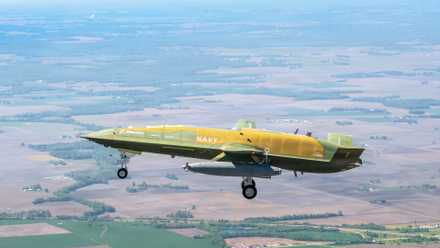
US Navy Enters Unmanned Era As First Boeing MQ-25A Stingray Takes Flight
Unmanned aviation is coming to the flight deck
Boeing MQ-28 Ghost Bat
The Loyal Wingman of tomorrow

The Ghost Bat is in a new league of uncrewed aircraft poised to revolutionize air warfare. It is one of the most mature collaborative combat aircraft designs in the Western defense industrial base. Being developed by Boeing Australia for the Royal Australian Air Force, it is also the first military airframe design built in Australia in over 50 years. It will enter service alongside fifth-generation fighter jets such as the Lockheed Martin F-35 Lightning II to enhance the lethality and survivability of advanced piloted platforms.
In 2025, a prototype MQ-28 successfully completed live-fire demonstrations as well as simulated operations in coordination with RAAF Boeing F/A-18 fighters and E-7A AWACS. Powered by a Williams FJ33 turbofan engine, the Ghost Bat can reach high subsonic speeds to keep pace with fighter jets. Its range is expected to exceed 2,000 nautical miles (3,700 kilometers), and it will have a low-observable design that minimizes its radar cross-section, allowing it to integrate with stealth fighters in operations over contested airspace.
The Ghost Bat will provide the RAAF with an affordable mass to ensure that force readiness levels are always capable of meeting mission requirements while also offering unmatched versatility and flexibility. The entire nose section of the aircraft can be completely detached and swapped out in the field within minutes. An ISR system package can be installed in the nose, along with an electronic warfare suite and an internal weapons rack for kinetic strike.