dailynewsnblog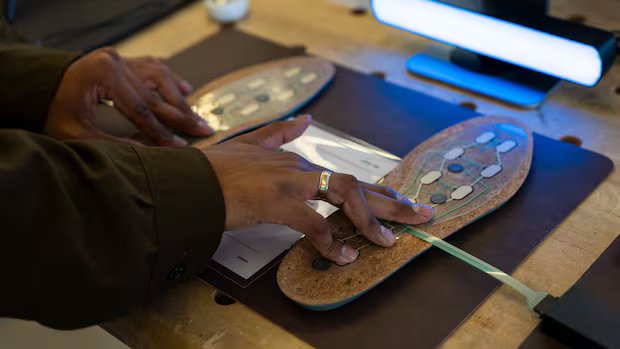
Imagine AI in your shirt. Your shoes. Your socks.
Toronto-based start-up Aurmada is one of a growing number of companies and designers trying to use AI to make clothing and footwear more interactive, testing ways to enable it to monitor everything from your gait to how close someone is standing.
Nearly two in five Canadians own wearable technology, according to a 2024 survey conducted by Leger. Smartwatches make up most of the market, but Aurmada CEO Zavosh Zaboliyan, 36, says that tech will soon be integrated into clothes, too, not just accessories.
“We’ve reached this technological advancement as a species, and why didn’t our clothing keep up?” he said.
Zaboliyan co-founded Aurmada after a car-crash injury. While re-training himself to walk, he grew tired of long waits for X-ray results and doctors’ assessments and started thinking about how he could get real-time information about what was wrong with his gait so he could correct it.
“Our body is constantly sending a signal,” he said. “We just don’t have the right tools to listen.”
AI integrated into clothing has the potential to do things like monitor and analyze vital signs and send them on to a doctor or caregiver, track your movements or detect objects in your blind spot, he said.

Alexa in your T-shirt?
Aurmada, which launched in October, got a chance to show off its designs at a technology showcase in Toronto last week.
The items on display included sensors embedded into shoe soles that can detect weight distribution, which, Zaboliyan says, could help with rehabilitation from injuries that impact walking.
The team is also working on sensors that are small enough to be sewn into clothing and, using AI, act like a virtual assistant that can answer questions.

A screen recording shows how AI software that Toronto startup Aurmada hopes to integrate into clothing detects nearby people and objects.
For the clothes themselves, Aurmada is exploring fabrics that have copper, silver or other metals woven into them to protect the embedded sensors from interference coming from nearby phone signals. The fabrics don’t feel harsh, and some are washable, Zaboliyan said.
The goal is to eventually attach lightweight solar panels to the fabric to power the tech inside, Zaboliyan said.
The company is also developing “low-tech” pieces, including a vest with a hockey-puck-sized device that uses electrical currents to heat up or cool down and lightweight jackets that, when plugged into a portable charger, turn on two small fans sewn into the back to cool you down.

While those are all prototypes, the company has launched a couple of non-AI-enhanced products, including bulletproof shirts made from a lightweight Kevlar material and socks made from thread that conducts electricity and stimulates muscles.

Designers experimenting with responsive fibres
Designers have been experimenting with integrating technology into fashion for several years.
In 2023, Adobe launched a dress that can change colours and patterns. In 2020, Levi’s partnered with Google to connect smartphones to a jacket, allowing users to play music, receive alerts and take pictures by tapping on a sensor embedded in a sleeve’s cuff.
The Fashion Institute of Technology’s DTech Lab in New York is one place where that experimentation is happening.
Michael Ferraro, the lab’s executive director, said one of his students made a jacket that uses electrical signals to interact with its surroundings.
“She embedded colour-changing thread and fibres into a plaid design that was responsive to external stimuli, including analyzing her Instagram feed, so that she basically had a mood ring that was her jacket,” Ferraro said.
Another designed a garment made of conductive fibres that track heart rate and breathing and feed that data into an AI algorithm that detects when a person is anxious and triggers a mechanism that causes the garment to tighten and give the feeling of a comforting hug.
“There’s lots of interesting fibres now that mimic muscles, so that they will constrict, which can be quite helpful for somebody suffering from anxiety,” Ferraro said.

He sees AI-enhanced features eventually showing up in more mainstream fashion as well as “purpose-built apparel” in fields such as emergency response.
Aurmada’s products, for example, are mostly targeted at workers in security, defence and manufacturing, who, Zaboliyan said, could benefit from sensors that identify potential threats or blind spots.
“We want to figure out ways to bring that body [and environmental] awareness to people,” he said. “I can’t see behind my back. So, if I’m working in a factory and something could go wrong … it’s going to prevent from injury.”

This Toronto company is designing AI clothes for an increasingly robotic world.
Privacy concerns
Still, the AI-enhanced clothing industry could face some challenges as it expands, Ferraro said.
Concerns about personal data collection and general wariness of AI will likely mean the mass adoption of AI-enhanced clothing is still years away, according to Janey Park, a Washington, D.C.-based marketer who founded the Digital Runway, a media site focused on wearable technology and fashion.
“We’ll see over the course of the next three years a lot of brands start dabbling in this and adding it to their product assortment,” she said, “but I still think that there is a giant … mountain to climb about normalizing it.”
At the moment, most wearable technology is useful but not necessarily fashionable, Park said. But if fashion and tech innovators can work together more closely, more stylish wearable technology could be widely adopted in the next five to eight years, she said.