dailynewsnblog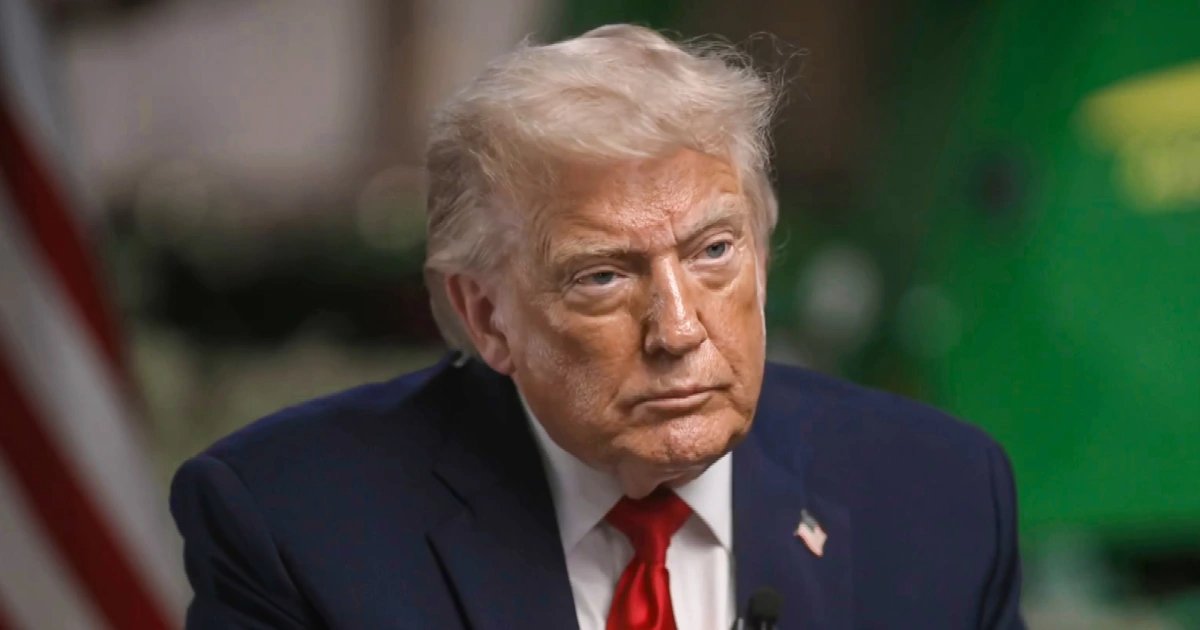
President Donald Trump sat for an interview with “Meet the Press” moderator Kristen Welker on Friday, discussing topics including the war with Iran, gas prices and the “anti-weaponization” fund.
Subscribe to read this story ad-free
Get unlimited access to ad-free articles and exclusive content.

Throughout the interview, which aired Sunday, Trump made a series of false, misleading or exaggerated comments.
NBC News reporters dug into some of the president’s remarks. Here are the facts behind the claims.
Iran war
Trump defended his first-term decision to terminate the Iran nuclear deal President Barack Obama had negotiated and his second-term decision to initially strike Iran in June 2025.
“They were very close to having a nuclear weapon. I terminated the deal. Then I sent the B-2 bombers in about nine, 10 months ago. And they obliterated, totally obliterated, the site. And I saved it,” Trump said. “We had a choice. We could let them have a nuclear weapon, or we could go along and have some beautiful days. But they would have, you know, it’s a judgment. They would’ve used a nuclear weapon.”
Later in the interview, Trump reiterated: “If I didn’t go in there with the B-2 bombers, they would right now have a nuclear weapon, and it could be that half of the world would be eradicated already.”
Trump’s statements are not in line with what then-Director of National Intelligence Tulsi Gabbard told lawmakers in March 2025, months before the initial U.S. strikes on Iran. At the time, Gabbard testified that U.S. spy agencies had assessed that Iran had not decided whether to build nuclear weapons, but that the country had stockpiles of enriched uranium beyond what is required for civilian purposes. NBC News reported in June 2025 that the U.S. assessment of Iran’s nuclear program had not changed since March. Additionally, while Trump claimed that the U.S. “totally obliterated” an Iranian nuclear site in the strikes, the reality is more nuanced. NBC News reported in July 2025 that one nuclear enrichment site was mostly destroyed, but two others were not as badly damaged.
Currently, Iran likely retains nearly 1,000 pounds of uranium enriched to 60%, a short step from weapons grade, according to the International Atomic Energy Agency (IAEA). Even if Iran had enough uranium enriched to weapons grade, it would need months or possibly more than a year to build a nuclear warhead that could fit on the tip of a missile, according to experts and former officials.
Before Trump withdrew the United States from the 2015 nuclear deal in his first term, Iran had no stockpiles of uranium enriched beyond a low level and was subject to regular United Nations inspections.
Welker noted that Trump had promised he would negotiate a better deal, asking him if he wished he would have done so in his first term. Trump responded that it was better to negotiate now, saying “Israel wouldn’t have been ready” during his first stint in the Oval Office.
Trump also said during the interview that major arms of the Iranian military were “gone” as a result of the current war.
“Their navy is gone. Their air force is gone. Their anti-aircraft is gone,” Trump said.
He said at another point in the interview: “In three months, I’ve demolished the navy, the air force, anti-aircraft. They have no radar. They have nothing.”
This is exaggerated. NBC News has reported that half of the country’s unconventional navy remains intact after weeks of bombing. The unconventional navy includes small “fast boats” typically used by the Islamic Revolutionary Guard Corps, or IRGC, Tehran’s hard-line military force. Those forces are key to Iran’s ability to influence international shipping through the Strait of Hormuz, and because of the nature of that navy, it has been harder for the U.S. to identify and target those forces.
The Pentagon has said the U.S. military has destroyed about 90% of Iran’s conventional navy and more than 95% of Iran’s naval mines, though. Defense officials have also said more than 80% of Iran’s “missile facilities” are gone, suggesting locations where Iran constructs missiles and other weaponry could be targeted should operations resume.
Trump was also pressed by Welker on his campaign pledge not to start any new wars.
“I didn’t guarantee no war. Why would I have built the strongest military in the world?” Trump said. “I built our military.”
But Trump repeatedly promised as a candidate that he would not start new wars if elected.
Trump said while campaigning in Pennsylvania in 2024: “I will not send you to fight and die in stupid foreign wars that never end. I will not send our sons and daughters to go fight for a war in a country that you’ve never heard of. We’re not going to do it. We’re going to bring our troops home, and we’re going to focus on America First.”
And in his November 2024 victory speech, Trump said: “I’m not going to start a war. I’m going to stop wars.”
Gas prices
Asked about rising gas prices that have resulted from the war, Trump said they would go down once a deal is reached.
“If we sign an agreement, it’ll go down now. Otherwise, they’ll go down after we’re finished,” Trump said.
But oil executives have said it will take time to restore oil production in the Middle East and bring down gas prices, even if the Strait of Hormuz is reopened immediately.
Exxon Senior Vice President Neil Chapman said at a Bernstein Research conference late last month that it is “going to take time to rebalance the global markets” once the strait reopens due to dwindling inventories.
“You can estimate four to six weeks before we get into a normal supply chain,” he said. “And it all depends on whether the strait opens — at what time it opens. And then the question for the world and every country and every commercial organization is how quickly do you rebuild those inventories?”
Meanwhile, Sultan Al Jaber, chief executive of the United Arab Emirates state oil group ADNOC, recently said: “Even if this conflict ends tomorrow, it will take at least four months to get back to 80% of pre-conflict flows and full flows will not return before the first or even second quarter of 2027.”
Jan. 6 riot
Trump defended the Justice Department’s proposed $1.8 billion “anti-weaponization” fund, saying that allies who “have been hurt so badly by radical left lunatics” deserve payment. While the Justice Department told a court that the fund is “not going forward,” there’s nothing to stop the Trump administration from giving payouts to Trump allies in the future, even without the fund.
Asked by Welker whether anyone who attacked police officers on Jan 6. should receive funds, Trump said he “wouldn’t be inclined to say so, but I have to see it.”
When Welker again brought up the roughly 170 Jan. 6 rioters who pleaded guilty to assaulting police officers, Trump said: “They pled guilty because they were frightened. They went down. They were ushered into a building. Many of them were arrested without even going into the building.”
This needs context, as some of the most violent rioters from that day never entered the building. The Biden Justice Department’s sprawling Jan. 6 probe mostly focused on individuals who either entered the Capitol itself or engaged in some sort of aggravating conduct outside the Capitol, such as assaulting police officers.
More from NBC News’ interview with Trump
For example, one of the longest sentences went to David Dempsey, who was ordered to serve 20 years in prison. Prosecutors said he swung makeshift weapons and hurled objects at officers, sprayed them with chemicals, and stomped five times on an officer’s head — acts committed outside the Capitol building itself.
Trump also claimed the FBI brought people into the Capitol on Jan. 6.
“They had FBI agents ushering them into the building,” Trump said.
As Welker noted during the interview, there’s no evidence that any FBI special agents ushered anyone into the building, and no on-duty FBI special agents were on the grounds until after the riot broke out and some responded to assist with crowd control.
There were four FBI confidential human sources, or informants, who entered the Capitol building, but they weren’t directed to do so by the bureau, according to a report from the Justice Department’s inspector general. The report also found that the FBI tasked three informants to report on domestic terrorism suspects who were possibly attending events in Washington, D.C., on Jan. 6. The FBI did not provide tasks for the other 23 informants in Washington that day.
California elections
Trump, who has for years made false claims of voter fraud, said the recent primary elections in California were “rigged.”
“The election was rigged. It was a dirty election. And it’s happening again right now in California,” Trump said. He added: “It’s four days and they aren’t even close to coming up with the — do you know why they’re doing that? Because they’re cheating on the election.”
Pressed for evidence, Trump said, “All I have to do is look. And I listen. I listen to people.”
There is no evidence of election fraud in California or problems with the state’s ballot counting.
Trump is pointing to the long vote count in California, which is the result of the state’s election rules and reliance on mail-in voting, long a target of ridicule for the president.More than 80% of California’s voters cast a ballot by mail in recent elections. Ballots that are postmarked by election day can be accepted up to a week afterward, when they must be validated, processed and tallied. States that vote largely in-person often report results more quickly because that process can happen at the polls with the voter present.
Trump noted that Republicans’ margins in some races are “dropping fast” as the vote is counted. But that is not due to fraud as he claimed. Democratic voters have been more likely to embrace mail-in voting, particularly in the post-Covid era, so as those ballots are counted, Democratic candidates’ numbers tend to improve.