dailynewsnblog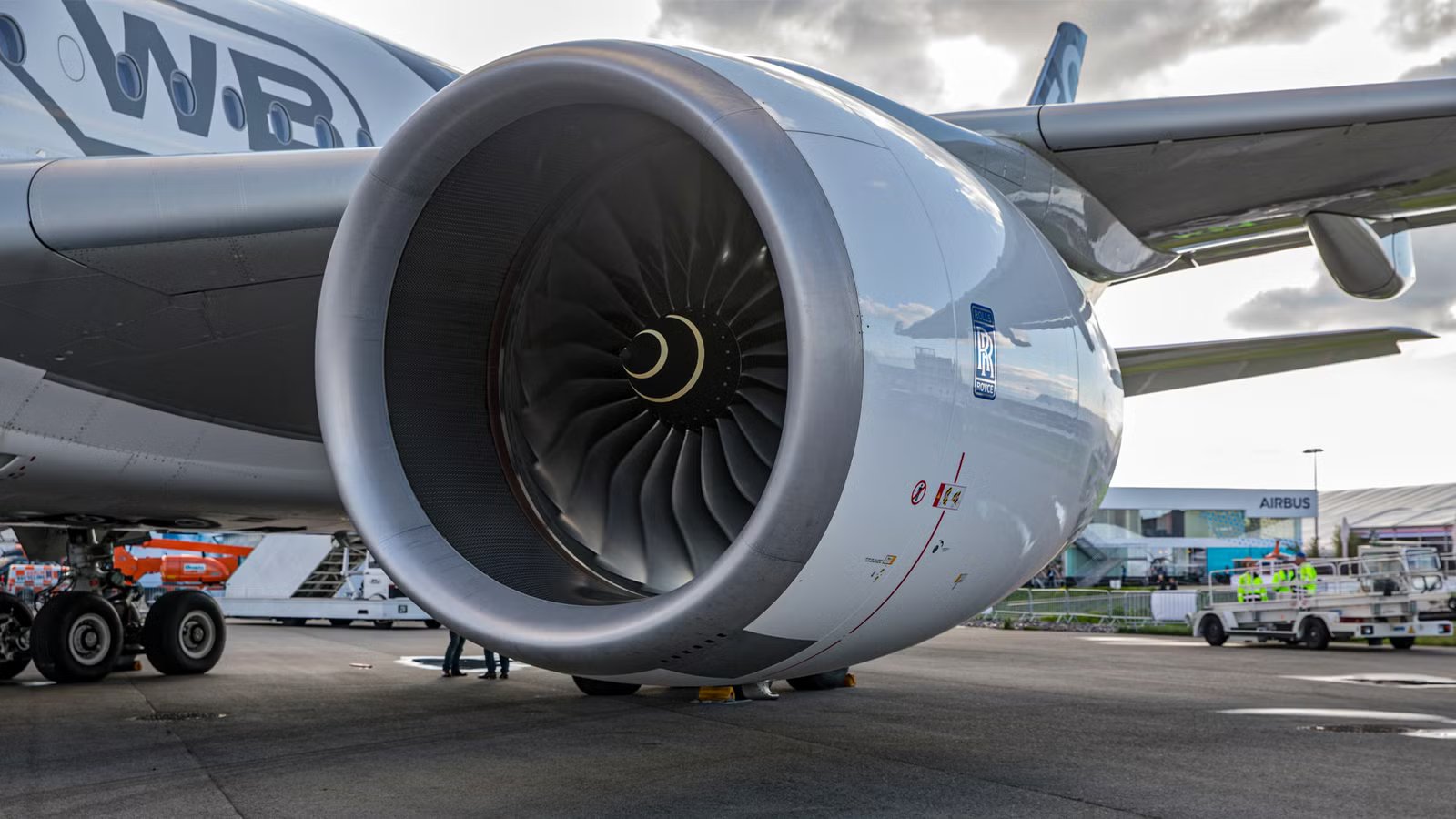
The Airbus A350 is only offered with the Rolls-Royce Trent XWB, a clean-sheet engine designed specifically for the A350. Manufacturers prefer to only offer one type of engine on their aircraft because this decreases development and production costs, as each type of engine otherwise requires dedicated pylons and software. However, this can also be risky because the performance of the aircraft is then directly tied to one engine, with Rolls-Royce specifically encountering numerous durability challenges with its Trent 1000 engine on the Boeing 787 that have hampered sales of its engine.
For Airbus, however, relying on the Trent XWB has paid dividends. Not only has the engine proven to be exceptionally fuel efficient, but the Trent XWB has proven unusually durable and reliable for a new engine. While there have been some concerns about high pricing in the past on Rolls-Royce’s part, these have largely subsided, and the Trent XWB-84 in particular has become an industry benchmark for on-wing time, helping the A350-900 become one of the industry’s most successful aircraft. But for the Trent XWB-97 on the A350-1000, the story is slightly different.
What The Trent XWB Brings To The Table

The Airbus A350 was designed mainly to serve as a larger, more capable replacement for the Boeing 777, able to fly essentially any route in the world while sipping nearly as little fuel as the Boeing 787. For this, a bleed-air variant of the 787’s engines, as was envisioned for earlier A350 concepts, wouldn’t cut it, and so Rolls-Royce developed a brand-new engine for the final A350 XWB design, which became the aircraft that we all know and love today.
The Trent XWB features the traditional coaxial triple-spool architecture associated with the Trent family, along with a 118-inch (300 centimeter) fan, the largest of any Rolls-Royce engine. It comes with an eight-stage intermediate-pressure compressor powered by a two-stage turbine, as opposed to a single-stage turbine on prior Trent models, as well as a six-stage high-pressure turbine powered by a single-stage turbine. The engine is designed with a 9.6:1 bypass ratio, along with a 50:1 overall pressure ratio.
The Trent XWB-84 has been extraordinarily successful and dependable, designed for the A350-900 with 84,000 lbs of thrust. For the Trent XWB-97 on the A350-1000, however, the story is slightly more complicated. The engine produces 97,000 lbs of thrust, and to achieve this, the Trent XWB-97 has a 5% larger core while the fan runs 6% faster. It uses thicker titanium fan blades to better handle the added stress, while the fan casing has also been strengthened, and the Trent XWB-97 runs hotter than the Trent XWB-84.
The Challenges With The Trent XWB-97

The issue with the Trent XWB-97 isn’t necessarily that the engine is massive or has a high bypass ratio. In a sense, the issue is rather that it isn’t big enough. Rolls-Royce was able to maintain the same bypass ratio for the Trent XWB-97 as its less powerful sibling, but the engine gains its extra power in part by pushing more air through the larger engine core, which burns significantly more fuel. This is compensated for by increasing the engine’s internal temperature, but this also strains the engine more.
The reason why Rolls-Royce would push the engine to such a degree, bumping the power by over 15% with fairly minimal mechanical changes, is that aerospace engineering is all about tradeoffs. Rolls-Royce could have designed a physically larger engine with a higher bypass ratio for the A350-1000, but this would have increased development costs, added weight to the engine, and reduced commonality. Instead, the manufacturer opted to get as much thrust as they could out of the Trent XWB and make minimal adjustments to accommodate the power.
It’s a valid strategy, and airlines have generally not experienced significant issues with the Trent XWB-97, but this design still comes with its own drawbacks. The engine has been extremely reliable, but durability has been mixed, as the engine generally performs well in standard conditions but has faced accelerated wear and tear in hot and dusty climates. The engine also burns slightly more fuel than the Trent XWB-84, but this is largely not a concern as the A350-1000 itself is a larger, heavier plane that’s more capable than the A350-900.
The Real Reason Why Rolls-Royce Owns The Airbus A350 Engine Slot
A closer look at the host of advancements offered by the Trent XWB, and how it continues to develop.
Where This Causes Issues For The A350

 Emirates had originally ordered 50 A350-900s and 20 A350-1000s in 2007, back when the A350-1000 was a simple stretch of the A350-900 akin to the Boeing 787-10. But in 2011, Airbus redesigned the A350-1000 to add range and boost its gross weights, while Rolls-Royce uprated the Trent XWB to 97,000 lbs of thrust. This was meant to boost the A350-1000’s market appeal, but Emirates later canceled all of its A350 orders. President Sir Tim Clark has repeatedly criticized the XWB-97 as being unsuited for the climate in the Middle East, going so far as to call it ‘defective’.
Sir Tim Clark, of course, is an outspoken person, and his comments were initially viewed largely as a public negotiating tactic, especially as the A350-1000 is already flown by  Etihad Airways and
  Qatar Airways. However, the carrier has still shied away from the A350-1000, even while placing new orders for A350-900s. With Qatar Airways, meanwhile, the carrier has not ordered new A350s in years, while both airlines have collectively ordered hundreds of Boeing 777Xs, business that could have gone to Airbus.
Airline | Airbus A350 Orders | Boeing 777X Orders |
|---|---|---|
Emirates | 73 (A350-900) | 270 (777-8, 777-9) |
Qatar Airways | 76 (A350-900, A350-1000) | 124 (777-9 with another 50 options, 777-8F with another 16 options) |
Etihad Airways | 37 (A350-1000, A350F | 15 (777-9) |
While Etihad and Qatar have not publicly voiced concerns over the Trent XWB-97’s durability, this doesn’t mean that the engine is trouble-free. It’s been increasingly reported that the Trent XWB-97 is indeed experiencing accelerated wear and tear in harsh conditions. While Emirates and Qatar Airways are only two customers, they have collectively ordered hundreds of widebodies, which makes them some of Airbus and Boeing’s most important customers. But until the durability issue is resolved, it appears that the A350-1000 is no longer a compelling option for them.
The Presence Of The General Electric GE9X

Emirates and Qatar Airways have collectively ordered up to 460 Boeing 777Xs powered by the General Electric GE9X, including options. Unlike the Trent XWB-97, which is highly strained and has durability issues in the Middle East, the GE9X is designed to be flown in harsh environments. It’s been tested to produce up to 134,000 lbs of thrust during testing, but will only be rated for 110,000 lbs of thrust in commercial service, meaning that the engine will never be operating at close to its true capabilities.
The GE9X is one of the most innovative engines ever built in terms of thermal efficiency, as the extensive use of ceramic matrix composites (CMC) allows the GE9X to run hotter with higher pressure ratios than any engine before it. It also has a 10:1 bypass ratio, and it’s been designed with 3D printed components, a third-generation twin-annular pre-swirl combustor, and just 16 fan blades made out of fourth-generation carbon fiber reinforced polymer (CFRP). All of this should give the GE9X up to 10% lower fuel burn compared to the GE90.
Emirates and Qatar Airways were always going to order the 777X, given their large 777 fleets and their need for large widebodies, but they’ve continued to favor the aircraft in recent years. Of course, the GE9X’s durability is far from assured, given that the plane has not entered service and the engine has experienced numerous challenges during the 777X’s development, including recent durability-related cracking in its mid-seal. However, Boeing and General Electric have collected years of data that they’re sharing with their customers, and the feedback appears to be positive.

Comparing The 2 Boeing 787 Dreamliner Engines
The Boeing 787 comes with both GE and Rolls-Royce engine options, although GE’s engines have become more popular in recent times.
What Rolls-Royce Is Doing About The Trent XWB

The General Electric GE9X represents a major threat to the A350-1000 and, in turn, the Trent XWB. In 2024, Rolls-Royce unveiled projects to upgrade its entire line-up of engines, which includes boosting the Trent XWB-97’s on-wing time in standard conditions by 50% and doubling the engine’s on-wing time in harsh climates. This is accomplished by developing advanced coatings to be applied to the engine’s seal segments and turbine blades, while also improving the Trent XWB-97’s temperature margins and improving the turbine case cooling.
The improvements were rigorously tested, with the new coating tested on hot materials that were heated up to 1,400 degrees Celsius (2,552 degrees Farenheight), while large amounts of dense sand were blasted at an active engine at Rolls-Royce’s testing facilities. These upgrades, named ‘Phase 3’, will be ready in 2028 and should deliver meaningful reductions in maintenance costs. Given Rolls-Royce’s track record with the Trent XWB, there’s reason to be optimistic, and the Phase 3 upgrades will make the A350-1000 far more compelling for Middle Eastern carriers.
Rolls-Royce Engines | Applications |
|---|---|
Trent 1000 | Boeing 787-8/9/10 |
Trent 7000 | Airbus A330-800/900 |
Trent XWB-84 | Airbus A350-900 |
Trent XWB-97 | Airbus A350-1000/A350F |
In addition to the Trent XWB-97, Rolls-Royce has already delivered a 1% fuel burn improvement for the Trent XWB-84 while boosting on-wing time. The Trent 7000 on the Airbus A330neo has also seen its on-wing time improved by 30%, while the manufacturer is also delivering a new variant of the 787’s Trent 1000, the Trent 1000 XE, which aims to boost on-wing time by 30% compared to the prior Trent 1000.
Catch what other trackers miss
Emergency squawks, holds, NOTAMs — live signals, no signup.
Open tracker
Catch what other trackers miss
Emergency squawks, holds, NOTAMs — live signals, no signup.
Open tracker