dailynewsnblog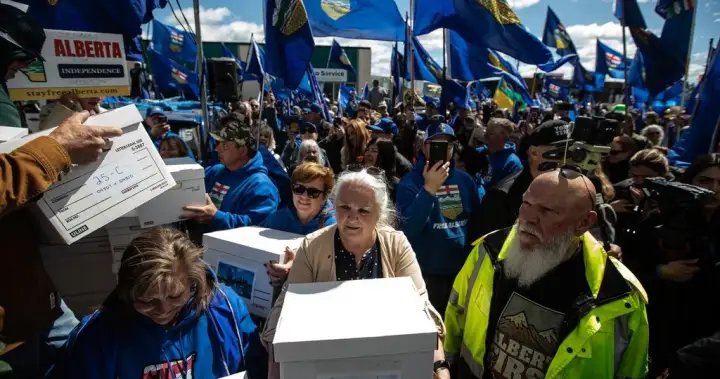
Support for Alberta separatism has declined since the beginning of 2026, according to a new Ipsos poll conducted for Global News.

The survey conducted between May 28 to June 1 found 19 per cent of Albertans said they would vote this fall to hold a separate binding separation referendum, while 72 per cent would check off the box to remain in Canada, and the remainder are undecided, would not vote or did not answer.
While the new polling data suggests the separatist momentum isn’t powerful enough to move past the initial referendum in October, Ispos asked Albertans what their intentions would be if that binding referendum were to somehow still happen.
If a binding referendum is held, the Ipsos poll suggests 18 per cent of Albertans would vote to leave Canada, compared with 72 per cent who would vote to stay. Nine per cent were undecided or did not respond.
That 18 per cent support marks a 10-point drop from January, when 28 per cent of Albertans said they backed separation.

At that time, the Stay Free Alberta separatist group was still gathering signatures but in the months since then, Alberta Premier Danielle Smith has opted to add a question about separatism to the referendum she announced in February, with the questions at the time focusing on immigration and the Constitution.
The additional question will be: “Should Alberta remain a province of Canada — or — should the government of Alberta commence the legal process required under the Canadian constitution to hold a binding provincial referendum on whether or not Alberta should separate from Canada?”
Darrell Bricker, chairman of Ipsos Canada and global CEO for Ipsos Public Affairs, said the new data from the past week suggests support for Alberta separation is weakening as the idea becomes more tangible.
“It seems like the more that people contemplate this being real — the act of voting — we see the support for separatism softening,” he said in an interview with Global News about the findings.
Stay voters more firmly committed than those favouring separation
The data also suggests those opposed to separation are more firmly committed to their position.
Among respondents who would vote to stay in Canada, 90 per cent described their choice as “definite” compared with 70 per cent of those who would vote to separate.
“What it shows is that people who really want Alberta to stay in Canada are really strongly motivated to vote for that,” Bricker said.
“There’s a certain level of strength we see for the separatist vote but it’s so much smaller that they’re going to have to turn out every one of the people who say they’re certain to vote — and probably times three more — in order to actually be competitive in this race.”
Stay Free Alberta separatism supporters in Edmonton, Alta. on Monday, May 4, 2026.
Global News
Stay Free Alberta, the separatist group driving the push to leave Canada, says it gathered just over 300,000 signatures on its petition calling for an independence referendum, which if verified represents around six per cent of Alberta’s population of five million people.
The process to verify the signatures is currently on hold due to the petition being quashed by a judge last month — something the Alberta government says it intends to appeal but also, the catalyst for Smith adding the 10th question.

Support for both holding a referendum and for separation itself is lowest in Calgary, where 14 per cent of respondents support moving ahead with a referendum — compared with 18 per cent in Edmonton and 27 per cent in the rest of Alberta.

Get daily National news
Get daily Canada news delivered to your inbox so you’ll never miss the day’s top stories.
Similarly, 12 per cent of Calgary respondents say they would vote to separate, compared with 16 per cent in Edmonton and 27 per cent in the rest of the province.
Support varies by political affiliation.
Among right-leaning United Conservative Party supporters, 50 per cent favour remaining in Canada compared with 40 per cent who support holding a referendum and 41 per cent who would vote to separate.
Bricker said that split is also reflected in Danielle Smith’s own political circle.
“While there’s a significant level of support for separatism, there’s also a significant amount of support for staying in Canada.
“So even (in) the UCP caucus, there’s certain amount of division.”
Among NDP supporters, 92 per cent favour staying in Canada compared with five per cent who support holding a referendum, while 93 per cent would vote to stay versus four per cent who would vote to separate.
Voters undecided on which party to support also lean strongly toward remaining in Canada, with 74 per cent supporting the stay option compared with nine per cent backing a referendum, and 76 per cent saying they would vote to stay versus four per cent to separate.

By age, support for holding a referendum is higher among those under 55 years old (22 per cent) compared with 14 per cent among those 55+.
Support for separation itself is highest among those under 35, at 22 per cent, followed by 19 per cent among those aged 35 to 54, and 13 per cent among those 55 and older.
The poll suggests motivations among those supporting separation have shifted: 61 per cent say their position is driven mainly by a belief Alberta’s future would be better outside Canada, while 39 per cent cite historical mistreatment within Canada.
This marks a reversal from January, when 55 per cent pointed to historical grievances and 39 per cent to future prospects.
Ipsos said the 10-point drop in support for separation since January may be, at least partly, due to those concerned about historic mistreatment rethinking whether this is adequate cause to separate.
Most Canadians want Alberta to remain, with weaker support in Quebec
Outside Alberta, support for provincial separation remains low overall but varies by region: 11 per cent of Canadians outside Alberta say they would support their own province separating if a referendum were held today, including 30 per cent in Quebec and 11 per cent in Saskatchewan and Manitoba. Support is minimal in British Columbia at two per cent, Ontario at three per cent and Atlantic Canada at three per cent.
Most Canadians also want Alberta to remain in the country: 80 per cent say Alberta should stay in Canada, including 63 per cent in Quebec.
“The numbers are pretty consistent — what we saw in the last referendum in 1995 for Quebec staying in Canada,” Bricker said.
“Canadians definitely feel Canada is better with Alberta in.”
Bricker noted support for Alberta remaining in Canada is notably lower in Quebec than the national average, suggesting Quebecers may be viewing developments in Alberta through the lens of their own provincial situation and could be more cautious about actions that might have implications for Quebec, such as federal intervention.
“(Quebecers) don’t want anybody to be doing anything in Alberta that they feel that they will have to deal with in the province of Quebec.”
A majority of Canadians outside Alberta — 58 per cent — believe the entire country should have a say in whether Alberta separates, while 28 per cent say it should be up to Albertans alone.
In Quebec, 51 per cent say the decision should rest with Albertans and 34 per cent support a national say.
“Again, that’s a reflection of what’s going on in the province of Quebec as much as it is a reflection of what is going on in the province of Alberta.”

On the role of the federal government, 53 per cent of Canadians outside Alberta believe Ottawa should play a role in a referendum campaign, compared with 29 per cent who say it should stay out.
“Half of Canadians say that the federal (government) needs to be involved, but where the number really drops off the cliff is in the province of Quebec,” Bricker added.
“They really don’t feel the federal governments should be involved.”
Opinions are split in Alberta, with 45 per cent supporting a federal role and 42 per cent against it.
Most Albertans already have minds made up
Multiple pollsters have asked Albertans and Canadians a range of similar questions to do with separatism and the data shows the needle has not budged much poll to poll, from month to month.
An Angus Reid Institute survey, conducted from May 22–24 after the province announced it was adding the 10th question to the referendum, found 60 per cent of respondents would vote to stay in Confederation, while 35 per cent said they would support beginning the process of separation.

A different poll in February by the Angus Reid Institute also found support for independence amongst the general public was at three in 10.
In January, an Ipsos poll found about three in 10 residents supported independence, but a deeper dive revealed that when faced with the costs and consequences of doing so, only half of those interested in separatism are truly committed to following through.
Albertans will go to the polls to vote in the 10-question referendum on Monday, Oct. 19.
The Ipsos poll conducted exclusively for Global News was done online between May 28 and June 1, 2026, with a sample of 1,500 Canadians aged 18 and older, including 600 Alberta residents and 900 from the rest of Canada. The results have a credibility interval of plus or minus 3.1 percentage points, 19 times out of 20, for the full sample.