dailynewsnblog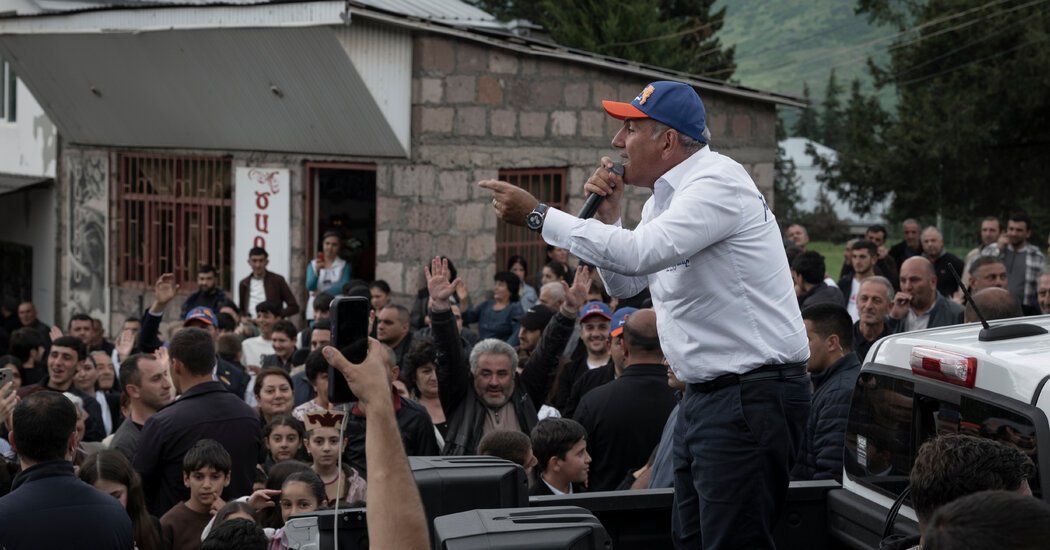
President Trump is backing him. President Vladimir V. Putin is trying to sabotage him. He and his domestic opponents are exchanging accusations of foul play and sordid transgressions. And his small nation, scarred by the trauma of war and defeat, is at a crossroads ahead of an election on Sunday.
Prime Minister Nikol Pashinyan of Armenia, who came to power in 2018 in an anti-corruption uprising, is now fighting for his political survival. His faction is facing off in the parliamentary election this weekend primarily against three leading pro-Russia parties.
Angry about Mr. Pashinyan’s overtures toward the West, Russia has given his opponents an assist, piling restrictions on Armenian imports, threatening to cut off cheap gas supplies and undertaking what experts call an aggressive disinformation campaign.
But all of that seemed a world away as Mr. Pashinyan bounded last week onto the back of a pickup truck in a quiet mountain village to address voters close to where he grew up.
He touted the state health insurance his government had recently rolled out. He spoke of new schools, day care centers and housing. And he argued that Armenians must re-elect him to see through a preliminary peace deal with neighboring Azerbaijan that Mr. Trump helped broker last year, describing the pact as a 9-month-old baby that must be nurtured to survive.
“Do we stand for our independence?” he asked.
“Yes!” the crowd chanted.
“Do we stand for our future?”
“Yes!”
“Do we stand for peace?”
“Yes!”
The election on Sunday is the first time that Armenians will head to the polls since the country lost the disputed region of Nagorno-Karabakh to Azerbaijan in 2023, a stinging defeat that the opposition has blamed on Mr. Pashinyan. The conflict between the two nations, both once part of the Soviet Union, began during the final years of the U.S.S.R. and led to decades of on-and-off war.
On the campaign trail, Mr. Pashinyan has sold a vision of an Armenia at peace for the first time since the Soviet collapse, and the economic and security dividends that would bring. The peace would include normalized relations with Azerbaijan and Turkey, which have closed their borders to Armenia for decades, potentially opening up avenues beyond Moscow in foreign affairs.
From atop the truck, Mr. Pashinyan promoted the Trump Route for International Peace and Prosperity, or TRIPP, a part of the peace talks that envisions an American-operated road and rail route running through Armenia to connect two parts of Azerbaijan.
Mr. Pashinyan has increased engagement with Washington, including by welcoming both Vice President JD Vance and Secretary of State Marco Rubio for visits, and has floated the idea of one day joining the European Union. Last month, he hosted European leaders for the first ever E.U.-Armenia summit, as well as President Volodymyr Zelensky of Ukraine.
Armenians largely soured on Russia after Moscow failed to come to their aid when Azerbaijan attacked positions inside Armenia in 2022 and took Nagorno-Karabakh the following year. The percentage of Armenians calling Russia the nation’s “main friend” dropped to 14 percent in 2024 from 57 percent in 2019, according to Caucasus Barometer, a survey of the region.
But even as Mr. Pashinyan has publicly clashed with Mr. Putin, he has not backed a full break with Russia, a treaty ally that retains a military base in Armenia and remains an indispensable economic and energy partner.
“We have stated numerous times that we are not going to argue with Russia,” said Ruben Rubinyan, a top member of Mr. Pashinyan’s party who serves as vice president of Armenia’s Parliament. “It’s not our intention to enter a standoff with Russia. Russia has been a close partner for us. We want that to continue.”
Still, Mr. Rubinyan said his party would not compromise on Armenia’s core interests and wanted to strengthen the nation’s sovereignty by pursuing new directions in foreign policy, instead of being only “with one geopolitical center as it has been before.”
On the ballot, analysts say, are hugely consequential choices.
“It’s a question of independence,” said Gerard Libaridian, an Armenian-American historian and former diplomat. “It’s nothing less, because Russian control does not just mean foreign policy and security policy. Russian control means what kind of government you have.”
The election campaign has been bitter. The Armenian authorities have arrested opposition members, accusing them of vote bribery, financial crimes and calls to overthrow the government. Mr. Pashinyan’s opponents, in turn, have accused him of using the power of the state to repress his political rivals ahead of the vote.
The leading opponent is Samvel Karapetyan, an Armenian billionaire businessman who made much of his fortune in Russia. He cannot become prime minister or enter Parliament under the current law, because he has Russian and Cypriot citizenship. His Strong Armenia party has vowed to change the rules to allow him to lead.
A triumph for Mr. Karapetyan’s faction could put Armenia on a path similar to that of neighboring Georgia, where a billionaire who also made his fortune in Russia upended years of pro-Western policies to move the nation firmly back into Moscow’s orbit.
Mr. Karapetyan has been campaigning from his mansion, where he has been under house arrest since last year, accused of calling for the overthrow of the government. His party has denounced his detention as political persecution.
Polling shows that Mr. Pashinyan is by far the most popular candidate in the race. But he is still vulnerable, because many voters remain undecided, and he lacks potential coalition partners with enough support in polling to enter Parliament.
If his Civil Contract party falls short of securing a majority of seats on its own, he could lose power and face prosecution or exile.
Mr. Trump, looking to keep alive the unfinished peace deal he helped broker, endorsed the Armenian leader on Truth Social on May 28, calling Mr. Pashinyan “a great friend and leader” who is making Armenia “strong, wealthy and very secure.”
A populist firebrand, Mr. Pashinyan has cut an idiosyncratic figure on the campaign trail, often wearing fedoras, filming viral TikTok videos with eyes locked on the camera and making his two hands into a heart, a gesture that is now the symbol of his campaign.
But the lead-up to the election has been a far cry from kumbaya.
Raw emotions from Armenia’s loss of Nagorno-Karabakh have spilled into the race, with Mr. Pashinyan more than once erupting at refugees from the region who have confronted him on the campaign trail. The Armenian authorities detained one activist refugee who aggressively confronted the leader, in what even some Armenians who plan to vote for Mr. Pashinyan called a step too far.
The opposition has tried to tarnish Mr. Pashinyan as a traitorous agent of Azerbaijan and Turkey for pushing the peace pact. And last year Mr. Pashinyan clashed with the leadership of the Armenian Apostolic Church, a cornerstone of Armenian identity and a major recipient of money from Mr. Karapetyan, his billionaire opponent.
After church leaders led antigovernment protests against Mr. Pashinyan’s peace negotiations with Azerbaijan and publicly called for his resignation, the Armenian leader accused them of breaking their vows of celibacy and engaging in a “criminal-oligarchic” plot to overthrow his government. A number of church officials have been arrested.
The face-off devolved into lurid exchanges. In one, Mr. Pashinyan accused a bishop of “banging” his uncle’s wife, with a supposed sex tape later circulating suspiciously online that the bishop denounced as slander. In another, a church spokesman accused Mr. Pashinyan of being a traitor and being secretly circumcised, implying that he was aligned with Azerbaijan, which is predominantly Muslim. In response, Mr. Pashinyan offered to show the church leadership his genitals.
As the tension mounted, Mr. Karapetyan said last June that “if the politicians fail” to defend the Armenian church and people, “then we will also have participation in this in our own way.” The Armenian authorities charged him with calling to overthrow the government and later expanded the allegations to include money laundering.
Aram Vardevanyan, a lawyer running as the No. 2 candidate on the Strong Armenia list, called the case political persecution and said the phrase “in our own way” wasn’t sedition.
“This is ‘our way’: participating in the political actions in Armenia, having a political party, starting a political campaign, participating in elections, everything which is in accordance with law,” Mr. Vardevanyan said.
Mr. Pashinyan, as he seeks to hold on to power, has been besieged not just by his domestic opponents but also by figures in Russia, including its state media commentators.
In 2024, Mr. Pashinyan froze Armenia’s participation in the six-nation Russia-led military alliance that obliges Moscow to defend the nation from attacks.
This April, the tensions exploded into the open during a testy meeting at the Kremlin between Mr. Putin and Mr. Pashinyan.
The Russian leader suggested “drawing a line under” the issues related to Nagorno-Karabakh and warned that Armenia could not stay in a trade union with Russia and at the same time pursue membership in the European Union. Mr. Putin also criticized the prosecution of Mr. Karapetyan, without mentioning the billionaire by name, urging Mr. Pashinyan to let “pro-Russia political forces” participate in the election.
Mr. Pashinyan shot back that Armenia is a democracy and implicitly criticized Mr. Putin’s growing censorship and political repression at home. He said Armenia would continue to consider E.U. membership while remaining in a customs union with Russia until “the point where a decision must be made.”
The following month, Mr. Putin warned that Armenia, which has not formally applied for European Union membership, was going down the same path as Ukraine.
“And where did it start?” Mr. Putin asked. “With Ukraine seeking to join the European Union.”
Armenia’s pro-Russian opposition parties have seized on the recent Russian restrictions on imports of Armenian flowers, produce, alcohol and mineral water.
At a recent opposition rally in Yerevan, one of the parties, the Armenia Alliance, aired video interviews from the stage with a flower grower and a tomato seller, who spoke of the pain that the restrictions had caused and blamed Mr. Pashinyan.
“Becoming an enemy to Russia — it’s insane,” Anna Grigoryan, a lawmaker from the Armenia Alliance, said in an interview ahead of the rally. “Nobody wants to gain an enemy like Russia.”
She said Mr. Pashinyan was using crass rhetoric, making unacceptable compromises in peace talks and antagonizing Russia unnecessarily, given that E.U. membership is unrealistic for Armenia short-term. Those voicing a reasonable position on Russia, she said, were being smeared as agents of Moscow and repressed.
Mr. Pashinyan’s party has warned that a victory for the opposition would risk a return to war and bring back the corrupt and autocratic forces promoting Moscow’s interests that ruled Armenia for years before the 2018 uprising.
“These elections are very important, because those who want to come back, they are not the most democratic forces in Armenia,” said Sona Ghazaryan, a member of Parliament from Mr. Pashinyan’s party. “They are not democratic at all.”
Oleg Matsnev contributed reporting.