dailynewsnblog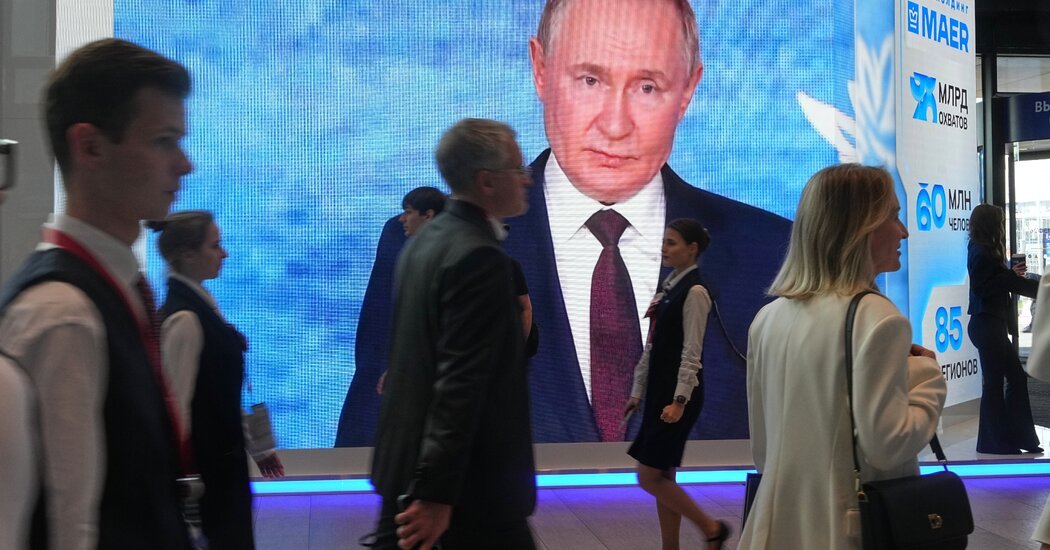
In the early days of President Trump’s second term, members of the Russian elite were full of hope that the new administration would fundamentally reset relations with Russia, pushing Ukraine out of mind and engaging in lucrative business deals.
More than 16 months later, the only thing the two sides seem to have agreed on is a hockey match between unspecified Russian and American players in Moscow, scheduled for July 1. It was announced on Thursday at President Vladimir V. Putin’s flagship annual economic conference in St. Petersburg.
Since the 2022 invasion of Ukraine, Russia has used the economic forum to show how it can withstand the pressure of Western sanctions by relying more on internal resources and by pivoting toward countries in the Middle East and Asia.
And yet Russia is still going out of its way to welcome some Americans, although U.S. sanctions remain in place and Moscow has yet to persuade the Trump administration to get back to business.
The contrast shows how Russia remains divided between hawkish security forces hostile to the West and more technocratic elites who would welcome a thaw in relations between Washington and Moscow.
During this year’s economic forum, a session on Russian-American cultural ties was headlined by the first U.S. official to attend the event since 2018. The official, Rodney Mims Cook Jr., holds a relatively little known role, as chairman of the Commission of Fine Arts. He is advising the White House on projects that include the ballroom expansion and the proposed triumphal arch in Washington.
The conference was also attended by Candace Owens, an American right-wing podcaster and commentator.
Both Mr. Cook and Ms. Owens were met with great fanfare in St. Petersburg. The room at Mr. Cook’s session was packed with journalists for Russian state media. He was ushered out by security guards as he declined to take questions.
Ms. Owens was more approachable. State media carried her every comment about how she had found Moscow, where she arrived at the end of May, to be an exemplary, clean and orderly city that defied her expectations. She also claimed that Americans were growing tired of supporting Ukraine.
She spoke on a panel dedicated to “balancing parenthood in a large family with a successful career.” The moderator, the Russian television anchor Maria Sittel, introduced her by asking: “Where do you get so much Russianness from, Candace? You are just so, so one of us!”
In her comments, Ms. Owens said her trip had revealed “how similar we are.”
“My main conclusion would be that we are grappling with the same issues, West and East,” she said. The problem, she added, was “the media messaging and constantly trying to make that division between what is going on in Russia, what is going on in America.”
Mr. Cook’s panel focused on how Russia and the United States might engage in joint cultural projects despite political gridlock. He described his extensive connections to Russia, saying they stretched from his home in Atlanta, which he designed in what he called a “Russian wooden vernacular,” to riding horses with Leo Tolstoy’s great-grandson.
His presence in St. Petersburg was apparently news to Secretary of State Marco Rubio, who said in Washington that he was familiar with the event but was not aware of any American delegation there. “I don’t think it would be a high-level official,” he said.
Mr. Rubio said that the United States had been working on new sanctions against Russia.
Mr. Cook’s session was attended by leading Russian cultural figures, including Valery Gergiev, the general director of the Bolshoi and Mariinsky theater companies, and Mikhail Piotrovsky, the director of the State Hermitage Museum.
Attendees concluded that it was time to restore cultural ties between Moscow and Washington. Panelists suggested that a renewal could be inaugurated with a performance by Mr. Gergiev in Mr. Trump’s new White House ballroom or under the proposed triumphal arch, depending on which project was completed first.
Robert Agee, the president of the American Chamber of Commerce in Russia, said that “right now between Russia and the U.S. there is a massive block of ice.” But because the two countries share deep connections in culture and sports, he added, those areas offer a logical starting point for diplomacy.
“Let’s play hockey together, and let’s have a ballet in New York,” Mr. Agee said.
Beyond the economic conference, Russia has rolled out the red carpet for other controversial American figures this week.
On Tuesday, in Moscow, a choir of Russian folk singers and dancers greeted Andrew Tate, a British American social media personality. Mr. Tate, a notorious figure in the toxic online space known as the “manosphere,” is facing multiple criminal and legal proceedings, including charges of human trafficking. He traveled to Russia with his brother, Tristan.
Speaking about Mr. Tate’s arrival, Roman Antonovsky, a Russian right-wing blogger, wrote on his Telegram channel, “We are supposedly ridding ourselves of worshiping the West, yet we continue to grovel before some Western clowns.”