dailynewsnblog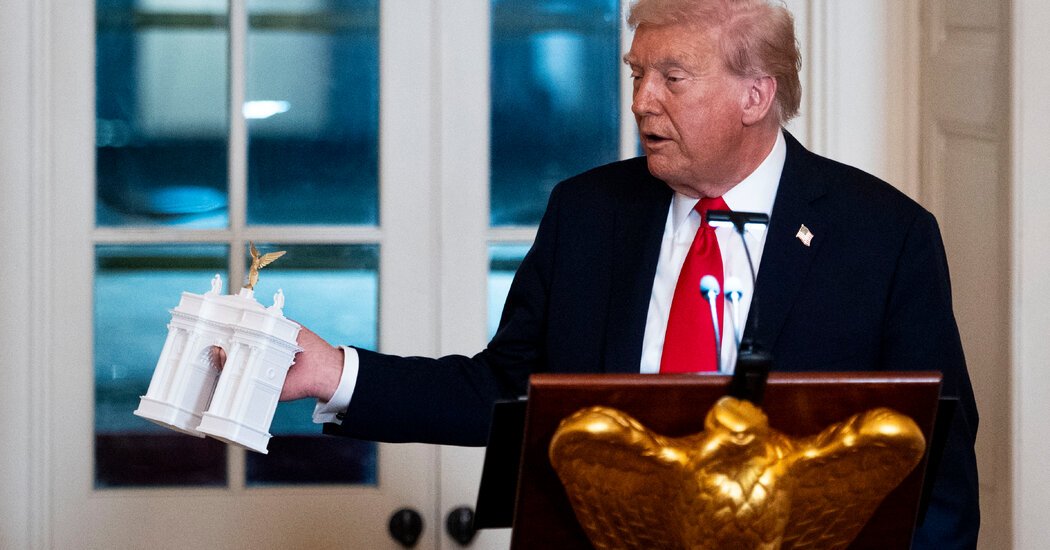
A federal planning commission on Thursday advanced President Trump’s plan to build a 250-foot arch in Washington, even after receiving overwhelming public opposition to the project.
The National Capital Planning Commission, which is led by allies of Mr. Trump, received nearly 1,700 public comments about the proposed triumphal arch, almost all of which opposed it. Staff at the commission also raised several issues about the plan, including whether the structure could disrupt flight patterns or violate laws restricting the height of buildings in the nation’s capital.
“The project team has some homework to do,” said the commission’s chairman, Will Scharf, who also serves as Mr. Trump’s White House staff secretary. He added, “I think that it is fitting and proper that we commemorate the 250th anniversary of our great republic with a suitable piece of monumental architecture.”
The panel voted 9 to 1 to advance the project to the next step in its review process, while incorporating the staff’s comments about the need for additional information and compliance with the existing laws. The project must return to the panel for a final approval.
Mr. Trump later posted on social media that he was grateful, extending a “very big THANK YOU” to the commission, though he mischaracterized the vote as an approval to actually build the arch.
One potential hurdle to the project is the federal Height of Buildings Act, which generally does not allow buildings that are more than 160 feet tall in Washington.
But Mr. Scharf said he believed that a strong legal argument could be made that the plans for the arch do not need to follow legal restrictions for height limits in Washington.
“I believe, speaking personally, that the best reading of the law is that the Height of Buildings Act is not applicable to federal construction,” he said.
Staff for the panel also said the president’s proposal lacked adequate information about building materials, proposed lighting and storm water management compliance, according to a document prepared by the group before the meeting on Thursday. The panel instructed the Trump administration to come back to present a more detailed plan.
The commission is the federal government’s planning agency for the Washington, D.C., region and could vote to block construction of the arch. But because Republicans and employees of Mr. Trump control a majority of the votes on the panel, it is not expected to do so.
One federal advisory panel, the Commission of Fine Arts, has already granted approval for the project after the president made some modest changes to its design, including removing plans for statues of gold lions perched along the arch.
The future of the project is still uncertain, however.
The Federal Aviation Administration is reviewing whether it could pose an aerial hazard, an evaluation that it requires for all structures more than 200 feet tall. The arch would sit about a mile from a Pentagon heliport and about two miles from Ronald Reagan National Airport, one of the country’s busiest flight hubs.
A group of Vietnam War veterans has sued to stop construction, citing the lack of congressional approval for the project and arguing that the arch would obstruct the view between the Lincoln Memorial and Arlington National Cemetery. The Trump administration has argued that congressional actions in the 1920s connected to the design of the Arlington Memorial Bridge already give it the legal right to build the arch.
Many critics of the plan have contended that the grandeur of the structure would detract from the solemnity that should be observed at the cemetery nearby.
In comments to the National Capital Planning Commission, which the commission posted online, many said that the arch would be a monument more to Mr. Trump than to the country. (Mr. Trump underscored that belief when he was asked by a reporter whom the arch was for and he replied, “Me.”)
“Please don’t build this monstrous vanity project to please Trump,” said one letter, signed by Jane Allison.
Another, signed by Ann Trowbridge, criticized the arch’s “ugly, garish design” and said, “It is too tall, a waste of current and future taxpayers’ money and will permanently scar the federal landscape of both Arlington and Washington.”
Some, however, supported the project. “I think the arch will look fantastic,” Will Nance wrote. “I can’t think of a better way to commemorate our 250th anniversary as a country.”
Davis Ingle, a White House spokesman, said the proposed arch would “enhance the visitor experience at Arlington National Cemetery for veterans” and serve as a “visual reminder” of the sacrifices made by Americans through the country’s history.
“The triumphal arch in Memorial Circle is going to be one of the most iconic landmarks not only in Washington, D.C., but throughout the world,” Mr. Ingle said.