dailynewsnblog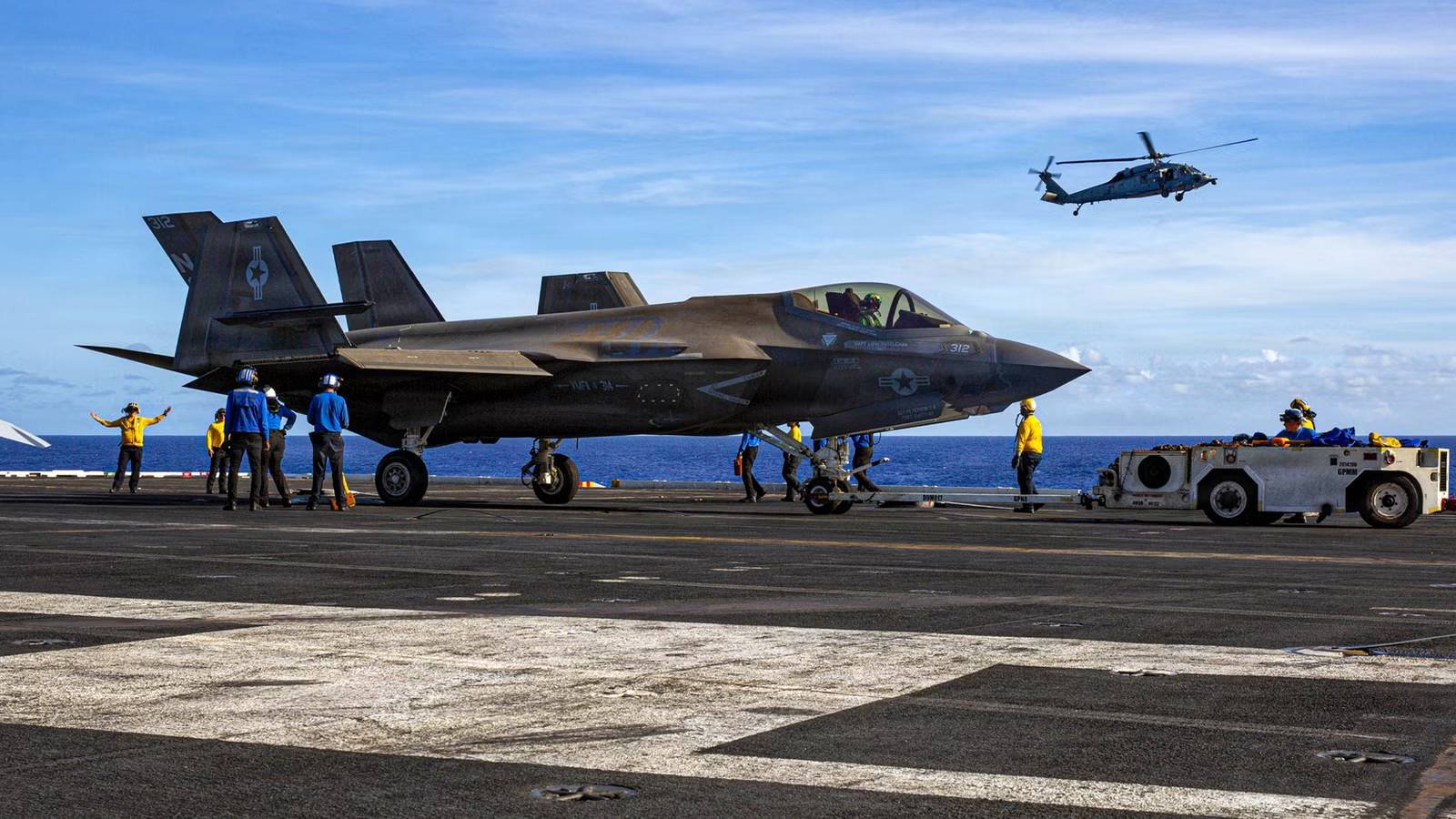
The story of the world’s largest navies by the number of carrier-based fighter jets is essentially a story of the US Navy and the rest. It is also a story of the rise of China and the fading out of Russian/Soviet fighter jets as carrier-capable aircraft. Three navies operate Russian/Soviet-derived carrier-based jets: China, Russia, and India. China and India are now looking to deploy more advanced domestic or French designs, while Russia no longer has an operational aircraft carrier.
Only three countries currently design and build carrier-capable fighter jets: the United States, China, and France, although the UK’s Rolls-Royce is the only contractor able to build critical components for STOVL aircraft. Here is what to know about the world’s carrier-based fighter jet fleets.
United States Navy/Marine Corps

The United States Navy/Marines boasts the vast majority of the world’s aircraft carrier-based fighter jets. The US Navy currently operates 11 super aircraft carriers, all of which are nuclear-powered. As of mid-2026, it is more accurate to say the Navy has ten carriers as the USS Nimitz (CVN-68) has completed her final deployment and will be decommissioned, while her replacement, John F. Kennedy (CVN-79), is undergoing sea trials and will not be operational for at least another year.
The backbone of the US fighter jet fleet is the F/A-18 Super Hornet with around 560 aircraft in service. The final order for the Super Hornet has been placed, and the final examples are expected to be delivered in 2027. It also has around 140 EA-18G Growler electronic warfare aircraft in service. These have some ability to carry munitions and carry out strikes in addition to their primary EW role. The Navy is estimated to have over 70 F-35C 5th-generation fighter jets in service out of a program of record for 273 examples.
The F-35C is intended to complement and partially replace the Super Hornet, while the 6th-generation F/A-XX in development is expected to eventually fully replace it. Between 2020 and 2026, the Navy purchased 10-19 F-35Cs a year. This is changing as the Fiscal Year 2027 budget request seeks a record 37 F-35Cs. Meanwhile, the Marines are expected to retire their legacy AV-8B Harrier IIs in 2026. The Marines currently operate a fleet of over 80 AV-8Bs, around 125 legacy F/A-18 Hornets, 183 F-35Bs, and 52 F-35C aircraft (February 2025). The Marines operate from both the US Navy’s nine amphibious assault ships and its aircraft carriers (with the F-35C).
Chinese PLANAF

The Chinese People’s Liberation Army Navy Air Force (PLANAF) is one of the most consequential stories as it is in the process of dramatic transformation. In the early 2000s, the Chinese PLAN was regarded as a littoral navy, but it is aggressively building up a blue-water navy. The first aircraft carrier, Type 001 Liaoning, was the refitted ex-Ukrainian Varyag Kuznetsov-class aircraft carrier commissioned in 2012.
Catch what other flight trackers miss
Emergency squawks, holds, NOTAMs — live signals, no signup.
Open tracker
Catch what other flight trackers miss
Emergency squawks, holds, NOTAMs — live signals, no signup.
Open tracker
She was later joined by the fully Chinese-built and improved Type 002 Shandong, based on the Kuznetsov class. That ship was followed by the Type 003 Fujian supercarrier commissioned in 2025. China is now building its fourth aircraft carrier, and that ship is expected to be nuclear-powered. The primary aircraft remains the improved Chinese J-15 derivative of the Soviet Sukhoi Su-33 Flanker.
Aircraft carrier+fighter jet navies | Approx. number of carrier-based fighter jets (per USN, RN, etc.) | Number of aircraft carriers (+ fighter jet carrying amphibious assault ships) | Fighter jet types |
|---|---|---|---|
US Navy/Marine Corps | 1,100+ | 11+9 | F/A-18 Super Hornet, F/A-18 Hornet, F-35B, F-35C, EA-18G Growler, AV-8B Harrier |
Chinese PLANAF | 100+ (numbers opaque) | 3 | J-15, J-35 |
British Royal Navy | 47 | 2 | F-35B (shared with RAF) |
French Navy | 41 | 1 | Rafale M (shared with French Air Force) |
Indian Navy | 36-40 | 2 | MiG-29K |
Italian Navy | Approx. 21 | 1+1 | F-35B, AV-8B Harrier |
Spanish Navy | 12 | 0+1 | AV-8B Harrier |
Japanese Navy | 8 | 2 | F-35B (not yet deployed) |
China is building its next-generation low-observable J-35 fighter jet, often described in the media as a 5th-generation fighter jet. The J-35 was officially unveiled in late 2024, appeared to enter serial production in 2025, and may be combat operational on the Fujian in some capacity in 2026. Due to a lack of transparency, it is unclear how many carrier-based fighter jets China has, although 80+ J-15s and 20+ J-35s, including training aircraft, is a reasonable baseline.
The World’s Most Superior Carrier-Based Aircraft
Engineering excellence and modern technology meld in the world’s best fighters found on the decks of aircraft carriers around the world.
Indian Navy

While India’s naval program is not on the scale of China’s, it is considerable. A core part of the Indian Navy’s mission is to be the dominant force in the Bay of Bengal and some other parts of the Indian Ocean and keep the Chinese PLAN at bay. The Indian Navy has two aircraft carriers in service. The INS Vikramaditya (based on the Soviet aircraft cruiser Gorshkov) and the indigenously-built INS Vikrant (entered service in 2022).
India has plans to build a second Vikrant-class carrier and is currently designing another aircraft carrier, the INS Vishal. The Indian Navy fighter jet fleet is currently based on the legacy Russian MiG-29K fighter jet with around 36–40 examples in inventory. India ordered 45 MiG-29K examples, of which some have been lost.
India is planning to purchase 26 carrier-based Rafale Ms to complement these fighters. The Rafale purchase is part of a larger package that includes more Rafales for the Indian Air Force. These aircraft are to be assembled in India, a first for France. The Rafale is considered a considerable leap in capability over the Russian MiG-29K.
European Navies With Fighter Jets

Four navies in Europe currently operate flattops with fighter jets. These are the UK’s Royal Navy, the French Navy, the Italian Navy, and the Spanish Navy. The Royal Navy operates a fleet of two large conventionally-powered Queen Elizabeth class carriers for which it has purchased and received 48 F-35B fighter jets. It now has 47 F-35Bs, as one fell off a carrier. The UK is expected to soon place another order for 27 jets to bring the total to 74 (12 F-35As and 15 F-35Bs). The F-35Bs are shared with the Royal Air Force.
France operates a single nuclear-powered aircraft carrier, the Charles de Gaulle, with plans to eventually replace it with a larger nuclear carrier in the 2040s. The French carrier-based fighter jet fleet is made up of 41 Dassault Rafale M fighter jets. Like the Royal Navy, these fighters are shared with the French Air and Space Force. France also wants a carrier-based version of the troubled FCAS 6th-generation fighter jet being developed.
The Italian Navy has the Cavour V/STOL aircraft carrier and the new Trieste amphibious assault ship, which also carries F-35B fighter jets. The Trieste is replacing the Giuseppe Garibaldi, with the latter being transferred to Indonesia. The Italian Navy’s fighter jet fleet is currently in transition, with around 10+ F-35Bs in inventory out of a program of record for 40 F-35B jets. It has around 11 AV-8B Harrier IIs remaining in service, and these are being phased out by 2028. The Spanish Navy has a single amphibious assault ship and around 12 remaining Harrier IIs with no replacement plan.

The World’s Largest Air Forces By Number Of Fighter Jets
This guide ranks the world’s largest fighter forces in 2026
Japanese Navy

Along with Russia, Japan is unusual for not officially operating aircraft carriers. The non-operational Russian Admiral Kuznetsov is officially designated a heavy aircraft cruiser to allow her to transit the Turkish-controlled Bosporus Strait to the Black Sea. Meanwhile, Japan is constitutionally forbidden to operate offensive weapons like aircraft carriers. Consequently, its Izumo-class light carriers are officially designated “Aircraft-carrying multi-role escort ships”, recently changed from “Helicopter-carrying escort ships.”
These two ships are being retrofitted to carry F-35B fighter jets. Japan also operates a pair of Hyūga-class helicopter carriers (officially a type of destroyer). There is speculation that Japan may retrofit these two ships to carry F-35Bs as well, although it remains unclear if Japan will. It’s worth noting that the Japanese Navy is designed with an emphasis on aerial denial, especially for its many southern islands.
The Japanese Navy does not yet have any fighter jets in operational service. However, it has ordered 27 F-35B fighter jets for its light carriers with a program of record to eventually purchase 42. In February 2026, Japan held a ceremony marking the deployment of F-35B fighter jets at its Nyutabaru Air Base. Japan took delivery of its first F-35B in August 2026 and by early 2026 had a fleet of eight aircraft. Training and transition take time, and the JS Izumo is expected to be operational with F-35Bs in 2028.
Former Aircraft-Carrier Navies

Perhaps the most notable navy missing from this list is the Russian Navy. While Russia’s only aircraft carrier, the seemingly cursed Admiral Kuznetsov, has not formally been scrapped, it has been in refit since 2017, and according to the Russian news outlet, Izvestia, she will not be returned to service. That said, Russia does still have a carrier-capable MiG-29K and the older Su-33 remaining in service in unclear quantities, but they exist without a carrier, making them ground aircraft.
The Thai Navy operates the HTMS Chakri Naruebet light carrier, but it also lacks fighter jets for it. The ship only carries aircraft like helicopters. As stated, the Italian Giuseppe Garibaldi is expected to be transferred to Indonesia, but it appears the Harriers will not be coming with it, and the ship will be used as a helicopter/drone carrier.
Australia and Argentina are also among the list of former aircraft carrier operators. Australia did consider retrofitting its two Canberra-class helicopter docks to operate F-35Bs, but it abandoned the idea due to costs. The Brazilian Navy has the ex-Royal Navy HMS Ocean in service as the NAM Atlântico. However, Brazil currently lacks an operational aircraft carrier.