dailynewsnblog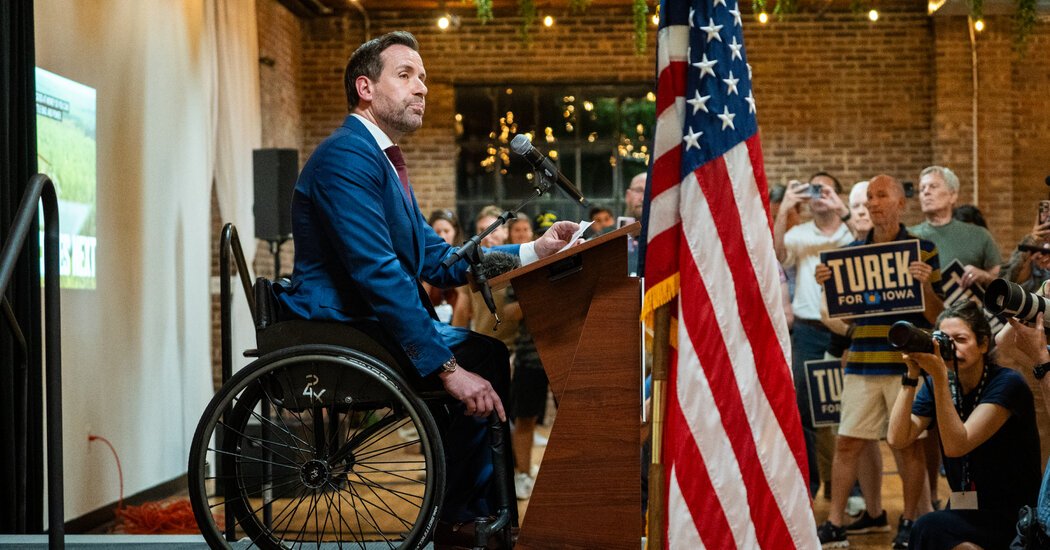
When President Trump met in the Oval Office with Ken Paxton on Tuesday, the newly minted Republican nominee for Senate in Texas, he brought handouts.
Democrats may feel bullish about their prospects in the state, but Mr. Trump has been dismissive of James Talarico, the 37-year-old Democratic nominee. Scattered across the Resolute Desk were printed photos of Mr. Talarico, along with an image of the 20th-century cartoon character that the president has compared him to: Alfred E. Neuman of Mad Magazine.
Mr. Trump had personally colored in one of Mr. Talarico’s teeth to create a similar gap-toothed smile, according to a person with knowledge of the president’s rendering who spoke anonymously to describe a private meeting.
If, in Talarico versus Paxton, the Democrats believe they’ve found a rare matchup to give the party a shot in November, Republicans believe they have an opponent they can cast as a wacky liberal from Austin.
With five months to go until Election Day, that same dynamic is playing out across the Senate landscape. Democrats are confident that they’ve recruited the right candidates and that political conditions give them a shot to flip at least four G.O.P.-held seats, which they need to take the Senate majority. Republicans are confident that Democrats will lose anyway, with plans to cast them as unelectable in red states.
Hours after Mr. Trump showed off his drawing, the contours of the Senate battleground map came into sharper focus on Tuesday night with the victory of Josh Turek, a Paralympic gold medalist, in Iowa’s Democratic Senate primary.
Mr. Turek’s ascent — with the assist of $10 million from a national Democratic veterans’ group aligned with Senator Chuck Schumer of New York, the minority leader — injected national Democrats with fresh optimism about expanding their map of potential victories in November.
At the same time, Democratic leaders were grappling with fallout from revelations of sexual text messages sent to up to six women by Graham Platner, the presumptive Senate nominee in the critical state of Maine and the only Democratic candidate in a key state who was not the choice of the party establishment. Mr. Platner is married.
The math for Democrats to win the Senate majority is both straightforward and daunting.
Republicans currently hold 53 seats, so Democrats must flip at least four Republican seats to claim a majority while also defending their own seats in the battlegrounds of Michigan, New Hampshire and Georgia.
For months, Mr. Schumer has outlined his likeliest four-state path to power through North Carolina, Alaska, Ohio and Maine. In three of those states, Mr. Schumer’s top recruit secured the Democratic nomination.
Still, the terrain is tough. Mr. Trump won both Alaska and Ohio by double digits in 2024. He won Iowa and Texas — two other states widely seen as reaches where Democrats hope to compete — by even more. One sign of the coming challenge in Iowa: About 14,000 more voters participated in Tuesday’s Republican primary than the Democratic one.
Mr. Turek will now face Representative Ashley Hinson, a three-term Republican, who began running advertisements before the Democratic primary was settled that opened with her own support of veterans, a seeming rebuttal to the millions spent on pro-Turek ads. “Our veterans deserve a hell of a lot better,” she says.
“The seriously unpopular war in Iran and ongoing price hikes from gas to groceries, health care to housing, continue to create broader opportunities for us in states I didn’t think would be in play,” said Senator Chris Coons, a Delaware Democrat.
Republicans appear acutely aware of how closely contested the fight for the Senate is. They have cried foul in recent days over the candidacy of a second Dan Sullivan in Alaska, where Senator Dan Sullivan, a Republican, is seeking re-election and facing Mary Peltola, a Democratic former congresswoman. The state’s unusual top-four primary system could allow both Mr. Sullivans to advance, likely creating confusion for voters in November. The logos of both candidates even feature similar blue color schemes and yellow stars.
One Nation, a Republican-aligned nonprofit group, announced on Wednesday a $6 million ad campaign for Senator Sullivan.
Maine, however, is the source of growing Democratic anxiety.
There, Mr. Platner, a veteran and oyster farmer running as a progressive outsider, catapulted past the party establishment’s preferred pick, Gov. Janet Mills. Ms. Mills, out of money and struggling in polls, suspended her campaign more than a month ago, though she remains on the ballot for the June 9 primary. Then, over the weekend, The New York Times and The Wall Street Journal reported that Mr. Platner’s wife had warned campaign officials that he had sent sexually explicit text messages to other women as recently as last summer.
Mr. Platner spent Tuesday in Washington, meeting with Democratic senators amid rising concern that more may come from a candidate whose postings on Reddit dismissing rape victims and demeaning women, as well as a tattoo with Nazi imagery that he has since covered up, have already caused a stir.
Mr. Platner also had a 30-minute private meeting with Mr. Schumer.
“We’re going to beat Susan Collins and take back the Senate,” Mr. Schumer said at the Capitol on Tuesday, batting away different questions with the same answer. “Any other subject you got? Any other subject?”
Democrats have long seen defeating Senator Susan Collins of Maine, the five-term Republican, as essential to taking control of the chamber. Even Mr. Platner’s team, in its invitation to Democratic senators to meet on Tuesday, wrote: “As you know, the path to a Democratic Senate majority runs through Maine.”
Caitlin Legacki, a Democratic strategist who has worked on past Senate campaigns, said the Platner situation was an unfortunate development at a moment when the party is in “a much better position than many of us expected to be.”
“What’s so frustrating about this is the degree of difficulty for Democrats to win the Senate this year is very high,” said Ms. Legacki, who is advising Representative Haley Stevens of Michigan, a moderate Democrat running for Senate. “And in just about every other state — whether it’s North Carolina or Texas or Alaska or Iowa — things are moving in the right direction. While it is possible to regain the majority without Maine, it seems needlessly difficult to do it this way.”
After Iowa’s primary on Tuesday, the fields remain unsettled in only two Senate battlegrounds.
In Michigan, Democrats are facing a three-way brawl between Abdul El-Sayed, a progressive endorsed by Senator Bernie Sanders, Mallory McMorrow, a state senator and regular contributor to cable news, and Ms. Stevens, whose support from the pro-Israel lobby has become an issue. The winner will face former Representative Mike Rogers, a Republican who narrowly lost a Senate race in 2024.
Georgia’s Republican Senate primary is headed to a runoff in two weeks between Derek Dooley, a former college football coach, and Representative Mike Collins, who finished first in the May primary. Senator Jon Ossoff, the Democratic incumbent, has banked more than $32 million for the general election.
In Texas, where Democratic hopes have been repeatedly dashed over the last 30 years, Mr. Talarico has once again brought a promise that this year will be different. The campaign said it is not sweating the Neuman caricatures coming from Mr. Trump and Mr. Paxton.
“What, us worry?” said JT Ennis, a spokesman for Mr. Talarico.