dailynewsnblog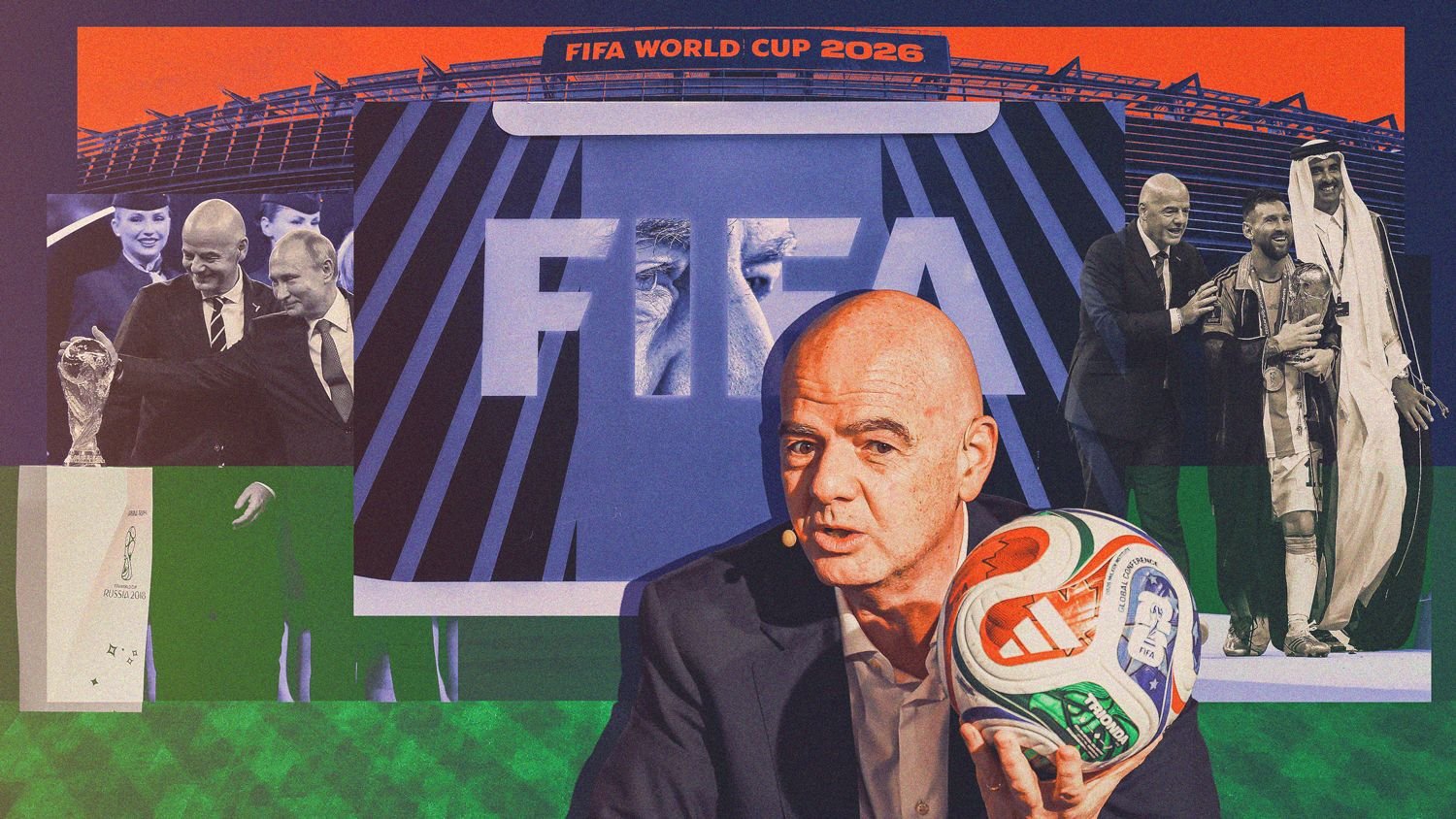
GIANNI INFANTINO CELEBRATED HIS ELECTION as FIFA president in February 2016 by buying beers for journalists in the bar of a hotel in Cardiff, Wales. After the previous regime of Sepp Blatter had been brought down by bribery and corruption, Infantino was soccer’s new man of the people: approachable, engaging and ready to restore the game’s reputation.
Ten years on, the Swiss-Italian lawyer is the most powerful man in the game.
He earns $6 million a year, and has world leaders — including U.S. President Donald Trump, Crown Prince Mohamed bin Salman of Saudi Arabia and President Vladimir Putin of Russia — on speed dial. He flies on a jet provided by the state of Qatar, and when he returned to Cardiff earlier this year for the annual International Football Association Board (IFAB) summit at the luxury Vale of Glamorgan resort, a decade on from that celebratory night at the bar, Infantino stayed next door at the 17th-century Hensol Castle.
Either by accident or design, Infantino’s lodgings only served to emphasize the reality of the 56-year-old now being an emperor of all he surveys.
– USMNT at the 2026 World Cup: Fixtures, squad, injuries, more
– Who are the best U21 players at this summer’s World Cup?
– Borden: What you missed in soccer since 2022 World Cup
SINCE 2016, he has twice been re-elected unopposed as FIFA president, in 2019 and 2023, and having served notice of intention to stand again in 2027, it is expected that he will retain his post without challenge. FIFA statutes rule that a president cannot serve more than three four-year terms — theoretically 12 years. But having replaced Blatter outside the usual election cycle in 2016, Infantino has been allowed to discount his initial three-year period and therefore start his 12-year period in 2019.
Sources told ESPN that Infantino will not attempt to stand for a fourth term — and therefore amend FIFA’s constitution — in 2031, primarily due to the draining effects of crisscrossing the globe in a role that is, according to a source close to Infantino, “exhausting.”
Despite generating controversy for appearing to cozy up to powerful world leaders, including his unilateral decision in December 2025 to create the FIFA Peace Prize for Trump, there is minimal open criticism of Infantino within the game. When ESPN approached a leading national football association to ask whether it would speak about Infantino defending FIFA’s hugely expensive World Cup ticketing scheme for the 2026 tournament, the response was swift and clear: “Ha, we won’t be doing that!”
Lise Klaveness, the president of the Norwegian Football Federation (NFF), has been a rare voice in the sport to publicly condemn the Infantino regime, albeit indirectly, by saying the Peace Prize award to Trump was a “breach of FIFA’s own statutes of political neutrality, and there was a lack of legal process within FIFA.”
Sergio Marchi, the president of global players’ union FIFPRO, released a statement during last year’s FIFA Club World Cup titled “The Man Who Thinks He’s God” in which he accused Infantino of making the tournament “reminiscent of the ‘bread and circuses’ of Nero’s Rome.”
Marchi also said, “Infantino lives in his own world — the only thing that matters to him are these grand spectacles.”
But aside from Klaveness, soccer’s leading officials have chosen not to question or upset a man who drove the decisions to honor Trump at December’s World Cup draw in Washington, D.C., green-light the controversial ticket pricing for this summer’s tournament and confirm Saudi Arabia as host of the 2034 tournament.
Infantino announced the bidding process for 2034 on Oct. 4, 2023, and restricted submissions to those from the Asian and Oceania confederations, citing continental rotation. Australia had considered a bid but opted against challenging the Saudi submission, with Football Australia CEO James Johnson saying the rapid submission process announced by Infantino “did catch us a little bit by surprise.” Saudi Arabia was announced as the sole bidder on Oct 31, 2023, with FIFA confirming it as the 2034 host in an extraordinary general congress on Dec. 11, 2024.
The limited criticism of Infantino within the game — a kind of soccer omerta — has been noted by Blatter, Infantino’s disgraced predecessor.
“We have 211 national associations and there is not one single association who is opposed to the work of the president [Infantino] who speaks only with heads of states,” Blatter told the Telegraph in December 2025.
Infantino celebrated 10 years as FIFA president in February: his anniversary was marked by a slick FIFA PR campaign including a specially designed “Infantino 10” logo, a 30-minute FIFA TV documentary, and congratulatory messages from officials, former players and coaches.
“Ten years as President. Ten years of progress,” the FIFA documentary declared. “From taking over in the darkest days of the organization’s history, to preparing for the biggest sporting event the world has ever seen. This is the story of Gianni Infantino’s decade at the helm of FIFA.”
2:26
Ogden explains the good and bad of Infantino’s FIFA presidency
But with controversy overshadowing this summer’s World Cup and Infantino’s role in many of the issues that have emerged, what is the real story of his 10 years as FIFA president?
Has he delivered on his election pledges, or is he a soccer version of P.T. Barnum: a salesman and a showman who has turned the World Cup, the biggest sporting event on the planet, into a circus reserved for the elite?
FIFA WAS MIRED IN SCANDAL when Infantino assumed the role of president in 2016.
A year earlier, an FBI investigation uncovered more than $150 million of bribes and kickbacks involving executives at the highest level of the organization, prompting Swiss police to raid Zurich’s opulent Baur au Lac Hotel in May 2015 and arrest seven senior FIFA executives following a request by the U.S. Department of Justice (DOJ).
Allegations relating to corrupt broadcasting and marketing deals, racketeering, money laundering and cash-for-votes during the bidding process for the 2018 and 2022 World Cups, which were awarded to Russia and Qatar respectively, all formed a 47-count DOJ indictment. Twelve FIFA officials ultimately pled guilty to a variety of charges, and the scandal led to the downfall of Blatter and his anticipated successor, UEFA president Michel Platini, who were both issued with an eight-year suspension from all soccer-related activity by FIFA in December 2015.
Blatter and Platini were found guilty of breaches surrounding a £1.3 million payment made to Platini in 2011. The FIFA ethics committee found both men to have demonstrated an “abusive execution” of their positions.
It is against this backdrop that Infantino was elected as president in February 2016, defeating Bahrain’s Sheikh Salman bin Ebrahim al-Khalifa by 115 votes to 88 with a campaign platform pledging to expand the number of countries participating in a World Cup, increase development funds and, crucially, in the wake of the Blatter era, to restore FIFA’s reputation.
Prior to his election, Infantino had been a low-profile administrator at UEFA, having joined the organization in August 2000, taking on the role of director of legal affairs and club licensing four years later. After being promoted to deputy general secretary in 2007, he became general secretary in 2009 — a role that saw him picking the balls from the pots for UEFA Champions League draws — and was Platini’s de facto deputy before his boss’s demise in the FIFA scandal led to Infantino being regarded as Europe’s best candidate to succeed Blatter.
“At the time we were pretty hostile to Blatter and we assumed, like many others, that Platini would get the FIFA job,” Greg Dyke, chairman of the English Football Association between 2013 and 2016, told ESPN. “And of course he would’ve done until it all fell apart in terms of the money between him and Blatter.
“So then it was wide-open, and Infantino, who we knew from his period as general secretary of UEFA, looked a good bet. We liked him as an individual, we thought he’d done a good job at UEFA, and therefore we supported him.
“My initial impression of him when he was doing the job was quite positive, but I’m not close enough to it to give you a rundown now. But I did think that the Peace Prize to the President of the United States was ridiculous and a big mistake.”
Sources told ESPN that Infantino’s decision to hand that award to Trump was “based on the situation at the time,” and that soccer executives and politicians “in many places” have directly told Infantino of their admiration for Trump’s intervention in helping resolve conflicts in countries such as Rwanda and Congo.
But while the Peace Prize and Infantino’s relish for courting the favor of powerful leaders have led to ridicule and condemnation — human rights campaigners FairSquare accused Infantino of an “egregious abuse of power” in an eight-page complaint about the Peace Prize, filed to FIFA last December — there are those within FIFA who regard their president as being an agent for significant change. Plenty of associations see him as someone who has delivered on his election promises.
According to FIFA, the distribution fund to its 211 member associations has grown eightfold during Infantino’s 10-year reign as president, with $5.1 billion invested into global football development. In 2016, FIFA reported an annual revenue of $502 million. Its last reported figures, in 2025, highlighted a growth to $2.66 billion, and it is projected to earn $9 billion in 2026 alone due to the men’s World Cup, which is the first edition with an expanded 48-team field.
Sources told ESPN that Infantino’s determination to eradicate the corruption and misappropriation of funds has led to some associations being visited by financial experts to deliver accounting lessons, warning that “every dollar must now be accounted for.”
“Gianni operates at the same intensity as a CEO of a major multinational,” a FIFA official who works directly with Infantino said. “He has an incredible attention to detail. Staff should never go underprepared to any meeting, as he will spot gaps immediately.
“He is of the ‘get s— done’ mindset and takes his role very seriously. It is significant that the U.S. Attorney General and FBI director traveled personally to meet him in FIFA’s Miami offices. That speaks volumes about how the organization has changed under him in the past decade.”
SO WHO REALLY IS Gianni Vincenzo Infantino?
He is a man shaped by his upbringing, raised in Switzerland as the son of Italian immigrants. He was a red-haired child and got teased about his appearance by locals; Infantino said his determination to drive soccer as a force for peace and togetherness was partly influenced by his own experience of prejudice, seeing signs in Switzerland that said, “No dogs, no Italians.”
Infantino studied law at the University of Fribourg in Switzerland, married a Lebanese woman and raised a family of four children. He speaks seven languages, including Arabic, and holds Swiss, Italian and Lebanese citizenship. He also has a jet-set lifestyle, operating out of FIFA’s offices in New York, Miami and Zurich, and often visiting different continents in the space of 24 hours. It is a way of living he has admitted is draining, also saying he has no idea which time zone his body clock adheres to.
An Inter Milan supporter, Infantino is a career bureaucrat who was in the right place at the right time to capitalize when Blatter’s FIFA empire collapsed and took Platini, Infantino’s boss at UEFA, down with it.
“He was a good No 2, but is not a good No 1,” Platini told the Guardian in January. “He worked very well at UEFA, but he has one problem: He likes the rich and powerful people, the ones with money. It’s his character. He was like that as a No 2, but back then he was not the boss.”
Platini’s remarks about attraction to wealth and power are regularly borne out by Infantino’s actions. His Instagram account — Infantino posts almost daily to his 4.1 million followers and has a personal photographer — is littered with photographs of himself alongside world leaders, celebrities or famous former soccer players. Many of those luminaries receive birthday wishes from the FIFA president, especially if there is a photograph of them playing alongside Infantino in one of the FIFA Legends games that take place at FIFA’s Zurich HQ, or at a stadium that is hosting a major tournament.
There are also plenty of pictures of Infantino at the White House, alongside Trump, with the World Cup trophy, the FIFA Peace Prize or the FIFA Club World Cup trophy prominent in the backdrop. For his part, Infantino is unapologetic about the car showroom nature of FIFA’s biggest trophies being on display in the Oval Office.
“Gianni sees himself as a salesman for FIFA,” a source close to Infantino said. “When he was trying to generate interest in the Club World Cup [staged in the U.S. in 2025] and sell tickets, he believed that there was no better way to promote the competition than by having the trophy on the president’s desk.”
Infantino applied the same logic to FIFA renting office space at Trump Tower in New York in July 2025, despite the risk of accusations of cronyism.
“It made headlines, because it’s New York and it’s Trump Tower,” a source close to Infantino said. “Headlines create publicity, and if you’re trying to sell something, then you want headlines.”
FIFA told ESPN that the Trump Tower office is rented at a fair market rate, with the same applying to the apartment in Doha, Qatar, that Infantino has used since prior to the 2022 Men’s World Cup in the country.
ESPN also contacted FIFA for clarity on the funding of the private jet donated by Qatar and who pays for fuel, maintenance and landing fees. “As we have consistently stated, FIFA has put in place rules which establish the framework for flights and travel by any FIFA official,” a statement read. “The FIFA President routinely travels around the world, together with relevant officials, on business and tournament-related matters and strives to visit member associations of FIFA whenever he can. Sometimes travel is organized on commercial (including low-cost) airlines and sometimes it is on private charter, depending on which is more efficient and cost-effective under the circumstances. FIFA expenses are published in our Annual Report and all travel is in line with FIFA’s regulations.”
– Referee explains how VAR will work at World Cup
– How World Cup’s ‘least-known’ player gained 1m followers
– World Cup squads: All 48 teams in full
INFANTINO’S CLOSENESS TO Trump and leaders in the Middle East led to him missing the start of FIFA Congress in Asuncion, Paraguay, in May 2025 due to his attendance at a world leaders summit in Riyadh, Saudi Arabia. When he finally took to the stage in Asuncion, three hours late, a group of European association leaders — including UEFA president Aleksander Ceferin — walked out of the conference hall in protest at Infantino’s failure to arrive on time.
Infantino might enjoy creating headlines and generating publicity for whatever tournament he is promoting at the time, but he can also be clumsy and insensitive; he was criticized for taking selfies with former players at the funeral of Pelé in 2023. Often, the FIFA chief displays an inability to read a room. Or, perhaps, he just ignores it altogether.
During April’s FIFA Congress in Vancouver, British Columbia, Infantino’s attempt to force a public handshake between Israel FA vice president Basim Sheikh Suliman and Palestinian FA president Jibril Rajoub ended in embarrassment when Rajoub walked offstage in disgust, with Palestinian FA vice president Susan Shalabi describing Infantino’s stunt as “absurd.” When he wore a red Trump hat during a meeting of the U.S. president’s “Board of Peace” in February, Infantino was investigated — and eventually cleared — by the politically neutral International Olympic Committee, of which he is a member, for breaching neutrality regulations.
“Gianni just likes to please people,” a source close to Infantino told ESPN. “That’s why he wore the Trump hat. When he was in Mexico, he wore a sombrero for the same reason. There was nothing more to it.”
1:20
Nicol: Pulisic’s form key for USMNT’s World Cup momentum
In 2023, New Zealand police rejected FIFA’s request for Infantino to be given a motorcade while attending games in the country during the women’s World Cup, and the Canadian city of Vancouver was similarly dismissive of requests for a “level-four escort” — allowing his convoy to override red lights and deploy road blockages — during Infantino’s visit for FIFA Congress in April.
Level-four protection is just one level down from the security afforded to the Pope and a level higher than that reserved for Canada’s prime minister, Mark Carney. Despite his attempts to charm city officials into submission, Infantino’s requests were denied.
Infantino has accused the media of being “mean” by criticizing his actions — both his faux pas and his celebrity-chasing persona — but there have also been occasions, off camera and behind the scenes, when he has displayed compassion and a human touch. When American sports journalist Grant Wahl, a longtime critic of FIFA’s governance, died suddenly while attending a game at the 2022 World Cup in Qatar, Infantino visited the hospital treating Wahl, spent time with his colleagues and helped facilitate his repatriation to the United States.
“[Infantino] is loyal to his workforce and asks after staff and their families,” a FIFA source said. “He has a loyal group around him.”
INFANTINO’S LEGACY WILL BE THE 2026 World Cup. Having promised to expand the tournament to 48 teams and transform FIFA’s finances, he might regard this summer as his crowning glory — an emperor surveying his empire, indifferent to the criticism raining down on his parade.
Infantino claimed last December that FIFA had received 5 million ticket requests from more than 200 countries for games at the tournament that will be hosted by three nations — the U.S., Mexico and Canada — for the first time. But the buildup to the summer event has seen excitement drowned out by a barrage of negative publicity.
The frustration has several strands; there’s the exorbitant cost of match tickets and predatory “dynamic pricing” in the resale market, vastly inflated travel fees in major cities, unprecedented restrictions on parking at venues. Furthermore, several participating countries are navigating uncertainty and anxiety over the ability of their fans to travel to the U.S. due to the Trump administration’s visa bans on 39 nations, including World Cup qualifiers Haiti, Iran, Ivory Coast and Senegal in January.
Infantino boasted in May that “25% of the group stage tickets can be bought for less than $300,” adding that “You cannot go to watch a U.S. college game — not even speaking about a top professional game of a certain level — for less than $300. And this is the World Cup.
“We have to look at the market. We are in the market in which entertainment is the most developed in the world. So we have to apply market rates.”
The cheapest tickets initially offered for the USMNT’s opening game against Paraguay in Los Angeles on June 12 were priced at $1,200 within FIFA’s dynamic ticket pricing scheme — an algorithm that adjusts prices based on event demand — prompting Trump to question the cost of attending the game.
“I did not know that number,” Trump told the New York Post. “I would certainly like to be there, but I wouldn’t pay it, to be honest with you.”
Sources told ESPN that FIFA’s use of the dynamic pricing system reflects the culture of ticket buying for sports and entertainment in the U.S., but it is pricing regular fans from across the globe out of the market.
“I blame Oasis and Taylor Swift for giving FIFA the idea of dynamic pricing,” Hamish Husband, spokesman for the Tartan Army, the Scotland fans group, told ESPN. “We’re not naïve, we know how the game is going now in terms of ticket prices, but we have worked out it will cost between £5,000-£10,000 [$6,750-$13,514] for Scotland supporters to travel to and attend games in the group stage.
“You have possibly two generations of young Scots who have no memory of our last World Cup in 1998, so there is an incredible clamor for tickets, despite the cost. We believe we have a right to go to a game and we will overcome any obstacles, but we are hoping that the dynamic pricing will see tickets become much cheaper in the days leading up to the games.”
But it is not just match tickets that are threatening to drain supporters’ bank accounts. Parking spaces at Gillette Stadium in Foxborough, Massachusetts, are being sold for $175 each, while round-trip train tickets from Boston to the stadium are on sale for $80 — four times higher than the $20 fee for other events at the stadium, including New England Patriots games.
“Some of our supporters have hired school buses in Boston to get us to games,” Husband said. “That’s an example of how we will do everything possible to overcome the obstacles in our way.”
In New York/New Jersey, a train from Manhattan to MetLife Stadium — which will host the World Cup final — usually costs $12.90 for a return ticket. Local authorities ramped the cost up to $150 for World Cup games earlier this year, but have since reduced that to $98 following widespread complaints, still a huge markup on regular prices.
Last week, Infantino used his Instagram account to announce a scheme of buses for fans in New York to travel to MetLife for $20, but tickets must be booked in advance subject to availability. The transport costs are beyond FIFA’s remit and are the responsibility of the host city, but nonetheless, the organization has been criticized for failing to contribute funds to cities to help cover costs of security and additional transport.
“Our administration inherited an agreement where FIFA is providing $0 for transportation to the World Cup. Zero,” New Jersey governor Mikie Sherrill said in April. “That leaves New Jersey Transit with a $48 million bill to safely get 40,000 fans to and from every game.
“At the same time, FIFA is making $11 billion off of this World Cup, and charging fans up to $10,000 for a single ticket for the final. I won’t stick New Jersey commuters for that tab for years to come — that’s not fair.”
In response, FIFA said, “FIFA is not aware of any other major event previously held at NYNJ Stadium, including other major sports, global concert tours, etc., where organizers were required to pay for fan transportation.”
A report by Fortune in May highlighted that 80% of hotels surveyed reported that bookings in World Cup cities were tracking below expectations, with the tournament described as a “nonevent” in some cities.
For Infantino, the World Cup simply can’t be a nonevent. If the tournament begins with empty seats in stadiums and apathy among supporters, it will be a failure attributed solely to him.
Infantino is somebody who talks about investing in the game, of wanting to build pitches for children in Gaza and redistributing soccer’s wealth to grow the “beautiful game” in every corner of the globe. But the man who bought beers in a Cardiff bar 10 years ago now rubs shoulders with presidents and princes, works out of an office in one of New York’s most prestigious addresses, and clocks up air miles in a Qatari jet while soccer supporters scrape together their savings and rent school buses to watch games at the World Cup.
If he winds down the window in his chauffeur-driven limousine while being sped to games, he might just see those fans whose “beautiful game” he controls.