dailynewsnblog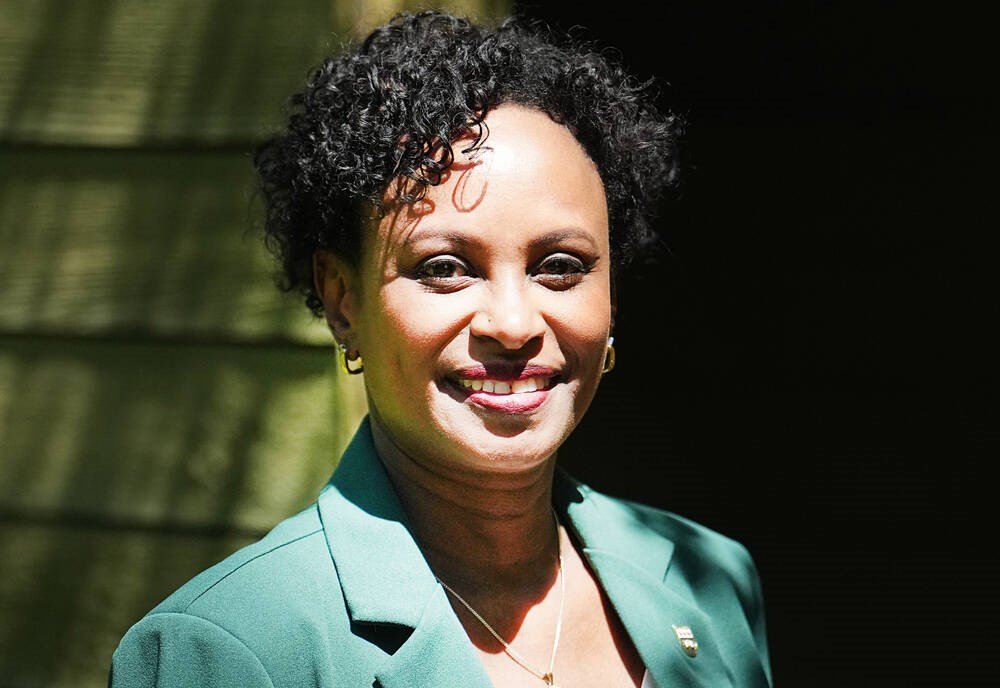

Rhonda McEwen, who comes to UVic from Victoria University at the University of Toronto, says the institution can better market its strengths.
The University of Victoria’s next president will make history as the institution’s first female and first Black president.
Rhonda McEwen is currently president and vice-chancellor of Victoria University at the University of Toronto, where she was appointed to a five-year term in 2022.
The 55-year-old telecommunications engineer, recognized for her work in technology, including artificial intelligence, begins her five-year term at UVic on Oct. 14.
McEwen, in an interview at UVic, said she never sought to be the first female Black university president, but she recognizes how important it is for anyone to potentially see themselves represented by those in power.
It’s one of the reasons she attends every convocation ceremony, she said. “For that one person out there, it could mean everything.”
Qwul’sih’yah’maht Robina Thomas had stepped in as acting president immediately following the abrupt August 2025 departure of Kevin Hall as president. He left for a United Arab Emirates university months into his second five-year term.
Thomas, who retires on June 30, said McEwen’s innovative approach to research and program development, drive for justice, equity and inclusion, and dedication to the student experience “make her a perfect choice for our university.”
UVic board of governors acting chair Erinn Pinkerton said the appointment marks the end of a comprehensive international search for the university’s next leader. She said the appointment committee recognized McEwen as an inspirational advocate for higher education in Canada and beyond. “Dr. Rhonda McEwen is an energetic and approachable leader, with the ability to build authentic relationships across the campus, Vancouver Island and the globe,” said Pinkerton.
McEwen said she believes passionately in higher education. “I want to make sure we put forward the best experience for students while providing value to our local communities and the world,” she said.
She faces challenges, including the university’s financial situation, as well as provision of housing and mental health and wellness supports for students in an environment where resources are constrained, she said.
As part of its 2026 budget, the province pushed back the completion date for a $178-million student-housing development planned for UVic, to 2034 from 2029.
McEwen said partnerships, including public-private partnerships, are key, “because universities can’t do it alone.”
“Provinces are not able to do more right now than they are doing — they’re very strapped.”
As for the university’s global rankings, McEwen maintains UVic can better market its strengths and talents.
She said the university has “some of the world’s best researchers,” citing work in clean energy, sustainability, oceanography, digital and engineering, but that’s not understood globally, “not even really within Canada, to be honest.”
“So, there’s some work to be done here to elevate the brand and to move that message out there.” UVic held its position at 17 among Canada’s top post-secondary institutions in the 2026 Global 2000 rankings published by the Center for World University Rankings this week. But it slipped 10 spots internationally from last year, now ranking 449th in the world, down from 439th.
McEwen said that, too often, Canadian ingenuity and research in technology is not being capitalized or taken to the next level in this country. “We need to be able to fix that pipeline from university into the actual business community and for our not-for-profit sector to make sure that we are keeping the talent in Canada.”
McEwen was born in Trinidad and Tobago, and says as a young child, she took apart and explored electronics. She remembers opening up an old transistor radio and finding the circuit board “beautiful,” and not only needing to know exactly how it worked but where that technology was going next.
In the late 1970s, her teacher parents moved McEwen and her brother to Wisconsin in the United States, where the parents pursued bachelor’s and master’s degrees.
After the family returned to Trinidad and Tobago, McEwen attended the University of the West Indies at St. Augustine, earning a bachelor of science and a scholarship to study in the United Kingdom.
She holds an MBA in information technology from City University of London, England, a masters of science in telecommunications from the University of Colorado, and a PhD in information from the University of Toronto.
Her doctoral thesis examined how cellphones helped first-year U of T and Toronto Metropolitan University students build and maintain friendships during their transition to university.
She spent more than 15 years working in the private sector in digital communication and management consulting — writing strategic plans and forecasting for efficiency was her “bread and butter,” she said — prior to shifting to work in higher education.
In 2011, her research on touchscreen technology for children on the autism spectrum was featured on the American news TV program 60 Minutes.
That appearance led to her joining an advisory group for Sesame Workshop, the non-profit that produces Sesame Street, which sought to include autism on its TV program.
McEwen, who has a 23-year-old daughter who is autistic and non-verbal, helped create a new Muppet, four-year-old Julia, who is on the autism spectrum. The puppet with bright orange hair, big green eyes and a rabbit named Fluffster was introduced in 2017 and the information shared through the Muppet is one of the most downloaded resources on the site.
McEwen also has a 19-year-old son who is studying law at the University of Birmingham in England.
Her husband, who was born in Canada, has retired as a partner in a consultancy firm and is orchestrating the family’s move.
McEwen became Canada’s first female Black university president in 2022.
[email protected]