dailynewsnblog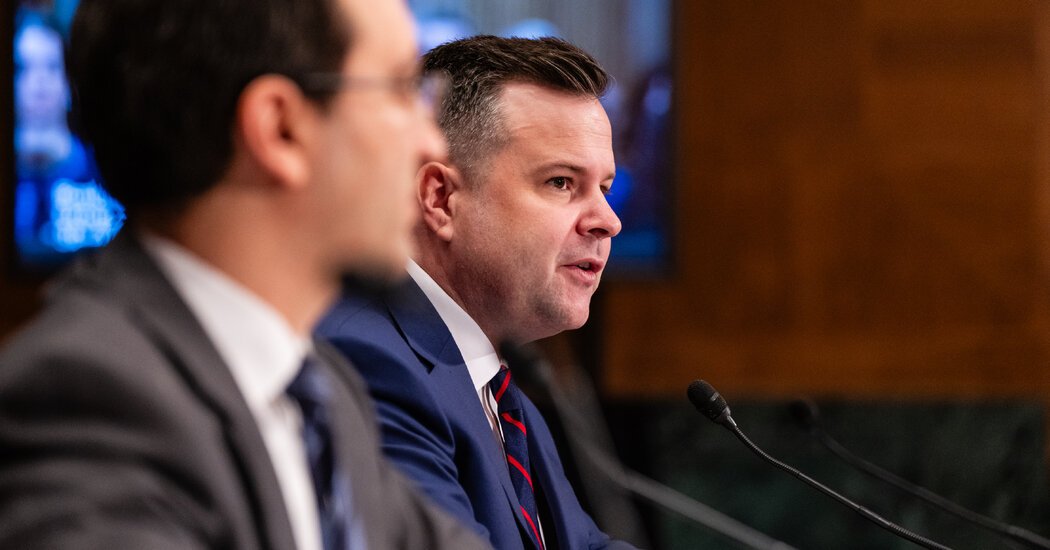
President Trump on Tuesday named Bill Pulte, who has pressed for investigations into the president’s foes, to serve as the acting director of national intelligence, giving him oversight of U.S. intelligence agencies.
He will replace Tulsi Gabbard, who announced last month that she was stepping down to care for her husband, who has cancer.
Mr. Pulte, who leads the federal housing finance agency, has no known background in intelligence, defense or national security, but he has been among the most aggressive advocates for prosecuting Democrats and others perceived by Mr. Trump as having crossed him.
The director of national intelligence is a cabinet post that oversees 18 intelligence agencies and supervises the production of the President’s Daily Brief, the compendium of intelligence analysis viewed by senior policymakers.
The appointment was viewed with deep skepticism on Capitol Hill. Democrats immediately denounced it, saying that Mr. Pulte did not have the national security experience the law creating the office required. Multiple senior Republicans also voiced doubts.
“We don’t need a weaponized D.N.I.,” Senator John Thune of South Dakota, the majority leader, told reporters. “We need professionals there.”
Mr. Thune added: “If he’s somebody we want in that position permanently, he’s got a lengthy road ahead of him.”
For now, Mr. Trump seems intent on avoiding the confirmation process, naming Mr. Pulte to the national intelligence post on an acting basis. Mr. Pulte will continue to run the housing agency while taking on the new position, which he wanted and lobbied for, according to U.S. officials.
The Federal Vacancies Reform Act generally limits acting officials to a base line of 210 days. When Richard Grenell was the acting director of national intelligence in the first Trump administration, he served for 96 days.
Mr. Trump started calling allies about the appointment over the weekend, but the announcement surprised many senior officials at the Office of the Director of National Intelligence. Mr. Pulte did not respond to a message seeking comment.
On paper, the director of national intelligence, a role created after the Sept. 11 terrorist attacks, is among the most powerful cabinet positions, responsible for coordinating the work of the C.I.A. and a host of other agencies. But Mr. Trump has never seen it as an important role, his advisers have said. And in his first term, he believed staff members working for the office were leaking information about him.
Mr. Pulte’s aggressive use of social media to go after those Mr. Trump perceives as political enemies has made him a favorite of the president’s. Mr. Pulte, an heir to one of the largest American home-building families, is also a friend of the president’s eldest son, Donald Trump Jr.
Mr. Pulte’s social media campaign against Jerome H. Powell, while he was the chair of the Federal Reserve, pleased Mr. Trump. But it led many on Wall Street to rally to Mr. Powell’s side. Similarly, Mr. Pulte’s efforts to get the Justice Department to investigate Lisa D. Cook, a Fed governor, for mortgage fraud has not resulted in criminal charges.
Ms. Gabbard was in and out of Mr. Trump’s good graces during her time in office. But she won his support when she announced that she would release documents she said undercut accusations that Russia tried to influence the 2016 election in favor of Mr. Trump, and when she accused President Barack Obama of leading a conspiracy to undercut his successor.
Still, Mr. Trump believed that Ms. Gabbard was moving too slowly in declassifying documents. In addition to choosing Mr. Pulte, Mr. Trump is giving John Solomon, a journalist who has been deeply critical of parts of the investigation into whether the 2016 Trump campaign conspired with Russians, a role as a special government employee leading a “transparency” task force.
The fact that Mr. Pulte will serve in an acting role, as opposed to facing Republican senators during a confirmation hearing for the job, could give him a freer hand in focusing on the president’s priorities, including his false claim that his election loss in 2020 stemmed from fraud, something that Ms. Gabbard was pursuing.
In announcing the appointment on social media, Mr. Trump said that Mr. Pulte “has deep experience managing the most sensitive matters in America, the safety and soundness of the Markets, and over 10 Trillion Dollars at Fannie Mae/Freddie Mac, a substantial increase from where it was just 12 months ago.”
Vice President JD Vance said on social media that Mr. Pulte recognized that “the bureaucracy of the intel community must respond to the elected leadership.”
But Republicans and Democrats questioned whether Mr. Pulte had the experience required to oversee and coordinate the work of many different intelligence agencies. Senator Mark Warner of Virginia, the top Democrat on the Intelligence Committee, said the appointment was more about Mr. Trump’s retribution agenda than about intelligence oversight.
“This president is not looking for an intelligence leader who will follow the facts or speak truth to power, but rather someone who will be willing to shape intelligence around the president’s wishes, regardless of the cost to the American people,” Mr. Warner said.
Senator Susan Collins, Republican of Maine, said that she was not sure whether Mr. Pulte had ever held a security clearance. “I do not know his background or whether he has any intelligence experience,” said Ms. Collins, another member of the Intelligence Committee. “I truly know nothing about him.”
Javed Ali, a former senior director at the National Security Council, said Mr. Trump’s decision to name Mr. Pulte to the position could further diminish the standing of the Office of the Director of National Intelligence.
“On the eve of the 25-year anniversary of 9/11 this September, appointing an individual with no formal experience in national security or intelligence suggests the administration believes O.D.N.I.’s role and the D.N.I. position may be less important than in previous years,” he said.
Mr. Pulte has already become a lightning rod in the administration. Throughout last year, while he was leading the Federal Housing Finance Agency, he used social media to accuse some of Mr. Trump’s perceived enemies of committing mortgage fraud.
His tactics frustrated officials at the White House, as well as prosecutors and the leaders of the Justice Department, who believed that Mr. Pulte was creating a false expectation that his accusations could be successfully brought to court.
But his actions earned Mr. Trump’s deep appreciation and admiration, and the president was eager to take Mr. Pulte’s phone calls.
The president’s selection of Mr. Pulte also came on the heels of Republican senators condemning Mr. Trump’s plan to create a $1.8 billion, taxpayer-funded “weaponization” fund to settle his own lawsuit against his government over his tax returns being leaked. The administration signaled on Monday that it was backing off that plan.
While Mr. Pulte’s tenure as the nation’s housing director earned Mr. Trump’s praise, it has been marked by few tangible results.
His plan for an initial public offering of shares of Fannie Mae and Freddie Mac, the two giant government-controlled mortgage finance firms, remains stalled. An idea he floated of a 50-year mortgage was widely panned by progressives and conservatives.
And Mr. Pulte has not produced any credible plan for spurring the construction of more affordable housing as director of his agency, which regulates Fannie and Freddie.
His tenure has also been marked by the dismissal of scores of employees at Fannie and Freddie. He named himself as the chair of both government-controlled companies’ boards, an unprecedented move.
Reporting was contributed by Zolan Kanno-Youngs, Glenn Thrush, Robert Jimison and Annie Karni.