dailynewsnblog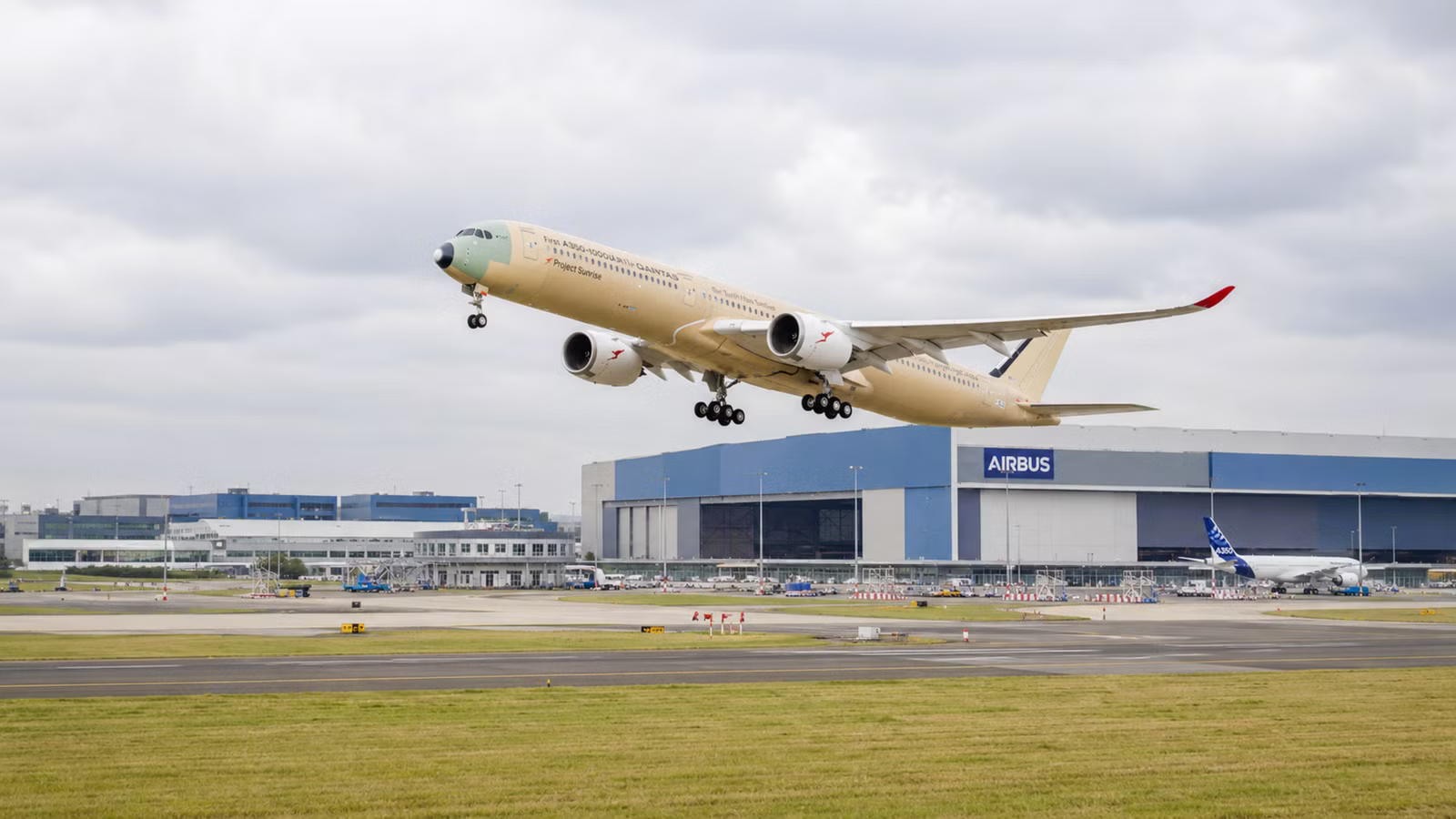
Qantas has been working on its ambitious Project Sunrise for nearly a decade, and it has become one of commercial aviation’s most closely watched projects. Designed to connect Australia’s east coast directly with far-flung cities such as London and New York, the initiative promises to eliminate intermediate stops and create the longest nonstop scheduled passenger flights ever operated. To make that possible, Airbus has developed a special ultra-long-range (ULR) version of its flagship A350-1000.
This week the program has reached a major milestone. Airbus announced earlier today that the first Airbus A350-1000ULR has completed its maiden flight from Toulouse-Blagnac Airport (TLS), beginning the certification campaign that will ultimately enable nonstop flights of up to 22 hours. While passengers will still need to wait some time before boarding those history-making services, the aircraft’s first flight marks the point at which Project Sunrise has moved from concept to reality.
The A350-1000ULR Finally Takes To The Skies

The aircraft that conducted the flight test is the first of 12 specially modified Airbus A350-1000ULRs ordered by Qantas for Project Sunrise. Airbus said the aircraft will now enter an extensive test campaign focused on validating the modifications that distinguish it from a standard A350-1000.
The program will include testing of performance, systems integration and, most importantly, the enhanced fuel system required for the aircraft’s extraordinary range capability. Airbus noted that it expects the testing to take a couple of months:
“During the first flight, the crew carried out general aircraft performance checks and tested the new fuel system architecture. This marks the start of a two-month flight test campaign to certify the modifications.”
The ULR aircraft for Project Sunrise are designed specifically for ultra-long-haul operations that extend their range 1,000 nautical miles further than a conventional Airbus A350-1000. The aircraft incorporates an additional fuel tank carrying roughly 20,000 liters of extra fuel, structural reinforcements to support the increased takeoff weight, and a cabin optimized for flights lasting more than 20 hours. These modifications will allow the aircraft to fly more than 17,000 kilometers nonstop, enabling routes from  Sydney Kingsford Smith Airport (SYD) to
  London Heathrow Airport (LHR) and
  New York JFK Airport (JFK).
For Airbus and Qantas, the first flight represents the most visible milestone yet in a program first announced in 2017. What was once considered the “last frontier” of commercial aviation is now entering its final development phase, bringing the prospect of direct flights from Australia’s east coast to Europe and North America closer than ever before.
Project Sunrise’s Long Journey To Certification

The journey to this point has been anything but straightforward. Project Sunrise was originally unveiled in 2017, with Qantas challenging aircraft manufacturers to make nonstop flights from Sydney and Melbourne to London and New York commercially viable. The airline also evaluated the Boeing 777-8, but ultimately selected Airbus and ordered 12 specially modified A350-1000ULRs. However, the program has since faced a series of delays.
Date | Milestone |
|---|---|
2017 | Qantas launches Project Sunrise study |
2020 | Project paused during COVID-19 pandemic |
2022 | Airbus selected; 12 A350-1000ULRs ordered |
2024 | Fuel tank redesign required by regulators |
April 2026 | First aircraft rolls out of final assembly |
June 2026 | First flight-test aircraft takes to the skies |
April 2027 | First delivery now expected |
2H 2027 | Planned entry into commercial service |
Some of those delays stemmed from the COVID-19 pandemic, which effectively froze major fleet planning projects across the industry. More recently, Airbus was also required to redesign the aircraft’s additional center fuel tank after regulatory concerns emerged during certification. Airbus executives later confirmed that the redesign of the unique fuel system was one of the principal reasons deliveries slipped from the original timeline.
The latest setback emerged last month when Qantas confirmed that the first delivery has now moved from late 2026 to April 2027 due to wider supply-chain disruptions affecting Airbus production. However, the airline told Simple Flying that the full details for the first commercial operations are imminent:
“Preparations for Project Sunrise continue with the first Airbus A350-1000ULR now in the paint shop in Toulouse taking on its Qantas livery, and test flights just weeks away. Pilot training is well underway at our new A350 simulator in Sydney, and next month we’ll announce the first route and timing of our inaugural commercial services.”
Qantas’ Project Sunrise Delayed Again As “Supply Chain Issues” Plague Airbus A350-1000ULRs
The manufacturer is seemingly is pumping the brakes on carrier’s big debut.
The Next Giant Leap In Ultra-Long-Haul Aviation

Commercial aviation’s longest-flight record has usually advanced in steps, with each new generation of aircraft pushing the boundaries of what is possible. The Boeing 747SP opened the door to true ultra-long-haul flying in the 1970s, before the likes of the Boeing 747-400, Airbus A340-500, and Airbus A350-900ULR each established new benchmarks.
The world’s current longest scheduled nonstop flight is with  Singapore Airlines from Singapore Changi Airport (SIN) to JFK at 9,537 miles (15,349 km). The return flight from New York has a block time of 19 hours and 15 minutes.
Year | Airline | Route | Aircraft Type | Distance |
|---|---|---|---|---|
1976 | Pan Am | New York JFK–Tokyo Narita | 747SP | 6,750 miles (10,860 km) |
1982 | Pan Am | Los Angeles–Sydney | 747SP | 7,488 miles (12,051 km) |
1997 | South African Airways | Johannesburg–New York JFK | 747-400 | 7,970 miles (12,825 km) |
2001 | Continental Airlines | Newark–Hong Kong | 777-200ER | 8,060 miles (12,970 km) |
2004 | Singapore Airlines | Newark–Singapore | A340-500 | 9,534 miles (15,344 km) |
2017 | Qatar Airways | Doha–Auckland | 777-200LR | 9,032 miles (14,535 km) |
2018 | Singapore Airlines | Newark–Singapore | A350-900ULR | 9,534 miles (15,344 km) |
2020 | Singapore Airlines | Singapore–New York JFK | A350-900ULR | 9,537 miles (15,349 km) |
2027 (planned) | Qantas | Sydney–London Heathrow | A350-1000ULR | 10,573 miles (17,016 km) |
Interestingly, it is not the longest nonstop ever flown. Air Tahiti Nui operates its service from Papeete in Tahiti (French Polynesia) to Paris using a Boeing 787-9 with a stop at  Los Angeles International Airport (LAX). But for two months during the early days of the pandemic, when transit through the US was prevented, it flew the service as a non-stop flight of 9,765 miles (15,715 km). This set a new world record for the world’s longest scheduled passenger flight, and simultaneously, the world’s longest domestic flight.
The Airbus A350-1000ULR is now poised to become the latest aircraft to redefine long-haul travel, carrying passengers farther than any commercial airliner before it. Sydney-London will immediately become the world’s longest scheduled passenger flight at 10,573 miles (17,016 kilometers), exceeding the current record holder by more than 1,000 miles. That is an enormous jump in an industry where distance records have typically been broken by only a few hundred miles at a time.
Yet many aviation experts regard Sydney-New York as the more demanding route. While it is shorter than Sydney-London at around 9,950 miles (16,013 kilometers), flights between Australia and the US East Coast must contend with powerful Pacific jet streams and highly variable seasonal winds. Those conditions can have a major impact on fuel burn and flight times, making operational reliability just as important as outright range. The ability to operate both routes year-round is ultimately the challenge Airbus and Qantas are trying to solve.
For now, Airbus continues with its certification campaign and securing regulatory approval for the aircraft’s unique fuel system before first examples are delivered to Qantas in 2027. But after years of delays, redesigns and engineering challenges, the world’s longest-range passenger aircraft is finally airborne. For Project Sunrise, the dream of connecting Australia nonstop with Europe and North America has never been closer.