dailynewsnblog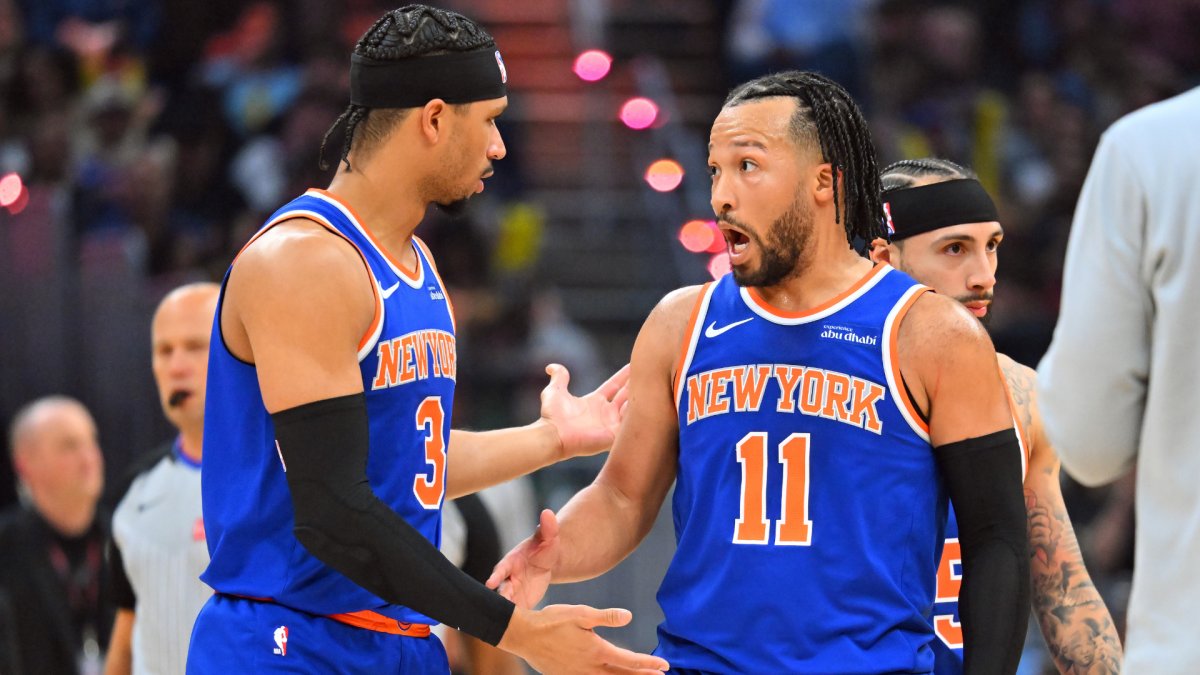
The NBA Finals only includes two teams, but their 28 eliminated counterparts still have to pay attention. The Finals don’t just determine who will win a given season’s championship, but showcase the strategies everyone else can theoretically attempt to replicate in pursuing future titles. There are usually lessons to be learned from the two NBA Finalists, things that other teams may not be able to emulate perfectly, but strategies that may be applicable in other ways.
On the surface, that just doesn’t seem to be the case this year. The San Antonio Spurs and New York Knicks are about as anomalous as NBA Finalists get.
It took a historic run of good luck to get the Spurs here. They won perhaps the most important lottery in NBA history to land Victor Wembanyama in 2023… and then grabbed the No. 4 and No. 2 picks in the next two drafts afterward. San Antonio’s lottery luck is now literally impossible to replicate. The NBA reformed the lottery in May, and one of the changes was that teams could no longer pick in the top five of three consecutive drafts.
What New York did may not technically be impossible to replicate, but we’re not far off, either. They are set to be just the third team since the merger to enter the Finals without a player that they drafted in their starting lineup. One of them was the 2020 Lakers, and “sign prime LeBron James” is not a realistic roster-building strategy for most teams. The other was the 1999 Knicks, who drafted Patrick Ewing only to lose him to injury during the playoffs.
These probably are not replicable blueprints. It’s hard to imagine another version of the Knicks or Spurs coming up behind them. But that doesn’t mean there aren’t smaller lessons baked into their strategies that other teams can learn from. So let’s look at the how the Knicks and Spurs were built and try to figure out if there’s anything the rest of the league can take from their anomalous builds.
How the Knicks were built
If you’re looking for one guiding principle in how the Knicks were built, it would be relationships. Leon Rose’s first major decision as president of the Knicks was to hire Tom Thibodeau, whom he represented as an agent at CAA for years. Two years later, he hired Rick Brunson, his first ever client as an agent, to Thibodeau’s staff as an assistant. A month after that, he signed Rick’s son and his own godson, Jalen Brunson, to a four-year, $110 million contract.
You could credibly call this the sixth-best free-agent signing in NBA history. Only the three LeBron James team changes, plus Kevin Durant to Golden State and Shaquille O’Neal to Los Angeles, would definitively rank ahead of it at this moment. A championship could push it further up the list. Rose knew Brunson since childhood. He saw something in him that the rest of the league did not. He was rewarded with a franchise player at a bargain price.
After the 2022 offseason, every player the Knicks either traded a first-round pick to acquire or spent at least $50 million to sign had a notable personal relationship to one of those key stakeholders:
The obvious parallel here would be the 2020 Lakers. Los Angeles aligned itself with Rich Paul and Klutch Sports, albeit unofficially, and won a championship with several high-profile Klutch clients on the team. The unofficial nature of that relationship was part of its undoing. Paul and the Lakers worked together productively, but their interests were not fully aligned. He was representing his clients, and in many cases, the Lakers prioritized them at the expense of better players. The decision to re-sign Talen Horton-Tucker over Alex Caruso is the most prominent, but iffy signings like the mid-level deals handed to Montrezl Harrell and Lonnie Walker fit the same bill. The Knicks were similarly able to leverage Rose’s relationships, but with him running the team officially, the team’s best interests were never compromised.
If anything, one of the defining features of this Knicks rise is that they’ve had no sacred cows besides Brunson. Case in point: they fired Thibodeau despite reaching the Eastern Conference Finals a year ago, a decision that now looks brilliant. A common mistake teams make is getting too attached to their best decisions. The Knicks don’t do that. Immanuel Quickley was probably the best draft pick this front office made. The Knicks didn’t hesitate to trade him for Anunoby. This regime’s best free agent signing was DiVincenzo and he was traded after a year alongside Julius Randle, who may have been signed by the previous front office, but grew into an All-NBA player under this one.
The Randle and Quickley moves are instructive on two other fronts. The first is fit. Again, Brunson was the only true untouchable ever among this group. Randle predated him in New York. In 2023, he made the All-Star team over Brunson. It’s easy to look back on this now and suggest it was easy, but Brunson didn’t fully pull away from Randle as the best player on the team until 2024. Both need the ball. There was only room in New York for one of them. The Knicks chose correctly. Quickley thrived as Brunson’s backup, but someone else would view him as a starter and pay him accordingly in restricted free agency. The Knicks knew he was too small to start alongside Brunson, so they cashed him out early for Anunoby.
Plenty of front offices would have paid them first and figured the rest out later. That’s the other lesson from Randle and Quickley: the Knicks are extremely particular about contracts. They almost always extract meaningful concessions from their players. Brunson made one of the most team-friendly contractual decisions in recent NBA history when he left over $100 million on the table by extending in New York a year early, but he was hardly the only value contract this front office has signed.
The Knicks frequently convince players to take contracts that descend in annual salary (Brunson did so on his first contract, and Mitchell Robinson is on such a contract now). They often attach team options to the end of contracts (Josh Hart has one at the end of his current deal, Evan Fournier’s contract had one). They signed Deuce McBride to an enormously cheap long-term extension right after they traded Quickley because they knew his role was about to grow. They convinced Bridges to time his extension, which came in just below his max, in such a way that he would be eligible to be traded in February, just in case Giannis Antetokounmpo became available.
Ironically, this Knicks front office even created problems for itself by signing a contract that was too team-friendly. When they signed Isaiah Hartenstein to a two-year, $16 million deal in 2022, his cap figure was so low that he was basically impossible to retain with Early Bird Rights. Had they given him a longer deal, which teams typically avoid and players typically prefer, they could have kept him with full Bird Rights a year later. They negotiated too hard and got punished because the player they signed was better than they realized.
Once you start to put all of these moves in sequence, you get a sense of what the broader vision here really was. The first priority was the acquisition of a superstar. They saw one in Brunson before the rest of the league did, and were so adamant about his future that they never buckled in trade negotiations for Donovan Mitchell later that offseason. The Bridges trade was an overpay in a vacuum, but he undeniably made more sense next to Brunson as a big, defensive wing than Mitchell did as a duplicative perimeter scorer.
The years that followed the Brunson acquisition were about positioning the Knicks to acquire players, like Bridges, who made sense next to him. Every contract was signed with future trade value in mind. The picks and youth they’d spent years accumulating were cashed out for their wing trio, and once that wing trio was in place, they felt they could defensively support another vulnerable scorer, hence, the Towns acquisition. That bet paid off. The Knicks currently have the best playoff offensive rating in NBA history. As shaky as things looked at times, the Knicks had an information advantage over the rest of the league when it came to most of their notable acquisitions. They trusted the people they built around because they knew them, and the result was a culture that ultimately proved strong enough to overcome last year’s defeat and the early struggles of this postseason to become an absolute juggernaut.

How the Spurs were built
The Spurs were the best organization in the NBA for basically Tim Duncan’s entire career. They are once again one of the best organizations in the entire NBA today. But this run started with the period in between. From the mid-2010s through the early 2020s, the Spurs simply were not an elite organization. You could argue, despite their many intangible strengths, that they were actually a weak franchise. Their long-term strategy was simply antiquated and aimless.
When exactly their relationship with Kawhi Leonard fractured, we can’t say. It might’ve been how his injury was managed in 2018. It might’ve been their decision to force him to wait a year for his rookie max contract despite winning Finals MVP in 2014 so they could sign LaMarcus Aldridge in 2015. But the Spurs had spent almost two decades built around the lowest-maintenance star in NBA history in Duncan. When faced with a more typical star in Leonard, something went wrong. Notably, a similar story played out with Aldridge, who initially asked to be traded in 2017. Something about the old Spurs way just wasn’t working anymore.
They should have known it was over the moment Leonard asked to be traded. That was the time to trade him for picks, deal Aldridge elsewhere and fully rebuild. The Spurs wouldn’t do it. They tried to remain respectable by trading for DeMar DeRozan. They extended their playoff streak one more year before falling below .500 for the next three. They whiffed on a number of picks they’d almost always nailed. Luka Šamanić at No. 19. Josh Primo at No. 12. Jeremy Sochan at No. 9.
By the 2022 trade deadline, they started seeing the writing on the wall. You can’t give the Spurs credit for their lottery luck, but you can certainly give them credit for recognizing the need to tank. They dealt Derrick White, admittedly for well below what we now know he was worth, to Boston. A few months later, they traded Dejounte Murray at the peak of his value, right after his first All-Star selection. They got a haul back from Atlanta in the process. At the 2023 deadline, they dealt Jakob Poeltl for what would become the No. 8 pick in the 2024 NBA Draft.
Again, San Antonio’s lottery luck speaks for itself, but how the Spurs chose to manage their build up to the Wembanyama acquisition and in its aftermath is part of why they’re in such an advantageous position on top of that luck. Trading away all of those veterans gave them a draft pick foundation to rival Oklahoma City’s, which puts them in a position to navigate the consequences of the current collective bargaining agreement more carefully than any other team.
Since landing Wembanyama, the Spurs have essentially only operated from a position of strength. They acquired De’Aaron Fox in part because Fox forced his way to them, allowing them to get him at an asset discount rather than paying full freight for a star trade like so many of their competitors have. They were paid an unprotected first-round swap to take on Harrison Barnes, who became a meaningful player for them, just because they were diligent about maintaining their cap space when the Kings and Bulls needed a facilitator in their DeMar DeRozan sign-and-trade. They saw an opportunity to snap up a top backup center last July because Luke Kornet’s former team, the Celtics, were dealing with second-apron issues.
That’s most of what this was: the Spurs timed their descent down the standings properly. They used that descent to accumulate assets and financial flexibility. They got extraordinarily lucky in several lotteries, including perhaps the most important lottery in NBA history. And from there, they recognized what a strong position they were in and chose only to take opportunistic swings on value propositions. They rushed nothing, and even Wembanyama has applauded them for that. “I know (general manager) Brian (Wright) knows who we are and trusts the process,” Wembanyama said in February. “He should get Executive of the Year also for not making a move.”
When they’ve encountered a problem, they’ve solved it internally. They were widely linked to a number of big-name forwards in the past year, and while Barnes was playing well, the Spurs knew they needed to upgrade his spot to jump to the next level. The easiest way to do that would have been to stack the salaries of Barnes and Keldon Johnson, their Sixth Man of the Year, with draft picks to bring in another big name. But both had meaningful roles on the court and both were essential locker room figures off of it. Instead, the Spurs elevated little-known reserve Julian Champagnie into the Barnes slot in the starting lineup, and they soared.
Their coaching hire played out similarly. Gregg Popovich is among the greatest coaches in NBA history. The culture he built in San Antonio is sacred, and Wembanyama’s presence virtually guaranteed long-term contention. That made their head-coaching job theoretically among the most desirable open positions in NBA history. Except, it was never really open. They could have hired almost anyone. They promoted Mitch Johnson without interviewing other candidates based on his work as the interim coach last season. He went just 32-45, but they saw enough to pick him over basically any other remotely available coach in basketball. That decision looks brilliant now.
All of this poses a really fascinating contrast with the Knicks. New York was so intentional about every acquisition. The Knicks had such a direct plan, and they hit every bullet point. That’s not really what happened with the Spurs. You can point to theoretical flaws in this roster — shooting, size at forward, stylistic optionality at backup center — and they haven’t taken transactional steps to address them yet. They haven’t needed to. That lottery luck allowed them to be patient, to strike only when the iron is hot, and play for continuity, culture and sustainability. The Knicks are the culmination of a half-decade build. The Spurs have barely started building and should only get better from here.
The modern need for contract value
Part of what made the Spurs and Thunder so dominant all season was how many of their best players were still on cheap rookie deals. The CBA is so unforgiving now that we might be entering an era in which younger, cheaper teams are more competitively viable than they’ve ever been simply because those are the only teams that can actually build and retain depth. The Knicks aren’t young and have no players on rookie deals, but Brunson’s pay cut helped them stay below the second apron this year, which will have major long-term roster-building implications for the long haul.
The rookie scale is what it is. You either have young players or you don’t. But it’s worth wondering if Brunson’s example trickles down to other superstars. NBA salaries are growing so rapidly that it won’t be long until there’s a player making $1 million per game. These numbers are cartoonish. Every player will tell you their main goal is to win. Very few put their money where their mouth is like Brunson did. He’s reaping the rewards of that choice now. Leaving $100 million on the table even a few years ago would have been unthinkable. It’s a bit easier to swallow when the contract you wind up signing is still worth over $150 million overall. Players achieve generational wealth so quickly now that maybe some of them will be more open to taking less than the max.
Brunson’s circumstances were unique. He was negotiating with his godfather. He had a layer of trust most players don’t have with their teams. He can reasonably expect to be rewarded for that cooperation down the line. Other players might not feel that way. But it’s something to keep in mind moving forward. The difference between, say, $250 million and $300 million is much bigger than the gap between nothing and $50 million. Financial sacrifice, either structural through the rookie scale or intentional on the part of players, is a bigger competitive advantage than it has ever been.
Three roster-building lessons
Again, nobody is replicating San Antonio’s luck, and with free agency all but dead, it’s hard to imagine anyone finding another Brunson there either. The Knicks and Spurs are roster-building unicorns, but there are a few lessons other teams can take from their ascents:
1. The importance of culture
New York’s culture was far from impeccable. There was quite a bit of reporting last year about internal frustrations. There were questionable quotes given to the media. But the Knicks were always intentional about adding players they knew. Whether it was through CAA or Brunson’s college connections, they largely kept things in the family. The bent, but never broke, and once they made it through the coaching change and all of the tumult that came with it, they emerged a far stronger team for having gone through it all.
San Antonio’s has persisted for almost 30 years. It’s always going to be a priority for the Spurs, even arguably at the expense of the on-court product. Do they really need three backup centers they barely use in Kelly Olynyk, Mason Plumlee and Bismack Biyombo? No, but they’re all beloved locker room figures. They didn’t rock the boat by trading Barnes or Johnson for an upgrade. The Knicks and Spurs targeted people as much as they targeted players.
2. Don’t get attached
You might be able to form a second playoff roster out of important Knicks from the last half-decade who are no longer on the team. Quickley, Randle, Barrett, Hartenstein, Quentin Grimes, Thibodeau as the coach. But the Knicks never took their eye off the prize and were never afraid of moving small organizational wins in favor of the bigger organizational goals.
The Spurs remained attached to their players too long after the Leonard era. They were rewarded for finally accepting the need to blow it up. The Spurs have admittedly been attached to the players in their building ever since, but where they deserve credit is the decision to ultimately start Champagnie. The Spurs went 37-15 in games Barnes started this season. The starting lineup with Barnes in Champagnie’s place was statistically excellent. There was no obvious impetus for making the change other than an internal recognition that it made the team better. They were willing to make a change that ultimately proved beneficial.
You could ironically point to the Knicks as an example of what happens when you don’t. New York’s starting lineup simply didn’t play well as a unit last season. Thibodeau didn’t do nearly enough experimenting with other lineups. Josh Hart offered to come off of the bench against Boston in the playoffs. Thibodeau waited until the Knicks were down 2-0 to the Pacers to make that change. By then it was too late, and he was out of a job.
3. Finding value in weaknesses
The Spurs don’t have a power forward-sized player on the roster. They start four players who are 6-foot-7 or shorter… and one player who’s 7-foot-4. Most teams can’t get away with playing such a small group. The Spurs can because they have Wembanyama. They were able to load up on shooting and ball-handling in their starting lineup because they had the one player in the NBA capable of protecting that unit.
Towns and Brunson are viable together in New York because the Knicks stacked so many strong defensive wings in between them. Towns, as an elite shooting center, makes Hart, an inconsistent shooting wing, viable in the starting lineup, allowing the Knicks to benefit from his rebounding, transition play, defense and passing. There’s a real symbiosis to both teams. They have players in roles that wouldn’t work for most rosters, but those players are maximized because they specifically have the players to cover up those vulnerabilities.