dailynewsnblog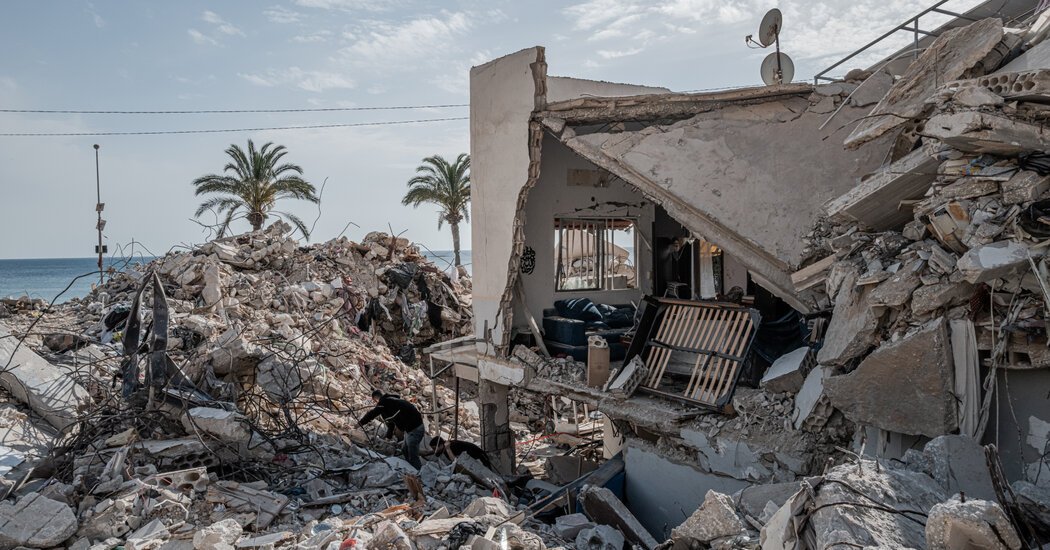
When Israel’s prime minister and defense minister warned on Monday that the air force would soon bomb the suburbs of Beirut, it wasn’t just a threat to intensify Israel’s simmering three-month-old war with Hezbollah, the Iranian-backed militia that dominates Lebanon.
It was an admission that Israel’s strategy in that fight was falling short.
And when Israel backed down from that threat a few hours later, the decision pointed up just how much it had been backed into a corner — stuck between domestic pressure to hit Hezbollah hard, and American pressure to constrain its attacks in Lebanon.
The Israeli strategy was to seize territory in Lebanon as a protective buffer and push Hezbollah back beyond the range of the antitank missiles with which it had long plagued tens of thousands of civilians living in northern Israel.
But Israel did not seem to be ready for Hezbollah’s widespread use of explosive “first-person-view” drones, which are controlled with fiber-optic cables that unspool for miles and are unsusceptible to electronic jamming.
The drones haven’t killed Israeli troops at anywhere near the rate that Israel has killed Hezbollah militants and Lebanese civilians during its offensive. But they have been steadily hunting down Israeli soldiers and commanders, both in Lebanon and in Israel, with the often-lethal strikes documented in chilling videos that Hezbollah has been posting on social media. Two soldiers were killed and 10 wounded in such attacks on Monday alone, the military said.
And so a matchup that had Israeli leaders sounding almost giddy back in March — sending their mighty tanks and infantry in to crush a weakened, vulnerable and somewhat rudderless Hezbollah — has devolved into something else. It is now a kind of deadlock in which Hezbollah suddenly looks more capable than it did when the war began and the soldiers of the Israel Defense Forces can look startlingly helpless.
“There was a strategy — was,” said Orna Mizrahi, a former Israeli national-security official who heads the Lebanon program at the Institute for National Security Studies in Tel Aviv. “But the drones made for some confusion, because it was a surprise. The I.D.F. didn’t think that it would be such a dangerous weapon. In Israel, they looked at it as a toy.”
Drones are only one of the challenges confronting Israel in Lebanon. Another, which is perhaps equally vexing, is the difficulty of meeting mounting domestic political demands to act aggressively enough to remove the threat that Hezbollah poses to Israeli civilians, without running afoul of President Trump.
For Prime Minister Benjamin Netanyahu, who is up for re-election in a few months, campaigning on his national-security record could be fraught when thousands of residents of northern Israel — including many of his traditional supporters — are either still running to shelters or have yet to return to their homes from wherever they evacuated to, said Michael Koplow, an analyst at the Israel Policy Forum, a liberal advocacy group.
“It’s not really a strategy,” he said of the military’s current posture in Lebanon. “It’s a political imperative in search of a strategy.”
Indeed, Israel began this round of warfare against Hezbollah with bold, absolutist promises of changing the situation in Lebanon “once and for all,” in Mr. Netanyahu’s words. But it quickly put aside such grand ambitions, given that doing so could require conquering all of Lebanon.
It throttled back even more in April, after Mr. Trump moved to end the war with Iran and, to aid those talks, pressured Israel to constrain its offensive actions against Iran’s proxy in Lebanon — including by effectively banning the bombing of Beirut.
Since then, after establishing a large buffer zone and displacing hundreds of thousands of civilians, the Israeli military has largely had to content itself with rooting out what it says is extensive Hezbollah military infrastructure.
Simply holding a buffer zone in Lebanon has numerous drawbacks, analysts said.
Assaf Orion, a retired Israeli brigadier general who is now a fellow at the Washington Institute for Near East Policy, said Israel appeared to be forgetting the hard lessons it learned after it invaded Lebanon in 1982 (an invasion that inspired the creation of Hezbollah).
At the time, Israel declared a roughly 25-mile “security zone” north of the border — about the range of the Katyusha rockets that Palestinian militants in Lebanon had been firing at Israel. It did not attempt to depopulate that zone, as Israel is doing now, instead allying with Lebanese Christians to take control of the south and lay siege to Beirut.
Israel had promised to pull out of Lebanon within 48 hours. It stayed for 18 years.
“Choosing to stay there in a stationary manner defies most of our lessons from ’82 to 2000,” Mr. Orion said in an interview. “Politically, because it provides Hezbollah with a pretext, which it needs, and reinvigorates the notion of resistance. But also operationally. Once you get stationary, it’s pretty clear that those forces will become targets.”
It is no wonder, then, that Israeli military and government officials have been agitating to resume an air campaign targeting Hezbollah strongholds in Beirut and across Lebanon. That desire for freedom of action against Hezbollah helps explain why Israel has wanted to separate Lebanon from the U.S.-Iranian peace talks.
“You hear Israelis saying that we have to fight with one hand behind our back, like we did against Hamas because of the hostages,” said Shira Efron, an Israel analyst for RAND. “That we can’t go at the heart of Beirut because the Americans are limiting us, but if we could, then Hezbollah would be under more pressure.”
Sarit Zehavi, president of the Alma Research and Education Center, which focuses on Israel’s northern border, said the constraints on Israel imposed by the United States were only helping Hezbollah in the long run. Removing them, she argued, would not only help Israel but also aid the Lebanese government, which has made clear it wants to disarm Hezbollah but has not shown itself capable of doing so.
“If you only operate up to the yellow line, and you don’t strike the beating heart of Hezbollah in Beirut, the smuggling routes and weapons-manufacturing facilities in the Bekaa, the commanders and leaders, the result is that you’re in a cat-and-mouse situation,” she said. “You don’t end this. And all of us want to end this.”
A contrary view was voiced by Ms. Efron, who said that a U.S.-Iranian agreement that included a real, two-way cease-fire in Lebanon could prove preferable to a situation in which, she said, Israeli soldiers are “sitting ducks” when they are not “destroying villages,” and the danger of “a prolonged occupation of southern Lebanon” seems to be looming larger every day.
“If a deal ties the hands of Hezbollah, and rolls back Israel’s presence in the buffer zone — not to zero, but maybe close to the five hilltops it had before the war — I think it would do Israel a favor,” she said. “And I have no doubt that people in the military are hoping for it, even though they’d never admit it.”


![Only 38% Full: Southwest Airlines’ 10 Emptiest Routes Revealed [Full List]](https://dailynewsnblog.com/wp-content/uploads/2026/06/southwest-airlines-737-mock-up-1.jpg)