dailynewsnblog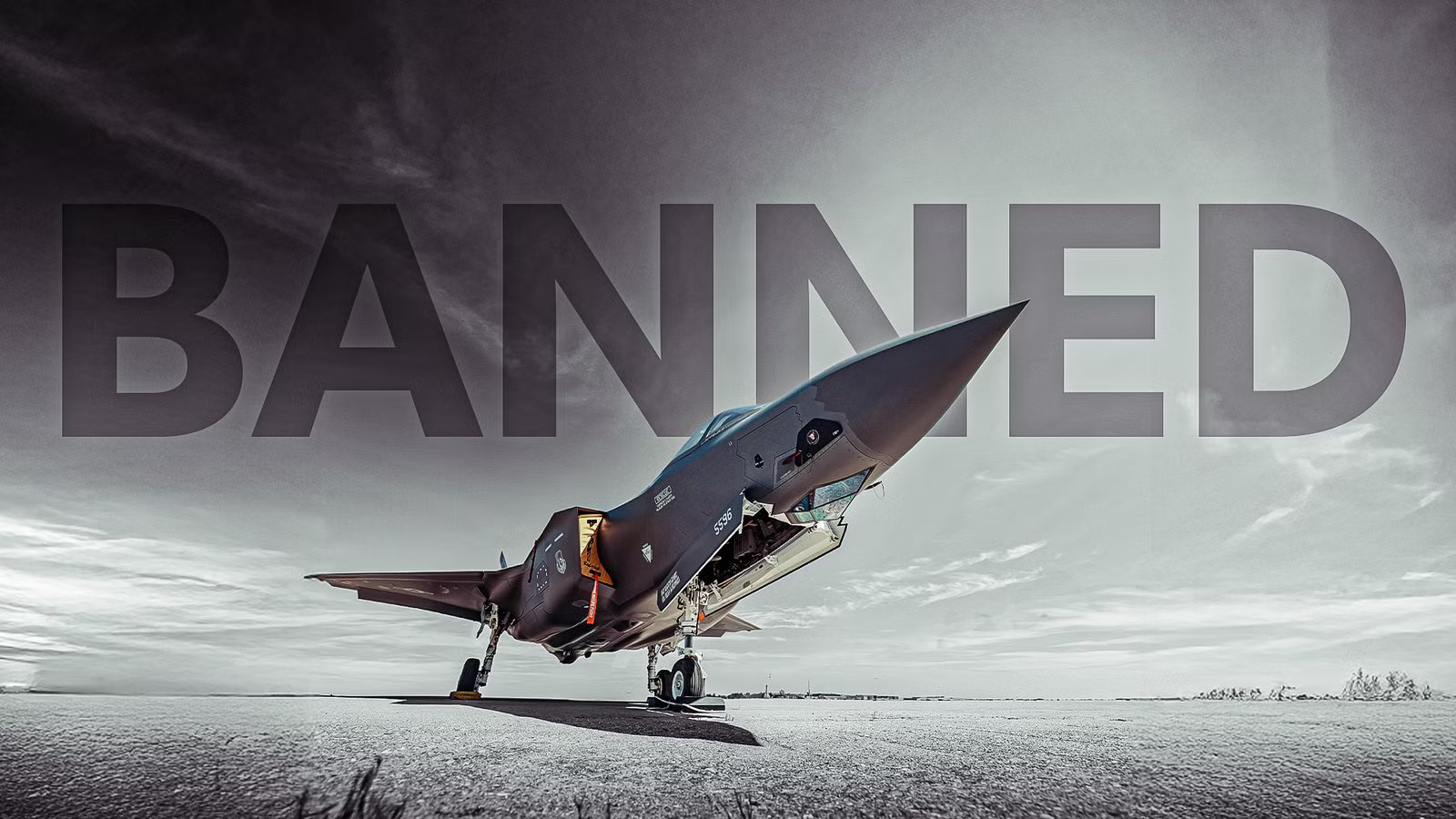
For many casual observers, it may seem like the United States always wants to sell its advanced F-35 fighter jets to as many countries as possible to generate the biggest profit. However, this is simply untrue. Fighter jet sales are incredibly complicated and bound up in geopolitics and domestic politics. The US frequently restricts the export of its most advanced fighters, partially or even entirely, to international customers.
Almost every US-allied country with the requirement and the funding available for high-end fighters has ordered it. Despite claims online about the F-35’s high costs and supposed low-dog-fighting capabilities, almost every country that has been given access to see its classified capabilities has then ordered it. The main exceptions are France and Sweden, which focus on their own domestic fighter jet programs.
Why The US Restricts F-35 Fighter Jet Sales

Unlike the F-22 Raptor, the F-35 Lightning II was developed as part of a broad coalition of participating countries. The F-35 was developed to be the 5th generation fighter of the United States Air Force, Marine Corps, Navy, and its leading allies. Notably, the UK’s defense contractor, BAE Systems, is one of the three leading contractors in the program, and the UK contributes about 15% to every F-35 produced. However, the US is still selective about who it sells the jet to.
The two leading reasons why the US restricts F-35 exports are to safeguard its sensitive technology and to safeguard Israel’s qualitative military edge. The US has barred the sale of F-35s to countries like Thailand, the UAE, Turkey, and Taiwan, partly out of concern that Russian and Chinese-made systems like Russia’s S-400 SAMs and China’s Huawei 5G networks could compromise the jet. Additionally, the US fears the perceived presence of Chinese spies and sympathizers in countries like Taiwan and Thailand.
In addition to Huawei 5G networks in countries like the UAE, sales are restricted to Middle Eastern countries due to the US-Israel Strategic Partnership Act of 2014. That act stipulates that the United States should preserve the qualitative edge of the Israeli military and consider military exports to Middle Eastern countries in that light.
Turkey Was Kicked Out Of The Program

The most high-profile example of the US refusing to sell the F-35 was to its US NATO ally, Turkey. The country was one of the partners in developing the F-35 and contributed financially to the program. Turkey also produced a limited number of lucrative components for the fighter. It previously had a program of record to purchase 100 F-35As, which would have made it one of the biggest export customers.
Turkey paid $1.4 billion for the first F-35s. The first examples were built, and Turkish pilots flew to the United States for training. However, after repeated warnings by the United States, Turkey chose to purchase Russia’s S-400 surface-to-air missile systems. The US fears these have the ability to gather compromising intel on the stealth fighter and relay that information to Russia. In response, in 2019, the US kicked Turkey out of the program before the first examples were handed over.
Since then, Turkey has negotiated to return to the program and sought to find a compromise with the US over its S-400s. As of July 2025, no solution has been reached, although Turkey still wants to purchase 40 F-35As. Turkey is currently purchasing the latest variant of the F-16 Block 70 Fighting Falcon, negotiating to purchase 40 Eurofighter Typhoons, and developing its own stealth fighter called the TAI Kaan.

How Many F-35s Are In Service With The US Air Force?
The US Air Force has over 400 and perhaps closer to 500 F-35s in inventory, while Lockheed has delivered over 1,000 F-35s in total.
Middle Eastern Countries Barred From The F-35

The UAE, Qatar, Saudi Arabia, and Egypt have all expressed wishes to purchase the F-35. During the first Trump Administration, provisional agreements were made to sell 50 F-35As to the UAE and 20 F-35As to Egypt. These deals soon fell through due to concerns about China’s Huawei 5G networks in the country and concerns that they would water down Israel’s qualitative military edge. Egypt and the UAE have since flirted with purchasing Chinese fighter jets. Egypt may have ordered Chinese J-10Cs.
Saudi Arabia’s and Qatar’s requests have also been rebuffed. In March 2025, Saudi Arabia announced it would make around $142 billion of US military purchases, but this apparently did not include the F-35. Separately, reports suggest that Morocco may be close to announcing a deal to purchase the F-35. Morocco is far removed from Israel and has enjoyed good relations with the United States since it became the first country to recognize US independence in 1777.
|
Countries prevented from purchasing the F-35 fighter |
|||
|---|---|---|---|
|
Countries |
Reported reasons |
Countries |
Reported reasons |
|
United Arab Emirates |
Huawei 5G, other Chinese tech, maintaining military balance |
Qatar |
Possibly maintaining military balance |
|
Turkey |
Purchased Russian S-400 |
Egypt |
Possibly maintaining military balance |
|
Saudi Arabia |
Possibly maintain military balance |
Thailand |
Perception of close relations with China |
|
Taiwan |
Fear of Chinese spies, fear of provoking China |
Indonesia |
Cost, wait times, security concerns |
It should be noted that the Chinese Huawei 5G networks are a real concern for the US and not just an excuse. In 2020, the US even started threatening the program’s closest international partner, the UK. The UK hosts some of the most important foreign US Air Force bases, including F-35 squadrons. The US said it would not deploy more F-35s to the UK if it didn’t ban Huawei (and other Chinese companies). The UK banned Huawei’s 5G networks, and the last of the technology must be removed from the UK’s networks by 2027.
Asian Countries Barred From Purchasing The F-35

In the Asia-Pacific, the US has sold the F-35 to its closest and most trusted allies, Japan, Australia, and South Korea. Thailand is a major non-NATO ally of the United States, but the US has rebuffed requests to purchase the jet. While the United States has long held close relations with Thailand, Reuters reported that part of the reason was “concerns about overtures by army-backed [Thai] governments towards rival power China.”
In 2024, Business Insider reported that Taiwan wants to buy the F-35 from the United States. Taiwan has wanted to purchase the aircraft for decades. The US has previously denied Taiwan’s requests out of a fear of antagonizing China and a fear of Chinese spies on the island. The US is instead supplying upgraded F-16 Fighting Falcons. Taiwan News reported that in 2025, there could be over 5,000 Chinese spies in Taiwan.
|
Lockheed Martin F-35 Lightning II |
|
|---|---|
|
Primary contractors |
Lockheed Martin, Northrop Grumman, BAE Systems |
|
Number delivered |
1,300+ by March 2026 |
|
Variants |
F-35A (conventional), F-35B (STOVL), F-35C (carrier-based) |
|
Primary operators |
US Air Force, US Navy, US Marines |
|
Largest export customers |
Japan, United Kingdom, Italy, Australia (program of record for 100+ aircraft) |
Under pressure from the United States, Indonesia canceled its plans to purchase Russian Su-35 fighter jets. It then sought to purchase the F-35. In 2020, Defense World reported the US rebuffed this request, citing long waiting lists and expense. It seems likely the US may be more concerned about Indonesia’s relationship with China. The country has the Huawei 5G network and Russian fighter jets in service.

Why The F-35 Has Such A Vertical Takeoff & Landing
The F-35B is the most advanced STOVL fighter jet and is ‘the’ 5th-gen fighter of warships smaller than US Navy supercarriers.
It Is Common To Ban Exports

It is common for the United States to ban exports of fighter jets. The export of the F-22 Raptor has been entirely banned by Congress since 1998. There was a time when the US had the policy not to export the then-new F-16 Fighting Falcon to Latin American countries, although it went on to export it to Venezuela and Chile.
For a time, the F-15 Eagle was the top US air superiority fighter, and the US was always more wary of selling it compared with the smaller, less capable F-16. During the Carter Administration, the US banned the F-15’s export to any country outside of NATO and a short list of select allies, which included Japan, Australia, and Israel.
The US has come to regret the sale of fighter jets to some countries. Notable examples were the sale of F-14 Tomcats to Iran and the sale of F-16s to Venezuela. The US sold the F-16s to Venezuela in the 1980s, but later relations deteriorated between the two. In 2005, Venezuela even threatened to sell its F-16s to China, although they were old tech by then.
A Closely Guarded Fighter Jet

While the US is prepared to sell the F-35 to dozens of allies, it does so with stringent conditions. Export partners are forbidden to modify the F-35 or interfere with its software. The only exception is Israel, where the US permits limited modifications to carry Israeli missiles. However, the US can also dictate who can fly it: for example, Israeli pilots with dual passports are barred from flying it.
The F-35 is one of the United States’ primary tools in projecting power and countering adversaries like China and Russia. The US bars any countries it thinks have relations too close to China and Russia. It also bars countries that operate Chinese and Russian equipment that could gather intel on it.
Saudi Arabia, Qatar, the UAE, Turkey, Egypt, Taiwan, Indonesia, and Thailand are countries known to have been rebuffed in their endeavors to purchase the F-35. The Trump Administration seems to be more open to selling the F-35 to more countries and has even suggested it could eventually be sold to India, which operates Russian S-400s and other high-tech gear. It is possible that export restrictions could be relaxed under the current Administration, allowing them to be sold to more erstwhile customers.

![American Airlines Suspends Flights On 6 Key Routes [List & Map]](https://dailynewsnblog.com/wp-content/uploads/2026/06/american-airlines-a321.jpg)