dailynewsnblog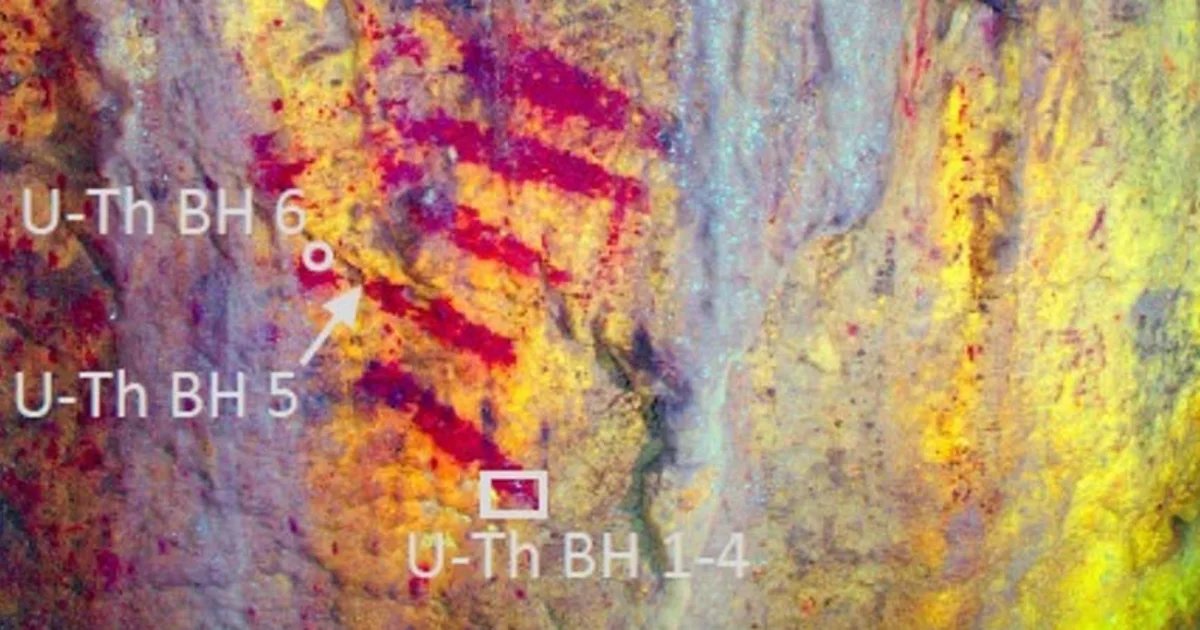
LONDON — Dismissed as a natural phenomenon for more than a century, red stripes on a rock in Wales have been found to be the oldest known prehistoric art in Britain and northwestern Europe — created by human fingers 17,100 years ago, according to new research.
Subscribe to read this story ad-free
Get unlimited access to ad-free articles and exclusive content.

An international team of scientists revisited Bacon Hole, a cave near Mumbles in South Wales, to re-examine the series of red-pigmented horizontal stripes on a panel first discovered there in 1912.
The markings were initially identified as prehistoric art in 1912 by Professor William Sollas and Henri Breuil but were later dismissed as a natural phenomenon caused by mineral deposits seeping through the rock, the study said.
“Overlooked and unrecognized, the panel existed as little more than a historical footnote, forgotten by the archaeological community,” George Harold Nash, an archeologist and specialist in prehistoric art who led the research team, told NBC News via email.

More than a century later, the original interpretation has been proven correct.
In a study published Monday in the journal Quaternary, Nash and other multidisciplinary scientists from the First-Art team concluded that “it is evident that the pigmented lines were intentionally created by human agency, rather than resulting from natural processes.”
This makes the once-overlooked red stripes the oldest known example of cave art in Britain and northwestern Europe, according to the study.
“I was both ecstatic and overjoyed,” Nash wrote of the moment his team made the discovery, calling it “exhilarating and deeply moving.”
“To stand before a painted panel that had been discovered over a hundred and ten years earlier, then dismissed, lost from scholarly attention, and suddenly rediscovered on site, was an extraordinary experience,” he wrote.
Using modern dating techniques, a joint team of scientists and academics from China, Germany, Italy, Portugal, Spain, and Wales analyzed pigment samples in a laboratory and compared the findings with observations made at the cave.
The horizontal lines of red pigment are evenly spaced and arranged in a way that suggests “a deliberate and structured pattern,” the study said.

Evidence also showed that the pigment had been applied by a finger, concurring with the original findings of Breuil and Sollas.
To understand the meaning of the painting, Nash said, it’s important to remember that “across Europe, cave art is frequently associated with ritual practices, symbolic behavior and the expression of belief systems.”
According to the paper, the full significance of the markings went unrecognized for decades, partly because graffiti left by a local fisherman in 1894 on another wall of the chamber complicated efforts to interpret the site.
Around 17,100 years ago, when the markings were first created, the local landscape was still emerging from a near-uninhabitable glacial period. During that time, Bacon Hole and other caves along the south Welsh coast, “would have offered suitable habitation sites for hunter-fisher-gatherer groups,” the study’s authors wrote.
“But these caves were not merely shelters — they were places imbued with cultural significance,” Nash said, adding that while we can never know with certainty what motivated Ice Age artists, “the placement of the art deep within cave environments suggests that these locations held meanings beyond everyday domestic activities.”
Today, Bacon Hole — a cave carved into limestone cliffs overlooking the Bristol Channel — is under the custodianship of National Trust Wales, which, together with the Bradshaw Foundation, has funded scientific research at the site.
National Trust Wales told NBC News via email that it is planning to formally announce the findings on Tuesday, and has not yet designated Bacon Hole officially as a site of significance.
Calling for the highest levels of legal protection for the site, Nash said that “prehistoric art is an exceptionally rare and fragile component of our archaeological heritage.”
“Once damaged or destroyed, it can never be replaced,” he said.