dailynewsnblog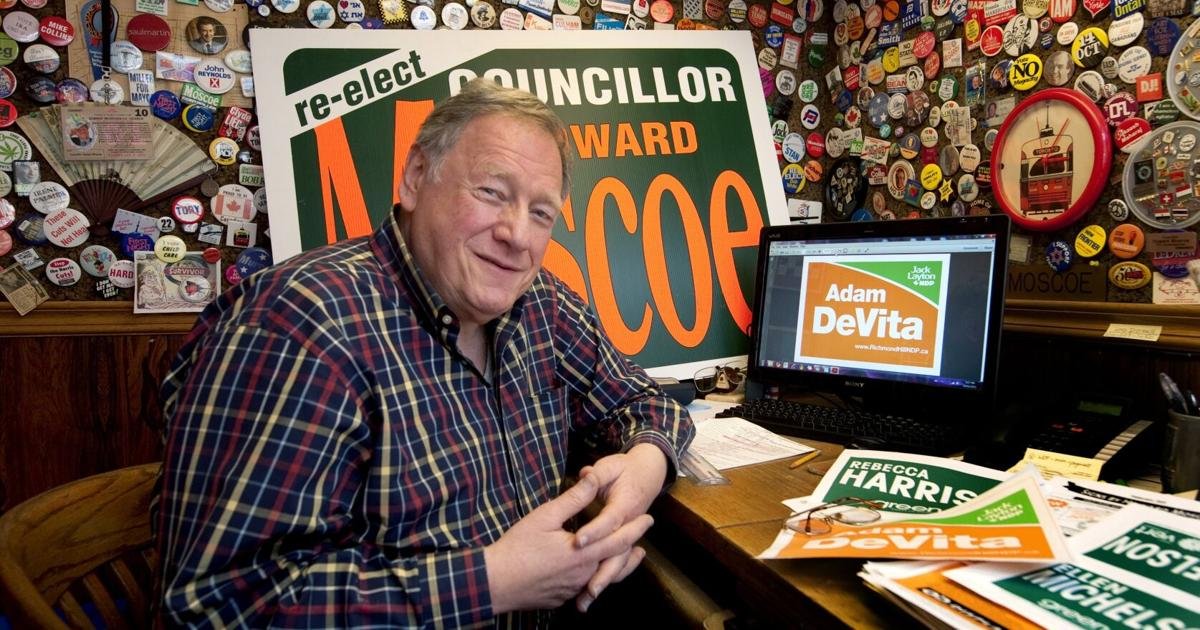
Mouthy, bombastic, never temperate, full of it, colourful, controversial and always entertaining.
Those words were plucked from just one column about Howard Moscoe — who died last week at age 86 after serving as a city politician for 32 years — written by Royson James, the Star’s former city hall columnist.
He also excelled at needling and baiting his victims, was always available to provide searing comments about political opponents, was a natural showman at a council meeting, and, by his own estimate, the sharpest knife in just about any room.
He wrote a book that was an ode to his cleverness. Modesty was never his policy. And nobody ever accused him of excessive seriousness.
Those are among my observations of Moscoe, whom I covered for eight years at the Star’s city hall bureau. He was a quote machine, a gift who kept on giving. And a helluva guy.
The Star’s Omar Mosleh wrote a beautiful obituary of Moscoe, but there was a lot that didn’t get into his story. I can fill in some of the blanks.

Moscoe served in office more than 30 years before retiring in 2010. He held roles including alderman, Metro councillor, city councillor and TTC chair.
Moscoe served in office more than 30 years before retiring in 2010. He held roles including alderman, Metro councillor, city councillor and TTC chair.
He had a habit of darkening the city hall press gallery about 5:30 in the afternoon and announcing he was available to provide quotes on any and every subject, while we were pounding out stories under the lash of impatient editors.
The Star bureau was his main destination. One day around Christmas, when I was first getting to know him, he came in while I was trying to finish a story. Someone had gifted me a box of handcrafted chocolates, so I offered him one to distract him from distracting me.
As he gobbled it, I said, “Have all you want, I’m trying to get rid of them.” He was on his fourth or fifth, with the box in his lap, when chocolate bubbled out of his lips as he giggled, saying it was a good thing his wife, Gloria, wasn’t there.
Why is that, I asked uneasily.
“Because I’m diabetic,” he said. “She’d kill me if she knew.”
“Kill you? She’ll come for me if you go into diabetic shock,” I said, snatching the box away.
He began politics in North York, before amalgamation, where he served on the same council as Mel Lastman, who was mayor. He’d mercilessly taunt Lastman, while the mayor opined that Moscoe was a dope and a “horse’s ass.”
Lastman suffered terribly from the humiliation of thinning hair, so much so that he took to wearing a wig until hair transplants came along. Being a sport, he put the wig up for auction, with the proceeds going to charity.
Moscoe made sure his bid was the winner. He claimed the prize and used it to dust off desks in the council chamber, before laying it to rest in a shoebox until the next round of mopping.
When all five of the city’s boroughs amalgamated in 1998, Lastman was its first mayor, and Moscoe was a councillor. By then, they had learned to get along, if there was utility in it.
Lastman made Moscoe the first amalgamation-era chair of the TTC in 1998, a job he had coveted. But the détente was brief; Moscoe’s management style was seen by critics, including the mayor, as meddlesome and chaotic.
It came to a boil in April 1999, when an attempted coup with Lastman’s approval played out at a special TTC meeting, where four of the seven commissioners — all city councillors — had agreed to oust him.
But Moscoe and then-councillor David Miller, a lawyer by trade and also a TTC commissioner, schemed to allow Moscoe to pass the task of chairing the meeting to Miller, so he could take part in the debate and add an amendment to the motion to dismiss him.
The amendment, if passed by a 4-3 vote, would have made Coun. Blake Kinahan the new chair. Moscoe and Miller knew that another commissioner, Coun. Brian Ashton would never vote for Kinahan.
The conspirators and their patrons were aghast when they realized they’d been snookered by Miller, the brains behind the manoeuvre, particularly Coun. Chris Korwin-Kuczynski, who was the point man for the coup and badly wanted to take a run at Moscoe.
Moscoe had mercilessly skewered K-K for wearing a white naval officer’s uniform with epaulettes, stars, gold braid and a jaunty hat after he was made an honorary captain of the decommissioned HMCS Haida, a waterfront tourist attraction.
When the meeting ended, reporters rushed up to the front, asking K-K to explain why they’d been outwitted. K-K, whose head was buried in his arms, looked bewildered as he lifted his head and said, “I don’t know.”
The media scrum afterward was Moscoe’s finest hour. He described the ploy as a “kindergarten coup” and referred to Kinahan, who earned a Ph.D at Princeton and a law degree at the University of Toronto, as “the smartest dummy I ever met.”
As a member of the Metro licensing commission, Moscoe made it his business to rein in the towing industry. Multiple drivers would descend on an accident and fight among themselves to decide who got the tow, then overcharge and take kickbacks from repair shops for bringing them damaged vehicles.
Angry drivers filled the room for commission meetings, heckling Moscoe and resisting entreaties to settle down. It was not unusual for scuffles to break out with security staff.
One meeting that was jammed with drivers got off to a calamitous start when the smallest man in the room jumped up on a table, tore off his leather jacket and declared he would fight absolutely anyone.
Things went downhill from there. At a key point in the meeting, Moscoe deliberately enraged the drivers by producing a sheaf of invoices that were examples of overcharging and challenged them about it.
A roar rose up from the crowd as several drivers charged the table where Moscoe was seated and tried to flip it over on him. Security guards rushed to intervene, wrestling with the attackers, who were screaming threats and antisemitic imprecations at an unruffled Moscoe.
It was in a photo finish, as they say at the races, for the most entertaining meeting I have ever covered. Moscoe later told me that my account of it was the “second best” story anyone ever wrote about him.
I envy the person who wrote the best one.
Moscoe was never prouder than when city hall released its annual report on how the office budgets of councillors were spent; for many years, he was the biggest spender. If anyone outspent him, Coun. Giorgio Mammoliti, for instance, he was morose.
He’d hold a media availability that was always well attended, where he’d gleefully itemize his spending and offer quotes that were carefully calculated to trigger Toronto Sun political columnist Sue-Ann Levy, who loathed him and could be relied on to write an outraged column about it.
At a scrum in 1997, he celebrated his reclaiming of the top spot after being deposed a year earlier. Some of the dough was spent on business travel, but he said, “These are definitely not junkets because I never have a good time. I even swear out an affidavit not to have a good time.”
Do not be deceived by stories about him playing the clown. He could also be deadly effective.
A city council committee was considering a proposal to read the Lord’s Prayer at the outset of council meetings. The idea was getting traction. Moscoe, who was not a member of the committee, came in and asked to speak.
In an unusually quiet voice, he explained that he attended a school where the Lord’s Prayer was recited at the start of each day. As one of the few Jewish kids at that school, he had to leave the classroom and stand outside the door during the prayer, saying it was embarrassing and stigmatizing.
He implored the committee to leave religion out of council meetings. Even Coun. Rob Ford, who was 180 degrees across from Moscoe on just about everything, voted against the motion, which failed to pass.
It is not for nothing that I say he was a helluva guy. A group of media and political people had, in the mid-90s, started a small-stakes poker game on Friday nights, which he joyfully played in, up until a few months ago.
Whenever a notice about a game went out, he’d reply that he was “a definite maybe.” So when he’d arrive, usually a bit late, a cheer would erupt from the players. Not just because he was good company; he was a dreadful poker player and reliably the biggest donor.
Like a teenager on a date, he loved to hold hands and would not let go, even when it was obvious from the betting that he was up against it. I can never remember him taking a win.
By last winter, it was clear he didn’t have many cards left to play. We stopped trying to grab him. When someone would fold a hand early, they’d stand behind him and give him advice on what to do. He nearly broke even.
Rest easy, old pal. If there’s a game where you are now, I bet they’ll hold a seat for you.
Opinion articles are based on the author’s interpretations and judgments of facts, data and events. More details