dailynewsnblog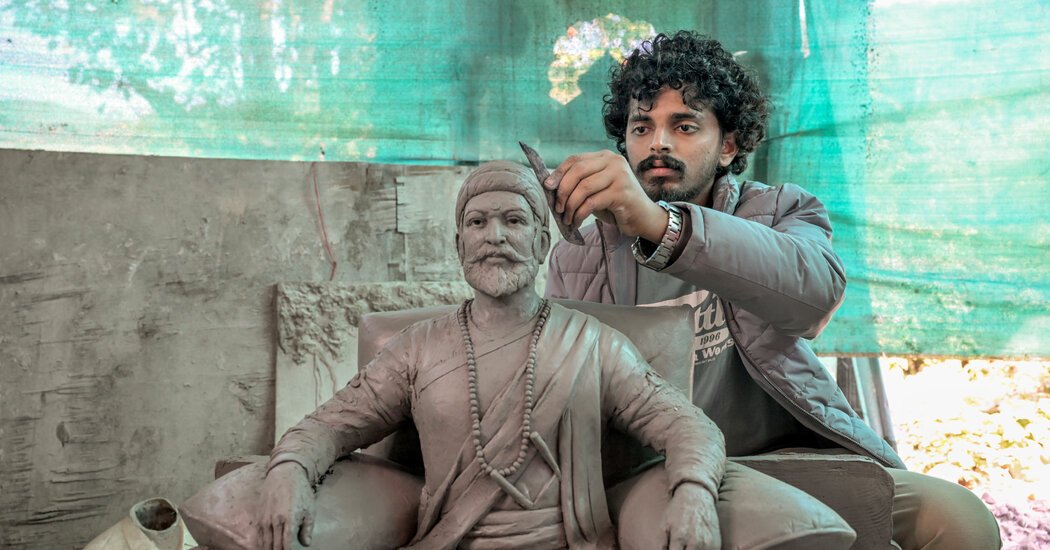
Anant Ganpat Chougule didn’t expect that the Shivaji figurine he fashioned out of clay, partly out of boredom during the Covid lockdown, would launch his career.
But providence was with the 25-year-old sculptor in western India: After he posted a video of the model on YouTube, Mr. Chougule’s intricately molded statuettes, some no more than six inches tall, caught the eye of potential customers just as the Hindu right’s latest push to promote the 17th-century Maratha king took off.
“There’s a lot of demand,” said Mr. Chougule, standing inside the storefront he opened more than a year ago to display his creations, even though most of his sales are online. “Now the feeling in people about Shivaji has grown manifold.”
Efforts to popularize Shivaji by the Rashtriya Swayamsevak Sangh, an organization that seeks to build a Hindu nation, and its affiliates, including Prime Minister Narendra Modi’s Bharatiya Janata Party, have been good for business, Mr. Chougule said.
Like many Shivaji supporters, he hails the king, who founded the Maratha empire and battled the Muslim Mughals, for stopping the “Mughal invasion.” Some on the Hindu right have displayed anti-Muslim sentiment through coded references to the Mughals as “invaders.” Mr. Chogule himself said he made no distinctions between the Muslim community in his hometown and the Mughals. “Right now, the situation is, they are one.”
His father, also a sculptor who mostly sells statues of Ganesh, the Hindu elephant-headed God, was unsure that Mr. Chougule could kick-start a new business. But Mr. Chougule, who got his first order in 2020, was encouraged by the “virality” of the videos he posted on social media, as he picked up thousands of followers. To keep up with demand, he has hired nine employees, including a social media manager.
His YouTube channel now has more than 260,000 followers and he gets as many as 200 orders a month. He often posts videos of himself at work, delicately shaping Shivaji’s beard, etching the pleats on his turban, attaching tiny clay globes to make strings of pearls, carving patterns on his throne.
The figurines, which can cost up to $10, can take days to produce. He first designs them in gray clay, then usually prints them on a 3-D printer using fiberglass — which is lightweight and durable — before burnishing them and painting the details by hand. Most of his customers buy the statuettes as home décor, Mr. Chougule said.
Although Shivaji is usually portrayed on horseback, Mr. Chougule chose to sculpt a version of the king seated on his throne at his coronation ceremony in 1674. “He looks royal in this pose,” Mr. Chougule said, gesturing toward the Shivaji figurines in his store with hands covered in tiny ridges of dried clay.
He draws inspiration from images on Google and other sites that display portraits of the king, but said he is delving deeper into historical research as he plans more ambitious designs. Currently, he has five models of Shivaji statuettes and is working on a sixth. Next, he wants to recreate scenes from snippets of Shivaji’s life, making art both from what he has read and what he has imagined.
Mr. Chougule said he has also gotten orders for big statues, from individuals, hotels and government officials who found him on the internet. In November, he was in the midst of building a 10-foot-tall Shivaji statue for a private buyer. He said he wasn’t worried about competition, because it’s a growing market. “Everyone has a lot of orders,” he said.