dailynewsnblog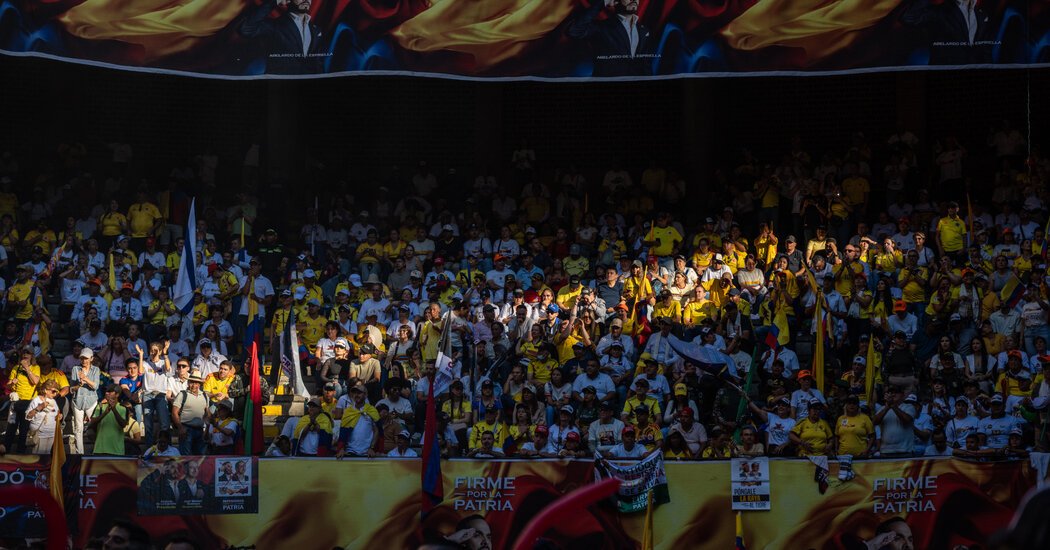
Voters in Colombia head to the polls on Sunday in a presidential election marked by widespread anxiety over public security and uncertainty about which two candidates will emerge to compete in an expected June runoff.
While the race has been framed as a choice between extremes, polling indicates that roughly 20 percent of voters remain undecided, many of them moderates or centrists.
The election also serves as a referendum on the legacy of the departing president, Gustavo Petro, the nation’s first leftist leader.
His term has been defined by the historic representation of Indigenous, Afro-Colombian and L.G.B.T.Q. communities, and also by a criticized peace process, a stalled legislative agenda, digressive public speeches, squabbles with judicial and legislative bodies and a rocky relationship with President Trump.
Who are the top candidates?
On the left is Senator Iván Cepeda, 63, a longtime human rights defender and staunch ally of Mr. Petro’s who helped form their party and is running on a platform of continuity. He holds a comfortable lead in most polls and is widely expected to advance to the June 21 runoff.
But while experts say Mr. Cepeda benefits from the left’s strong base, it is unclear if his reserved personality will move voters as much as Mr. Petro’s galvanizing presence did.
Challenging from the far right is Abelardo De La Espriella, 47, a flamboyant criminal defense lawyer and businessman and a political newcomer. Pitching himself as an outsider come to rescue the nation in the vein of Mr. Trump or El Salvador’s President Nayib Bukele, Mr. De La Espriella ran a fiery campaign focused on hard-line security measures, including a promise to build 10 megaprisons.
A surge of support in the campaign’s final weeks put him neck and neck with Mr. Cepeda, some polls showed. Along with security, he has promised to prioritize God and family, winning over the religious right.
Paloma Valencia, 48, a longtime senator and prominent institutional conservative, would be the country’s first female president. She campaigned with support from Álvaro Uribe, an influential former president.
Ms. Valencia’s candidacy made female voters a target demographic, and policies aimed at helping women and single mothers came up frequently on the campaign trail. Ms. Valencia also tried to win female votes after Mr. De La Espriella made occasional gaffes that critics called sexist.
Until May, she and Mr. De La Espriella were locked in a dead heat for the conservative vote, but Ms. Valencia lost momentum this month, and she now appears to be a distant third in the race. Experts say there is a small chance that she captures enough undecided voters to make it to the runoff.
What’s on the mind of voters?
Security is a top issue in Colombia, where killings, kidnappings and forced displacements have soared in recent years, particularly outside major cities, where armed groups have battled for control.
The assassination in Bogotá last year of Miguel Uribe Turbay — a presidential hopeful from one of Colombia’s most prominent political families — stoked fears of a return to the urban violence of three decades ago.
The campaign itself was marked by threats and attacks. Two of Mr. De La Espriella’s campaign workers were fatally shot, and Mr. Cepeda’s running mate, Aída Quilcué, a senator and a prominent Indigenous leader, was briefly kidnapped.
Mr. Petro’s signature “Total Peace” strategy — which sought negotiated settlements with various criminal armed groups — has faced public backlash, with critics claiming groups took advantage of cease-fires to expand their territorial control.
Under Mr. Petro, the number of areas considered active conflict zones more than doubled across the country to 16 from seven. And last year, the collective membership of armed groups surged by 23 percent, to over 27,000.
Facing pressure from the Trump administration, which has sought to militarize the fight against drug trafficking in Latin America, Mr. Cepeda closed his campaign saying he wanted to end the “violent cycle” of military attacks and retaliation.
He has said he will continue to pursue a version of Mr. Petro’s peace plan, which the other top candidates have said they would abandon. Both Ms. Valencia and Mr. De La Espriella have said they will seek to partner with U.S. military forces
For Mr. Cepeda’s progressive base, the election is viewed as a fight to preserve progress on several fronts: falling poverty rates, land redistribution, reduced deforestation in the Amazon and greater political representation of marginalized communities.
Several electoral observers expressed concern over narratives of fraud pushed by Mr. Petro and Mr. De La Espriella, with each suggesting that the other side might rig the election, even though experts say the Colombian voting process is extremely transparent and resistant to manipulation.
The director of Colombia’s electoral observation mission, Alejandra Barrios, said observers worry about public perceptions of fraud and how people will react to election results.
When are results expected?
Polling stations across Colombia are open from 8 a.m. to 4 p.m. local time on Sunday. Results are expected by Sunday night. A dry law has been in effect this weekend, a measure meant to prevent alcohol-fueled violence.
Annie Correal and Luis Ferré-Sadurní contributed reporting.