dailynewsnblog
Airbus A380 & Trent 900 Designed Together

The Trent 900 is a very powerful engine providing between 75,152 lbf and 84,098 lbf, each depending on the variant. The Trent 900 was developed as a bespoke engine for the A380, with the aircraft and engine being developed in parallel. The aircraft was designed from the start to be fitted with engines in the 70,000 lbf to 80,000 lbf class.
The Rolls-Royce Trent was selected as one of the engine options early in the aircraft program, and so it didn’t suddenly require Airbus to redesign the A380 in any major way after it had been defined. In fact, the Trent 900 was intended to power a larger aircraft than the A380-800. Airbus had planned the A380-800 to be the short member of a family that would include the stretched A380-900 and possibly the extra-stretched A350-1000. However, only the A380-800 was ever built, leaving the aircraft with large wings and powerful engines.
Catch what other flight trackers miss
Emergency squawks, holds, NOTAMs — live signals, no signup.
Open tracker
Catch what other flight trackers miss
Emergency squawks, holds, NOTAMs — live signals, no signup.
Open tracker
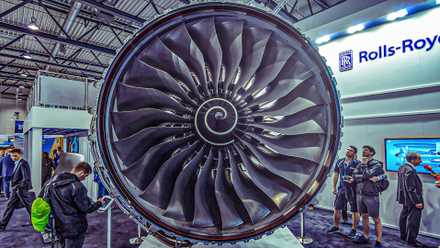
The massive size of these engines required Airbus to design very robust wing structures, pylons, cooling, hydraulic integration, and other features. But these were known from the outset. Noise and efficiency targets helped guide the development of the engines as well as the aircraft, but again, these were known factors. Large fans (around 116 inches or 2.95 meters in diameter) are a key part of the Trent 900’s ability to achieve a high bypass ratio, be comparatively quiet, and be fuel efficient.
A380’s Thrust Reversers

One area where the A380 had to be modified was the addition of thrust reversers. Initially, Airbus thought that wheel braking would be enough for the mighty aircraft, but as the development went on, it chose to add thrust reversers to the two inboard engines. Thrust reversal is an operating mode for jet engines for slowing down an aircraft after landing. It aids with wheel braking and wing spoilers and reduces brake wear.
Thrust reversers are not essential for stopping performance, and the A380 is certified to stop using just its brakes and spoilers on dry runways. Airbus chose to add limited thrust reversing to engines 2 and 3 for a safety margin on slippery/contaminated runways, such as when conditions are icy. They help to reduce the load on the brakes and reduce the risk of aquaplaning. Given that the superjumbo’s powerful carbon brakes and large spoilers provide excellent deceleration, Airbus thought it excessive to add them to all four engines.
Most narrowbody and widebody commercial aircraft have reversers on all the engines. Reversers come with downsides, like adding weight to the engines, as well as benefits like improving safety and reducing brake wear. It can take hours for the brakes of widebody aircraft to cool down after landing, and waiting for the brakes to cool can sometimes be a reason for the pilots to delay the flight.

Comparing The 2 Boeing 787 Dreamliner Engines
The Boeing 787 comes with both GE and Rolls-Royce engine options, although GE’s engines have become more popular in recent times.
The Need For A Bigger Engine

Being such a massive aircraft, the A380 needed engines more powerful than those powering its twin-engined A330 widebody and its quad-engined A340 widebody. Not only is the A380 the only aircraft with a max take-off weight over one million lbs, but it exceeded the milestone by more than the max take-off weight of an Airbus A321 narrowbody airliner (around 205,000 lbs).
With a max take-off weight of 1,268,000 lbs (575,155 kg), the aircraft was designed with a requirement of around 280,000 lbf. The Rolls-Royce Trent 900 was first proposed for the Boeing 747-500/600X program in 1996 and was later offered to Airbus’ A3XX program in 2000. Rolls-Royce says, “Delivering the lowest lifetime fuel burn and excellent environmental attributes, it’s easy to see why the Trent 900 is the engine of choice for the Airbus A380.”
Historically, only three engine manufacturers have been able to produce engines in this class: Pratt & Whitney, Rolls-Royce, and General Electric (GE Aerospace). France’s Safran tends to focus on smaller engines, while China’s ACAE is seeking to join the elite club in the 2030s. Russia is also developing the Aviadvigatel PD-35, although it will be on the less powerful end. Rolls-Royce currently has almost half of the market for widebody engines, with the larger half being owned by GE Aerospace.
Airbus A380 Has 5th Most Powerful Engine

As large and powerful as Trent 900 engines are, they are not the largest or most powerful engines on the market. The engine with the highest certified rating is the GE90 turbofan that powers the twin-engined Boeing 777-300ER and Boeing 777-200LR. It has a 128-inch diameter and a certified rating of 115,300 lbf. The upcoming GE9X, which exclusively powers the Boeing 777X, is even wider at 134 inches but has a lower thrust rating at 110,000 lbf.
The GE9X has broken thrust records, having been test run at 134,300 lbf, but its official certification is a little lower than the GE90. Next is the PW4098 variant of the PW4000-112 series that powers the Boeing 777-300 with a rating of 99,040 lbf. Also coming above the A380 is the twin-engined Airbus A350-1000, whose Rolls-Royce Trent XWB-97 turbofans are certified for 97,000 lbf.
|
Aircraft with most powerful engines by certification (peak sub-variant) per Rolls-Royce, GE Aerospace, etc. |
||
|---|---|---|
|
Boeing 777-300ER/777-200LR |
GE90 |
115,300 lbf |
|
Boeing 777X |
GE9X |
110,000 lbf |
|
Boeing 777-300 |
PW4098 |
99,040 lbf |
|
Airbus A350-1000 |
Trent XWB-97 |
97,000 lbf |
|
Airbus A380 (practically tied with A350-900) |
Trent 980-84 |
84,100 lbf |
The highest powered engine sub-variant found on the A380 is the Trent 980-84 with 84,100 lbf. This is about the same as the XWB-84 engines powering the Airbus A350-900. This means the peak-power A380 engine subvariant makes the A380 ranked fifth in the list of commercial aircraft by the most powerful individual engine. For reference, the Boeing 747-8 Jumbo is powered by four General Electric GEnx engines with 66,500 to 69,800 lbf. The GEnx is the same family that powers the Dreamliner.
Why Did Rolls-Royce Develop The Trent XWB Engine?
Rolls-Royce had the advantage of producing a solution for the XWB earlier, while GE was not very interested and P&W lacked a workable solution.
The Rolls-Royce UltraFan

While GE Aerospace may have the most powerful turbofans on the market, Rolls-Royce has built the largest turbofan demonstrator. UltraFan is a massive 140-inch (3.5 meters) demonstrator that is designed to enable RR to achieve a 25% fuel efficiency leap over the first-generation of Trent engines. It is expected to serve as the basis for a new family of commercial engines in the 2030s.
The new engine core architectures offer an impressive 40% improvement in NOx reduction and a 35% reduction in noise. Importantly, it is designed to be scalable and highly modular, with it planned to support engines in the 25,000 to 110,000 lbf range. Rolls-Royce says, “Rolls-Royce has developed a scalable suite of technologies which are being applied to the development of UltraFan 80 widebody and UltraFan 30 narrowbody demonstrators.”
RR adds, “The demonstrators are validating key enabling technologies and propulsion system design for future widebody and narrowbody ducted engine solutions.” The UltraFan 30 is aiming to achieve a 20% fuel reduction compared with today’s narrowbody engines, while its UltraFan 80 is now in testing and is planned to be the basis of future widebody engines. The UltraFan 80 has been test run in 2023 at 85,000 lbf, with more tests expected to be carried out in 2026.
Rolls-Royce Currently Limited To Widebody Engines

The current widebody engine market is now completely occupied by Rolls-Royce (A330neo, A350, and limited 787) and GE Aerospace (777X, 777F, and most 787s). Pratt & Whitney has found itself sidelined from the commercial widebody engine market, except for the US Air Force Boeing 767-based KC-46 tankers. China’s AECC is working to break into this market with the CJ-2000 large turbofan.
Meanwhile, Rolls-Royce has found itself pushed out of the narrowbody and regional commercial airliner market. This is now filled by Pratt & Whitney (A220, Embraer E-Jets, some A320neos) and the GE Aerospace/Safran CFM International joint venture (Boeing 737 MAX, C919s, and most A320neos). Rolls-Royce also produces engines for some business jets (and the upcoming B-52J), meaning RR has been pushed out of the mid-sized commercial engine market segment.
Rolls-Royce is seeking to return to the narrowbody market with its next-generation family of engines based on the UltraFan 30. This is to be in the 30,000 lbf class and is expected to begin demonstrator ground testing in 2028 and enter service in the late 2030s. It is positioning the engine as an engine for the upcoming A320neo and Boeing 737 family replacements. CFM is working on its own open-fan next-generation solution for the A320neo replacement.

![United Airlines Just Added Its 25th Mexico Destination [Here’s Where It’s Flying]](https://dailynewsnblog.com/wp-content/uploads/2026/05/united-express-e175-mock-up.jpg)