dailynewsnblog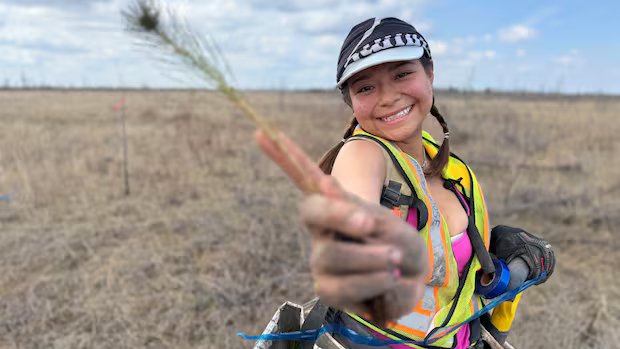
Marley Moose is spending her third summer planting trees in northern Manitoba as part of a crew trying to help Mother Nature regenerate forests destroyed by wildfires.
But that goal has become more challenging with the cancellation of a federal program that aimed to plant two billion trees by 2030.
“Everywhere around me is burnt, but it’s where life used to be, so we’re back here giving life back to these dead areas,” said Moose, 22, efficiently digging a hole and slipping tiny jack pine and black spruce trees into the ground.

A northern Manitoba tree-planting program is trying to replace trees destroyed by wildfires, but the cancellation of the federal two billion trees program is making that more challenging.
In 2016, this forest in Manitoba’s Interlake region, about 300 kilometres northwest of Winnipeg, was devastated by a jack pine budworm infestation. It was starting to regenerate when wildfire ravaged the Devils Lake area in 2021.
Areas just north are already burning this spring.
Moose says she felt sad when she returned to the forest three years ago as part of a tree-planting program through Nekoté LP, an Indigenous-owned corporation representing seven Swampy Cree First Nations in northern and central Manitoba.
“Our nations are trying to take more control and have more say within the land that we occupy and where we come from,” she said. “We want to take care of it, because when we take care of the earth, the earth also takes care of us.”

According to the Canadian Tree Nursery Association (CTNA), the country is losing trees faster than nature can grow them or people can plant them.
Trees are chopped down for development, lumber and paper, and also increasingly consumed by species like the mountain pine beetle. But the CTNA also says nearly a tenth of Canada’s forests were destroyed by wildfires between 2023 and 2025, and that it would take 7.3 billion seedlings to replace just 15 per cent of that.
Mass-planting program cancelled
The CTNA has been working to replace trees through the 2 Billion Trees Program, the federal planting initiative announced by former prime minister Justin Trudeau during the 2019 election campaign. He later earmarked $3.2 billion over 10 years for the program.
But last fall, the government of Prime Minister Mark Carney cancelled it, as part of a federal budget aimed at cutting spending and instead investing in defence and infrastructure.

It means programs like the Nekoté LP tree-planting initiative are in jeopardy.
Existing project funding will only get the 2 Billion Trees program to half its original goal, and it comes at a time of recurring wildfires, said Doug Hevenor, executive director of the CTNA.
“Seed sources were lost and people were starting to realize that some of these mega-fires are preventing natural regeneration. So the program was just starting to … address areas that have been burned out,” he said.
Canada is coming off three consecutive severe fire years. Last season was the second-worst on record, behind only 2023, when wildfires burned through about 150,000 square kilometres of land.
Long-range forecasts suggest much of the country could be hotter than normal in the coming months.
Meanwhile, Canada’s managed forests have in recent years started to release more carbon than they absorb, reinforcing a climate feedback loop. In the most striking example, Canadian wildfires in 2023 released more planet-warming emissions than any country on Earth save for China, India and the United States, a NASA study found.
“What happens when this zombie fire rolls through and kills all the seed trees, kills all these stored stashed seeds, it’s gone,” Hevenor said.
“So we really face a great dilemma in our country right now. There’s a tremendous action happening against our forests and I think we need to react.”
Henevor says seed producers, foresters, tree planters and seedling growers are working together to find solutions in light of the cancellation of the 2 Billion Trees program.

Farron Sharp is looking for new funders. She’s a project manager with Blue-Green Planet Project, a tree-planting company based in Smithers, B.C., that focuses on sustainability.
For the last five years, she has been working with Nekoté LP, which also partners with Canadian Kraft Paper in the Nisokapawino Forestry Management Corporation, to manage 8.7 million hectares of the boreal forest around Devils Lake.
Sharp said the project has some guaranteed funding through the 2 Billion Trees program but needs more to meet its own goal of planting 20 million trees by 2030.
“Every tree that goes into the ground is like a gift back to Mother Earth,” Sharp said, adding that the survival rate of new trees has been up to 99 per cent.

She sees this work as an antidote to the burning of fossil fuels as our main energy sources, rampant consumerism focused on cheap, mass-produced products and unsustainable logging practices in old-growth and sensitive rainforest habitats.
“It’s really important that we have funding that gives back to what is devastated by the decisions that we’ve made and how that’s impacted global warming and caused these types of wildfire events,” Sharp said.
Moose acknowledges that tree-planting is back-breaking work, but as she and her team fanned out on the land, she explained why she does it.
“So that future generations, not my children, but maybe my grandchildren, they’ll be able to run through these forests.”