dailynewsnblog
Competition Is Fierce

Flight attendant openings are quite rare, only appearing once or twice a year per airline. It has always been a job in demand, and there are thousands of surplus applicants who don’t make it through the first selection process, let alone the subsequent steps of recruitment. Hundreds of thousands of applicants apply for a flight attendant role, but only a few of those will actually receive their wings. It is certainly not like applying for any other job. Airlines have very specific requirements and stick to the recruitment process precisely to find the very best crew possible.
The acceptance rate for  American Airlines flight attendants is less than 1%, therefore making it one of the most competitive recruitment processes in any industry. Meanwhile, at
  Delta Air Lines, the acceptance rate dropped to approximately 0.6% during the last recruitment campaign. At the same time, the odds of getting into Harvard are 3.4%. In comparison,
  Emirates accepts around 2% of overall candidates, and
  British Airways around 4%. Large airlines such as these receive hundreds of thousands of applicants every year, and around 90% are filtered out at the very first stage.
From the golden days of air travel, when flight attendants were seen as glamorous and were predominantly female, the role has always attracted thousands of applicants, hoping to live their dream of traveling the world while representing their chosen airline. Indeed, Delta Air Lines’ general manager of inflight services recruitment has described the process as “incredibly competitive, and that’s by design — this is a job people idolize and dream about,” as reported to INC.
Standard Airline Requirements

Airlines usually ask for a minimum age of 21, due to the service of alcohol on board. The candidate must have completed high school and have at least 1 year of experience in customer service or hospitality. Fluency in English is required as it is the international language of aviation and must be spoken on board the aircraft. Personal presentation standards are also important, as wearing a cabin crew uniform represents the company as a whole. No visible tattoos or piercings are usually required, though some airlines have become more lenient about this rule in recent years.
Although height and weight have often been required in the past, airlines now use the ‘reach test’ as standard. Candidates must be able to reach and retrieve emergency equipment from overhead bins, which is crucial to safety. The standard reach requirement is approximately 6 feet 11 inches (212 cm) measured from the floor to the highest point a candidate can touch. During recruitment events or assessment days, there is a formal reach test conducted standing flat-footed or on tiptoe, depending on the airline. If a candidate cannot reach the marker, they are immediately sent home.
Airlines often ask for candidates to be confident swimmers and be able to use a flotation device; this depends on the airline. This is due to the fact that flight attendants have to be able to evacuate an aircraft that has landed on water and practice ditching exercises during training. This means boarding a life raft, swimming with a flotation device, climbing into and disembarking a life raft, as well as swimming with an injured person and performing protective exercises to stay warm in water.
Why The Role Of The Airline Purser Has Changed Dramatically In 20 Years
Diversifying roles and lack of experienced crew may cause future issues.
The Multi-Stage Screening Process

The recruitment process starts with applications being filtered by an applicant tracking system. This checks against the basic requirements such as age, reach, education, and work experience. At this stage, 95% of candidates are filtered out. From there on, the candidate may be invited to an assessment day or open day, where it is not unusual for there to be hundreds of candidates. There will also typically be a medical questionnaire, a background check, and sometimes further assessments like English and Math tests.
There is usually an introductory presentation, and candidates are assessed in small groups. There is then a group task where candidates work through a scenario. This is important because it tests teamwork, communication, and problem-solving skills and is closely observed. These are crucial skills for normal everyday operations, as well as in an emergency situation. After this stage, most candidates are asked to leave and have been unsuccessful.
The last stage of the assessment day is the final interview, which is usually held with three recruiters and one candidate. Very few candidates make it to this stage. Recruiters use deliberate ‘trap’ questions, such as “Tell me about a time you failed,” to test personality. Many candidates are eliminated for giving generic answers, failing to handle hypothetical emergency scenarios, or arriving unprepared for the aviation-specific terminology interviewers expect. Candidates will usually hear within a month whether they are successful.
What Quietly Disqualifies Candidates

Even after receiving the good news that you have a position as a flight attendant, there are still numerous other hurdles to jump over. These include medical tests and background checks. If visible tattoos or piercings are found (depending on the airline) and not completely covered by the uniform, this can disqualify a candidate from the role, as it shows dishonesty and rule-breaking, which are not good qualities for a flight attendant.
During a medical, if a candidate is not fully fit to fly or has an undiagnosed condition, they may be released from the position and will not be able to hold a valid medical license. A failed drug test will result in immediate termination of the job. These are documented by the federal government and can follow a candidate permanently. Random drug and alcohol tests are conducted throughout the entire career.
Background checks may uncover a criminal record. Acts such as terrorism, espionage, or violence will disqualify a candidate under TSA guidelines, as flight attendants need airport identification to access secure areas. Convictions within the past 10 years are also disqualifying, though individual airlines can apply stricter standards than the federal baseline.
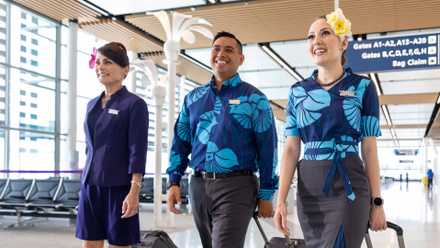
250 Hawaiian Airlines Flight Attendants Told To Drop Leis & Aloha Shirts On New Seattle Routes
Alaska Air Group executives admitted that the move was a “difficult decision.”
Other Qualifications

Even after all these processes and procedures, training has to be passed. This is very intensive and often covers a six to eight-week period. Customer service is only a tiny percentage of this. Most of the training course is about safety and emergency procedures and equipment, aviation first aid, firefighting, ditching, and aircraft-specific procedures. Other modules include security, restraint, manual handling, dangerous goods, self-defense, service style, food safety, survival, and crew resource management.
Exams are completed throughout training with a high pass rate of usually 92 to 98%, and candidates are expected to study constantly. If the candidate fails, they will have one more attempt to pass, or they will be asked to leave. It is estimated that approximately 30% of all candidates will fail the training course or just realize it was not the job they expected. Once training is passed, flight attendants receive their wings. Ab-initio flight attendants must complete a certain number of supervised familiarization flights, during which they are not considered part of the standard crew but are assessed by the senior crew member.
Airlines in the US often open applications that specifically require speakers of particular languages. Having fluency in a listed second language gives candidates a competitive edge over other candidates and will attract an additional language of destination payment. On international routes, airlines are required to have a number of crew members who speak specific languages per flight. This is why airlines like Qatar Airways and Emirates have a huge number of international cabin crew from all over the world.
The Bottom Line

Becoming a flight attendant is a dream of many, and hundreds of thousands of candidates apply every year, but only a handful of people make it through the rigorous selection process. Most do not get through the first filtering, but if they do, a candidate will be offered an assessment day or open day invitation. The assessment day consists of tests, interviews, and tasks that are carefully observed by recruiters seeking the very best potential crew.
There are very specific requirements for flight attendants, and these are non-negotiable. Even if a candidate is successful, after the final interview, they still have to pass medical tests and background checks, as well as pass training. Training is hard work, and some candidates do fail. The training course is mostly about safety and emergency procedures, equipment, and aircraft specifics, as well as aviation first aid and modules based on subjects such as firefighting, ditching, and security, to name just a few.
The journey to becoming a flight attendant is a difficult one and at times very challenging, but rarely does anyone regret it. A contract may be six months or six years, but it is never boring and always rewarding. It takes patience and persistence to gain a flight attendant job, but for most, it’s well worth the effort, for the skills learned, friends made, and places visited. Every day is different, and a new challenge awaits.