dailynewsnblog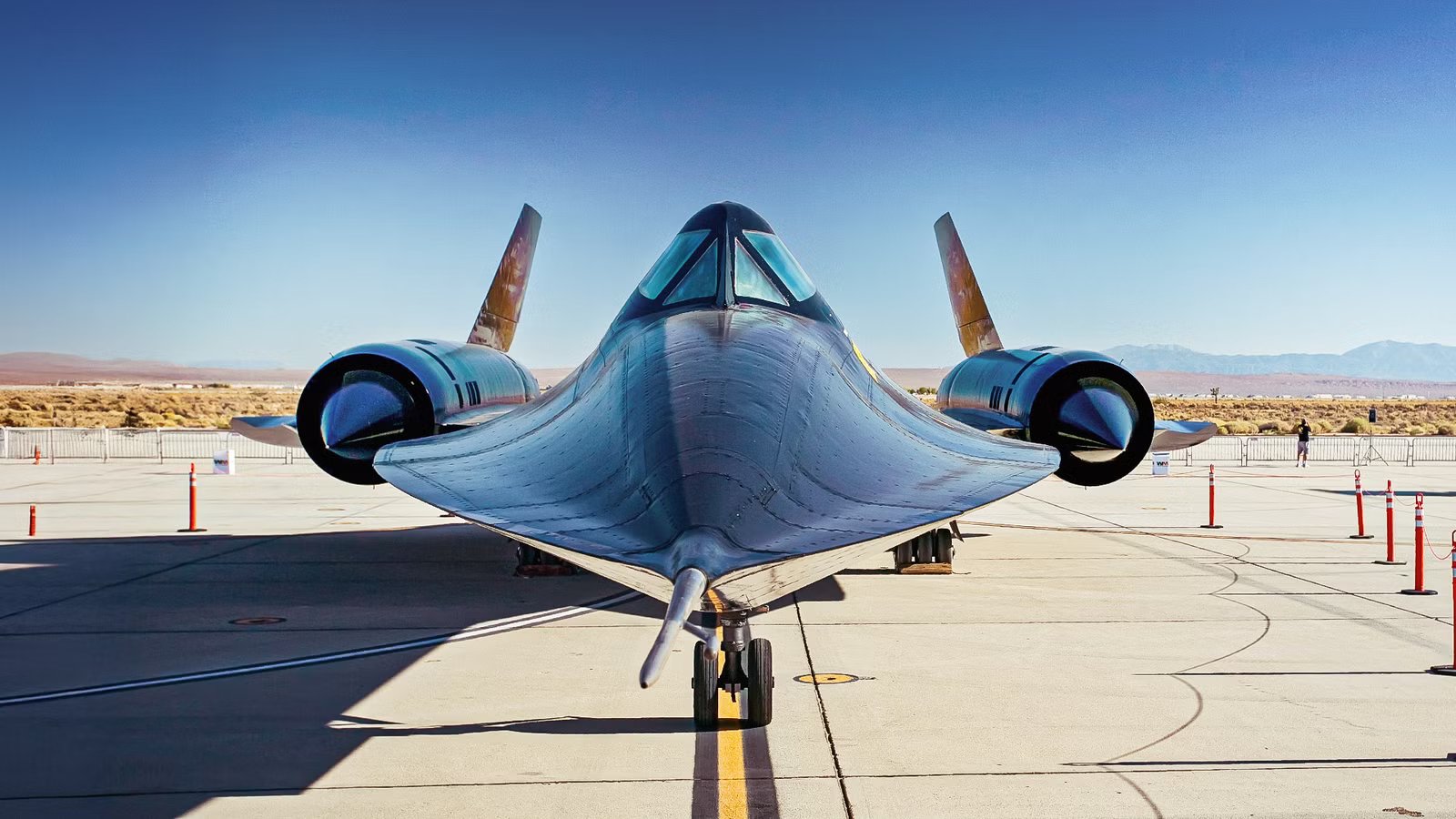
The Temperatures The SR-71 Actually Reached

According to The National Interest, surface temperatures on the SR-71 during a sustained Mach 3 mission regularly reached 800°F (427°C) at the nose, 1,200°F (649°C) on the engine cowlings, and 620°F (327°C) on the cockpit windshield. These figures reflect not the temperature of the air the aircraft flew through, at 85,000 feet (25,908 meters), ambient air temperatures are well below zero, but kinetic heating: the compression of air molecules against the leading edges of the airframe at supersonic speed, which converts their kinetic energy directly and efficiently into heat.
The phenomenon scales dramatically with velocity. A conventional jet cruising at Mach 0.85 generates negligible aerodynamic heating on its airframe. At Mach 2, it becomes a serious engineering consideration. At Mach 3.2, it becomes the single most demanding design constraint the aircraft faces, overwhelming every other thermal source on board. The engines, the avionics, the hydraulics: all of them generate heat, but at Mach 3+, the skin of the aircraft is hotter than all of them.
What made the Blackbird’s thermal environment particularly brutal was its duration. The SR-71 held Mach 3+ for extended reconnaissance missions, meaning every component had to survive those temperatures not for seconds of a brief supersonic dash, like a fighter jet during an interception, but for hours, repeatedly, across years of operational service.
Why The Windshield Had To Be Completely Reinvented

Modern military aircraft like the Lockheed F-22 Raptor use a canopy made from monolithic polycarbonate. That tough, optically clear plastic handles the relatively modest thermal demands of supersonic flight without issue. At 620°F (327°C), polycarbonate would fail immediately. Standard borosilicate glass, the heat-resistant variety used in laboratory equipment, would distort well before reaching those temperatures. As Jalopnik has reported, even materials that technically survive the heat can warp subtly under it, and for a reconnaissance aircraft, optical distortion in the windshield would represent much more than a pilot visibility problem.
The Skunk Works solution was fused silica — solid quartz glass — machined to a thickness of 1.25 inches (3.2 cm). Quartz offered a melting point of approximately 3,000°F (1,650°C), far beyond any temperature the windshield would encounter in service, and critically, it maintained its optical geometry under heat in a way that conventional glass could not. As Simple Flying has covered, preserving that optical clarity mattered not only for the pilot’s line of sight but for the camera systems the aircraft depended on for its intelligence-gathering mission.
Rather than a single continuous canopy, the windshield was divided into four separate sections. According to Jalopnik, smaller individual quartz panels were substantially less susceptible to the mechanical stresses generated at Mach 3+ than a single large pane would have been, both from the aerodynamic loads involved and from the differential thermal expansion between the glass and the titanium frame it was bonded to.

Here’s Why The Lockheed SR-72 Has The US Air Force Excited
The hypersonic SR-72 “Son of Blackbird” could reach Mach 6, giving the US Air Force a revolutionary reconnaissance and strike aircraft for the 2030s.
The $2 Million Bond: How Corning Glass Works Solved The Impossible

The choice of quartz solved the material problem, but that created a new one: how do you attach 1.25-inch (3.2 cm) quartz panels to a titanium airframe when every conventional adhesive on the market would either melt or fail under repeated thermal cycling? At operating temperatures, standard structural bonding agents were useless. The glass needed to be fixed to the frame with zero tolerance for movement or seal failure at 620°F (327°C), and it needed to survive that temperature thousands of times without degradation.
As Simple Flying has reported, Corning Glass Works spent $2 million and three full years developing a solution. The process they arrived at was ultrasonic fusing: using high-frequency sound waves to bond the quartz panels directly to the titanium frame at a molecular level, with no adhesive involved at all. The result was a joint that could survive the full thermal cycle of an SR-71 mission, from ambient ground temperature up to 620°F (327°C) at cruise, and back again, indefinitely.
The acoustic engineering behind that process was, by any measure, a purpose-built industrial breakthrough developed for a single application. The cockpit interior it protected was, paradoxically, one of the quietest environments in military aviation, because the quartz panels and titanium frame combination that made the exterior so resistant also functioned as an exceptionally effective sound barrier against the Mach 3 airflow outside.
The Windshield As An Oven: What 620°F Means In Practice

The human-scale version of those temperature figures came from the pilots themselves. SR-71 pilot Brian Shul, author of Sled Driver: Flying the World’s Fastest Jet and one of the most celebrated voices on the Blackbird program, was a fixture at airshows for decades after his retirement, and one of his signature stories required no technical explanation at all.
According to Plane & Pilot, Shul would heat his in-flight meals by pressing the squeeze tube containing his food against the hot quartz glass with his gloved hand. The food was consumed through a straw, because the crew wore full pressure suits and helmets throughout the mission and had no other means of eating.
“The windows of the aircraft would get as hot as a pizza oven, and he would heat his lunch — holding the tube of food against the window with his gloved hand.”
That detail is the clearest possible illustration of what 620°F (327°C) on a cockpit windshield actually means, and why the $2 million Corning development program, the quartz panels, and the ultrasonic fusing process were not just engineering luxuries. The window Brian Shul used as a stovetop was the product of one of the most expensive and technically demanding single-component programs in the history of crewed aircraft.
Mach 15? NASA’s 1st Hypersonic Jet Concept That Never Flew But Is Still Relevant Today
Decades before hypersonics entered today’s headlines, NASA drafted an aircraft that bordered on surreal. Discover the story behind the X-43 Hyper X.
JP-7: The Fuel That Doubled As A Coolant

If the windshield protected the crew from the heat, the fuel protected almost everything else. The SR-71, along with the earlier A-12 Oxcart and D-21 drone programs, ran on JP-7, characterized by an exceptionally high flash point and resistance to ignition even under extreme temperatures. In fact, it was so difficult to ignite that the engines required injections of triethylborane (TEB), a pyrophoric chemical that ignites on contact with air, to start combustion.
That stability was essential. At the SR-71’s cruise speeds, skin temperatures across the aircraft could exceed 500°F (260°C). A standard jet fuel would have risked premature ignition inside the fuel tanks or plumbing long before reaching the engines. Before combustion, JP-7 was routed through a network of heat exchangers throughout the airframe, absorbing thermal energy from the engine oil, hydraulic systems, and cockpit avionics.
The fuel arrived at the Pratt & Whitney J58 engines pre-heated — and the airframe could face cruise temperature slightly cooler. As The Aviationist has detailed, a system of 16 centrifugal, fuel-cooled pumps moved JP-7 through those heat exchangers continuously, making the fuel simultaneously a propellant and the aircraft’s primary thermal management fluid.
At Mach 3.2 cruise, the propulsion system itself also transitioned into something closer to a ramjet than a traditional turbojet. According to The National Interest, roughly 80% of the aircraft’s thrust at top speed came not from the engine core, but from the inlet spike and ejector nozzle system managing supersonic airflow. The J58’s turbojet core contributed only about 20% of total thrust during cruise, effectively turning the propulsion system into a hybrid turbo-ramjet. The result was one of the defining engineering paradoxes of the Blackbird: the faster it flew, the more efficiently the aircraft worked. Ram compression increasingly replaced mechanical compression, aerodynamic heating became manageable through fuel circulation, and the aircraft’s extreme speed began to sustain its own operating environment.
Titanium, Black Paint, And The Airframe That Expanded In Flight

The windshield and the fuel system solved specific thermal problems on specific components. The airframe itself required an answer to the same temperatures applied across every square inch of outer skin, simultaneously. As Simple Flying has examined in the context of the SR-72 Darkstar program, Lockheed’s solution was to build approximately 93% of the SR-71’s structure from titanium alloy, a figure that was borderline revolutionary in the early 1960s, when titanium was almost exclusively used for small leading-edge components. The supply chain challenge alone was substantial enough that the CIA had to source the material through shell companies and third-party countries, with the Soviet Union, the very nation the aircraft was designed to spy on, ultimately supplying much of it.
The famous black paint served a dual purpose and is often reduced to a single explanation. The primary thermal function was radiative: black surfaces shed heat more efficiently than bare metal, helping to manage localized thermal stresses on the skin during sustained Mach 3 cruise.
But as covered by Simple Flying, the paint also incorporated ferrite particles with radar-absorbing properties, meaning the Blackbird’s iconic color was simultaneously a thermal management tool and a stealth feature, not one or the other.
The physical consequences of those skin temperatures were visible on the ground every time the aircraft landed. The SR-71 notoriously leaked JP-7 fuel on the runway before takeoff, because the titanium panels were engineered with gaps that only sealed under the thermal expansion of high-speed flight, usually 3 to 4 inches (7.6 to 10.2 cm) in total length during each mission. Wing panels used corrugated skin sections specifically to accommodate that expansion without cracking. Every lesson encoded in that titanium structure, that black paint, and those quartz windshield panels now sit at the center of whatever Lockheed’s Skunk Works is developing as a hypersonic successor, because at Mach 5 and beyond, the SR-71’s thermal problems don’t go away. They get harder.