dailynewsnblog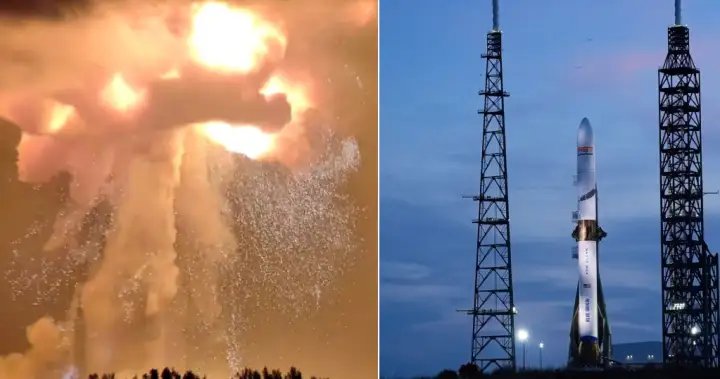
A Blue Origin rocket exploded into a massive fireball on the launch tower during a test at the launch pad Thursday night in Florida.

Blue Origin said its New Glenn rocket exploded during an engine-firing test being conducted ahead of a satellite launch planned for next week.
The company said it “experienced an anomaly during today’s hotfire test,” adding that no one was hurt.
“All personnel are accounted for and safe. It’s too early to know the root cause but we’re already working to find it. Very rough day, but we’ll rebuild whatever needs rebuilding and get back to flying. It’s worth it,” Jeff Bezos wrote in a post on X after the explosion.

Homes shook in nearby Cape Canaveral and Cocoa Beach around 9 p.m., with residents turning to social media to wonder what happened. Launch Complex 36 is visible from the beach, and the internet quickly filled with photos of an orange fireball.
Emergency crews remained more than an hour after the explosion. Officials stressed there was no threat due to fumes or other potential hazards.
Earlier this week, NASA awarded Blue Origin a contract worth hundreds of millions of dollars to launch a pair of moon buggies in the next few years as part of the Artemis program.
NASA administrator Jared Isaacman said Thursday that he was “aware of the anomaly that occurred tonight at Launch Complex 36 involving Blue Origin’s New Glenn rocket at Cape Canaveral Space Force Station.”
“Spaceflight is unforgiving, and developing new heavy-lift launch capability is extraordinarily difficult,” Isaacman wrote in a post on X.
“We will work with our partners to support a thorough investigation of this anomaly, assess near-term mission impacts, and get back to launching rockets. We will provide information on any impacts to the Artemis and Moon Base programs as it becomes available.”
Space X’s Elon Musk wrote following the explosion: “Sorry to see this, I hope you recover quickly.”

Get breaking National news
Get breaking Canada news delivered to your inbox as it happens so you won’t miss a trending story.
The New Glenn was grounded in April after it left a satellite in the wrong orbit because of engine failure. It was only the third flight of the rocket that Blue Origin intends to use to launch landers to the moon for NASA, including the landers that will take astronauts to the lunar surface.
This isn’t the first time an explosion has taken place during a routine test.
Last June, a SpaceX rocket exploded, sending a dramatic fireball high into the sky during a routine test for launch in Texas.
The explosion was broadcast on a livestream of the SpaceX facility. In the footage, the fireball appears to come from the top of Starship 36 before the entire screen turns white due to the brightness of the explosion.

After that, a large fire was seen at the site, along with scattered debris around the test site area, while the fire continued to burn for two hours following the explosion.
SpaceX said the Starship rocket “experienced a major anomaly” at about 11 p.m. while on the test stand preparing for the 10th flight test at Starbase, SpaceX’s launch site in Texas.
“A safety clear area around the site was maintained throughout the operation and all personnel are safe and accounted for,” SpaceX said in a statement on X. “Our Starbase team is actively working to safe the test site and the immediate surrounding area in conjunction with local officials.”
The Musk-led company added that there are “no hazards to residents in surrounding communities.” It also warned people not to approach the area while it was conducting safety operations with local officials at the test site and surrounding area.
After the explosion, SpaceX CEO Musk took to X and wrote, “Just a scratch.”
Last May, the Starship rocket was launched on its ninth expedition and briefly left the Earth’s atmosphere before spinning out of control and breaking apart over the Indian Ocean.
Musk had planned to launch eight simulator satellites following liftoff, which did not happen because the spacecraft’s doors failed to open fully. Shortly after, it began to spin out of control.
The company later confirmed that the spacecraft experienced “a rapid unscheduled disassembly,” adding in an online statement that its team “will continue to review data and work toward our next flight test.”
There was also a late-stage explosion during SpaceX’s eighth test flight of its Starship rocket last March, leaving a barrage of blazing shrapnel visible in the skies that disrupted air traffic.

In January 2025, SpaceX launched its seventh test flight of the Starship rocket, but the spacecraft was destroyed following a booster catch back at the pad.
Flights near the Turks and Caicos Islands were spotted diverting to avoid the debris from the explosion and footage was shared of debris falling from the sky in the area.
Musk shared a video of the debris falling, writing, “Success is uncertain, but entertainment is guaranteed!”
— with files from The Associated Press
© 2026 Global News, a division of Corus Entertainment Inc.