dailynewsnblog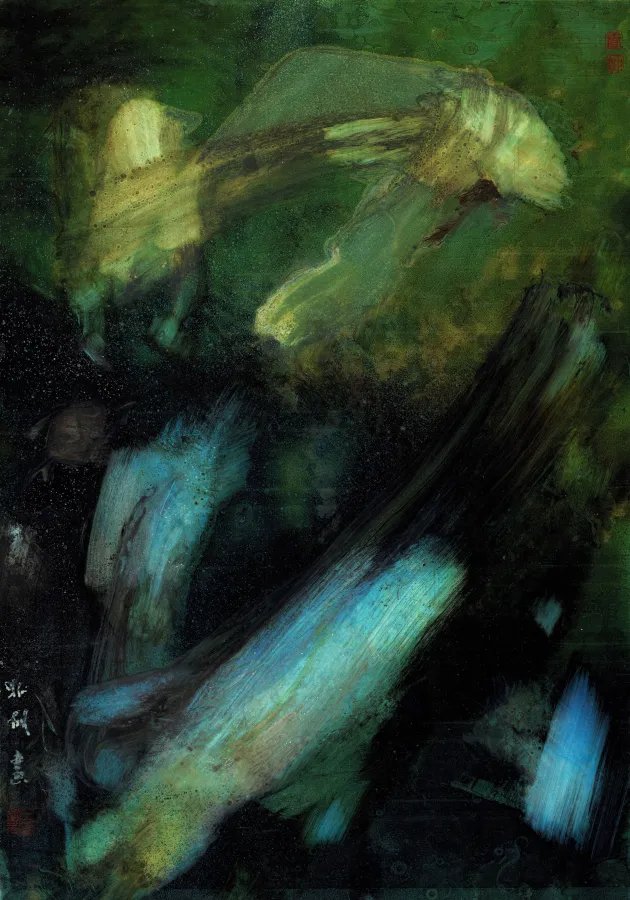
Light as State of Being – this title stands for an article about the use of light in painting and, in particular, for my own special integration of cosmic light or frozen light into my images.
Actually, I had planned a different article for today: one in which I wanted to announce a break from writing about my art. That one will appear later. Why a break? There is a risk that even my most loyal readers might find some of what I write too specific and therefore not relevant to them personally. And nothing is further from my mind than wanting to waste other people’s time. Yet with every article, I think about what readers might find useful for themselves – or what might at least stimulate them to reflect on aspects that normally are not in the everyday focus. Today’s article about light is a good example of this.
Cosmic Light, Frozen Light
Like probably many other painters, I would like to create art that steps out of the shadow of conventional painting and create an entirely new kind of seeing. Undoubtedly a high goal – one that I, especially given my age, will likely never achieve. But, firstly, for me the journey is the destination, and secondly, there are partial aspects in which I see myself on a good path, which is something like the fuel of my doing. The depiction of light is particularly noteworthy in this regard. That is why I am inserting this article before the announcing of a break.
Light and Painting in the Past
Without going too deeply into the history of light and painting, the development of the last few centuries can be summarized as follows: Well into the 19th century, painting was done in the studio and defined by academic parameters. Perspective and light created space and mood. Light in still lifes, but also in portraiture, often acted like a spotlight. Even landscape painting was illuminated by imagined light. [sample1]

Then came the Impressionists. They tore open the studio windows, let in air and, above all, light, and began to paint outdoors. Van Gogh went a few steps further: Tough expressive in his own style, he succeeded, among other things, in capturing the light of Arles. Something we can only truly appreciate when we have visited Arles. [sample2]

In all these cases, light is understood in the conventional, familiar sense. Light serves to define objects in their environment. It creates shadow, depth, and space.
Cosmic Light
Using the term cosmic light [1] carries a certain danger. All too easily, it is associated with esotericism – a realm I would not like to be too closely associated with, although areas such as meditation can already be seen as esoteric practice. As unusual and provocative as some of my works may be: Due to my education alone, I am a scientist and feel bound to scientific knowledge and act accordingly.
So what is cosmic light?
In astronomy and physics, the term “cosmic light” is rarely used as a fixed technical term, but it describes real physical phenomena. Usually, it refers to background radiation or cosmic radiation.
- Cosmic Microwave Background (CMB): The afterglow of the Big Bang. Light that has been traveling through the universe for nearly 14 billion years.
- Extragalactic Background Light: The sum of all light ever emitted by stars and galaxies.
- Cosmic Radiation: Not actually light (photons), but high-energy particles – protons and atomic nuclei – traveling at nearly the speed of light.
Physically speaking, this “light” is measurable, has a wavelength, and transports energy. It is the foundation of how we understand the universe. This transportation of energy receives my very special attention, as can easily be seen from my works.
In esotericism or spirituality, “cosmic light” is used metaphorically. Then it does not describe measurable photons, but:
- a form of universal life energy or consciousness,
- a purifying or healing power emanating from a higher plane,
- a symbol for enlightenment or divine presence.
This is not the place to delve deeper into the physics of light. But the core of the phenomenon should have been clearly outlined. Because now we approach the central theme: What light means to me, and why I am – hopefully – on a good path in the depiction of light. [sample3]

In my attempt toward a new way of seeing, I try to leave out everything academic – above all perspective, color theory, proportions, and conventional light. [2] As seen in the example shown, I thereby achieve a level on which I can treat different worlds simultaneously: often from the cosmos, across the earth, down into the deep ocean. Without the images appearing strained. More than that: They do justice to the Daoist aspect of Wu Wei. [3] [sample4]

Ur-Light as the Core Theme
In my painting, the primary endeavor is to depict Ur-light. Away from the lamp or the sun, toward a fundamental property of being.
- Put directly: Light here is not illumination, but a state. [4]
- Scientific bridge: Matter is ultimately frozen energy or frozen light. [5] When we see light in images like the one below, we are actually seeing energy attempting to take form. [sample 5]

Light in Asian Painting
Light has no place in the academic writings on Asian painting. Without light, there are no shadows either. The Daoist background: Everything is in motion. Recognizable light sources and shadows suggest a snapshot, a standstill – whereas the ultimate goal of painting is about describing laws and truths that go beyond a snapshot and have eternal meaning.
A Step Further in Light
In Asian Xieyi painting (写意; pinyin: Xiěyì – Freehand brush work) [6], color has no or only minimal significance. Now, I am not Asian, am also too strongly shaped by Western art, and in both cases certainly do not want to continue where my great-grandfather’s generation left off. But as always, nevertheless: The philosophical foundation of my work is Daoism and Zen as they have everlasting validity. And as mentioned earlier, quantum physics now confirms Zen Buddhist ideas that were previously dismissed as esoteric gibberish. [sample6]

Abundance through Omission
I have already written several times [7] about the theme that we gain by omitting, and I am fundamentally of the opinion: If you leave something out, you have to replace it with something else, otherwise the work becomes shallow or even meaningless. In many of my works, my treatment of light takes on this task. Using light merely as an effect is too cheap – especially when it is applied flatly. Through many sketches, exercises, and studies, I try to give that little that is ultimately shown a deeper meaning – such as space and consistency. [sample7]

Finally, to better illustrate the article, I am showing two recent works. As often discussed, I usually work in series. [8] The works of different series can be close in time, but also further apart. When a work is finished, I usually think about how I can better refine the underlying ideas – and above all, what I can still leave out without losing sight of the core statement.
The first one I recently showed without comment. (article: When the World Shatters) It is already very minimalist in itself, largely avoids conventional beauty criteria, and attempts to draw depth from the subconscious. [sample8]

In a further attempt, in which I reduced even more and explored the limits of minimalism, it is once again the light – also reduced to the extreme – that keeps the image alive. [sample9]

As much as I hope my thoughts on light have offered a new perspective, I also realize that a certain limit of what is still worth saying has been reached. It is time to leave the light back to the pictures.
[1] Scientific Grounding: The author emphasizes that “Cosmic Light” is primarily treated as a physical reality (photons/radiation) rather than a spiritual metaphor, aligning the artistic process with astrophysical data.
[2] By stripping away constructed perspectives and artificial light sources, the artwork creates a space where cosmic, terrestrial, and oceanic realms coexist without being forced into a traditional hierarchy. This process allows for the representation of “Primordial Light” as an inherent state of being rather than a mere optical effect.
[3] Wu Wei in Art: A Daoist concept meaning “non-action” or “effortless action.” In the context of the paintings, it refers to a composition that feels natural and self-arising rather than constructed.
[4] Light as State: A departure from “Chiaroscuro” (light-dark contrast). Instead of light revealing a form, the light and the form are one and the same energy.
[5] Xieyi (写意): A style of Chinese painting emphasizing the spirit or “idea” of the subject rather than literal realism. The author utilizes this philosophical lack of “fixed light” to achieve eternal relevance in the work.
[6] Frozen Energy: A reference to the mass-energy equivalence in physics, used here as a metaphor for how light in the paintings represents the point where energy transitions into visible matter.
[7] prevoius articles: Gaining by letting go, About letting go, Less is more
[8] My way of working in series follows not only an artistic impulse but also a principle reminiscent of physics. In science, a thesis must prove itself valid through repeated experiments – and in a similar way, I try to arrive at a deeper truth in my images through variation and repetition.