dailynewsnblog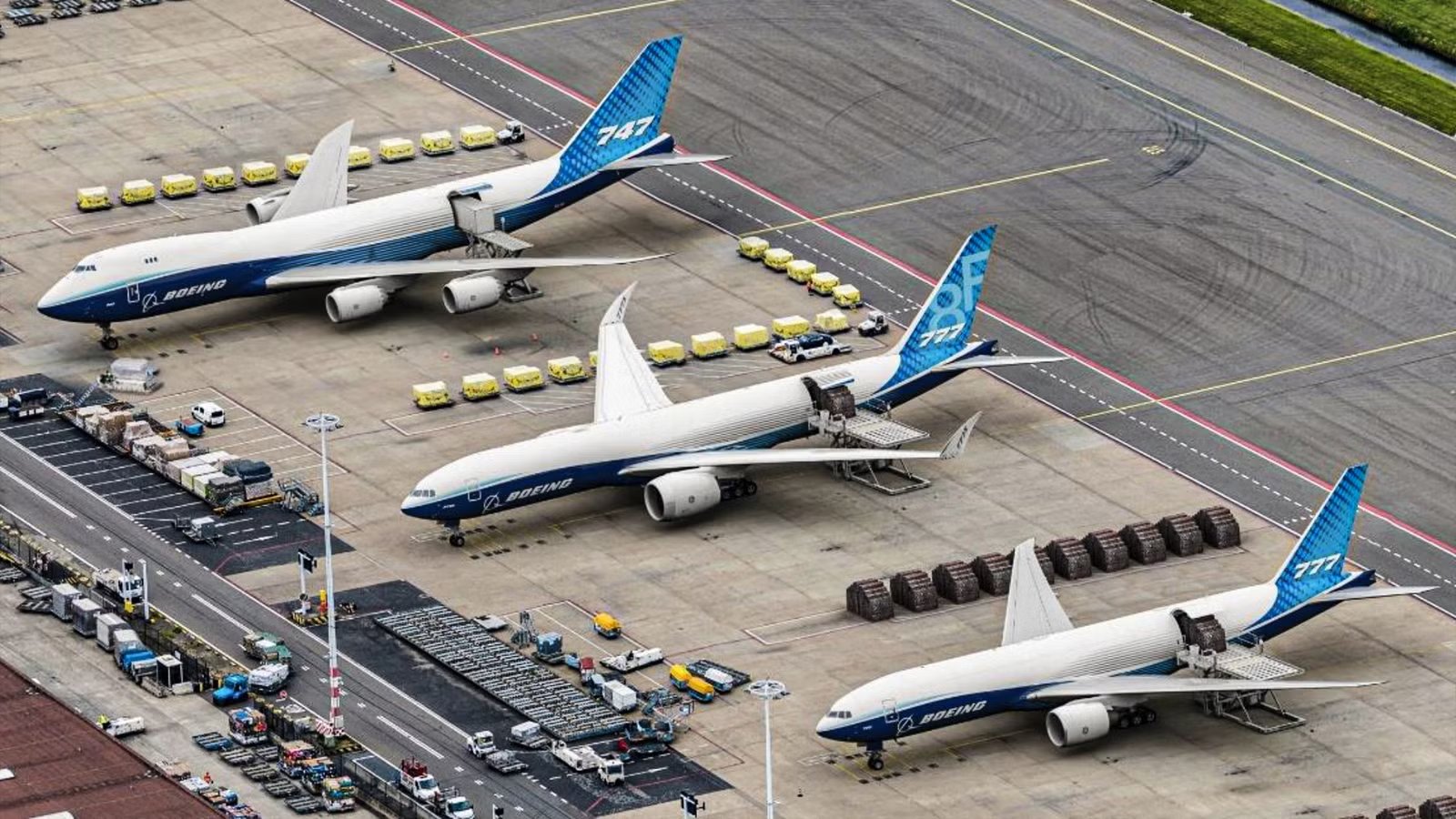
A Freighter Program Taking Shape While The Passenger 777X

Boeing’s 777-8F freighter program has received considerably less attention than the passenger 777-9, which has accumulated years of certification delays and approximately $15 billion in development charges. The freighter variant has had a quieter development path and is now at an advanced stage of final assembly at Boeing’s Everett facility in Washington. The wing-body join was completed earlier this year, a significant production milestone. Boeing is targeting initial deliveries between 2028 and 2029.
The 777-8F shares its basic airframe dimensions with the passenger 777-8, including the 235-foot composite wingspan, but is configured exclusively for freight from the outset rather than converted from a passenger design. It carries a maximum structural payload of 118.2 tons and a commercial payload of 112.3 tons. The program has accumulated 68 firm orders as of early 2026, with customers including Cargolux, Korean Air, and Silk Way West. That order book is modest compared to the broader 777X passenger backlog but reflects genuine operator commitment to a specific aircraft type rather than placeholder positions.
The 777-9 passenger variant is further along in physical production, with approximately 30 completed airframes stored at Paine Field (PAE) awaiting certification and rework to meet the final certified standard. But the program remains stuck in the certification process that has defined it for years. The 777-8F is earlier in its manufacturing timeline, with just its first airframe in advanced final assembly, but it has moved through that stage without the delays and setbacks that have defined the passenger variant’s path.
Why The 747-400F’s Replacement Can’t Wait Much Longer

The current-generation Boeing 777F, which has been in production since 2008, will cease production at the end of 2027 under ICAO emissions standards adopted in 2017. The FAA and other global regulators ratified banning production of aircraft, including the 777F, that do not meet the emissions and efficiency standards by the end of 2027.
The timing creates a gap. Entry into service of the 777-8F is now planned for 2029, with some customers wanting early production concentrated on the 777-9 passenger model, which could push the freighter’s entry into service to 2030 or beyond. To bridge that gap, Boeing filed a petition with the U.S. Department of Transportation in December 2025 seeking an exemption to sell 35 more 777Fs beyond the end of 2027, arguing that large widebody freighters move a major share of high-value air exports and that supply cannot be interrupted while the 777-8F comes to market. As of mid-April 2026, the FAA had not issued a decision, with a public comment period still open.
The 747-400F fleet that the 777-8F is primarily designed to replace is meanwhile aging out of service regardless of Boeing’s production timeline. Most 747-400Fs in service today are between 20 and 30 years old, and operators cannot simply defer replacement decisions until the 777-8F arrives. That pressure is what is driving early commitments to the program despite a delivery window that is still several years away.
$2 Billion: The Boeing 777X’s Composite Wing Vs. The Airbus A330neo’s Entire Development
Why Boeing invested in such a thorough overhaul of the 777, while Airbus only lightly refreshed the A330.
What The 777-8F Actually Offers Over The Aircraft It Replaces

The 777-8F’s headline numbers against the 747-400F are straightforward. It carries a maximum structural payload of 118.2 tons, comparable to the 747-400F’s capacity, while burning 30 percent less fuel and reducing operating costs per ton by 25 percent. For cargo operators whose highest single cost is fuel, those figures make the economic case without much additional argument. The 777-8F achieves that efficiency through its GE9X engines, the same powerplant being developed for the 777-9 passenger variant, combined with a 235-foot composite wingspan that generates significantly better aerodynamic performance than the metal wings of the aircraft it replaces.
The comparison to the 747-8F is relevant because it was Boeing’s most recent heavy freighter variant before the line closed. The final 747-8F was delivered in early 2023, ending 54 years of 747 production. It offers better economics than the 747-400F and carries a higher maximum structural payload at approximately 137 tons, but at considerably higher four-engine operating cost than any twin-engine alternative. For operators currently flying the 747-8F, the 777-8F represents the most direct long-term replacement, offering lower fuel burn and maintenance costs per ton on routes where the 747-8F’s extra payload capacity is not fully utilized.
The 777-8F also benefits from being a twin-engine aircraft in an era where four-engine operating costs are increasingly difficult to justify on routes where twin-engine alternatives are viable. Maintenance costs, engine shop visits, and fuel burn all favor a twin over a quad on comparable payload missions. The 747 remains the only option for certain outsize loads that require the nose-door loading configuration, but for standard pallet and container freight on the routes where most 747-400F capacity is currently deployed, the 777-8F’s operating economics are the primary reason operators are committing to the type.
The Carriers Committing To The Type

Qatar Airways Cargo was the launch customer for the 777-8F, placing a firm order for 34 aircraft with options for 16 more in a deal valued at more than $20 billion. That order established the program’s commercial viability when it was launched in 2022 and has been followed by commitments from a range of major cargo operators. The order book now includes Cargolux, Lufthansa Cargo, China Airlines, ANA Cargo, and Silk Way West, with the program accumulating more than 60 firm orders as of early 2026.
Korean Air’s commitment is structured as part of a broader fleet renewal agreement. The order for eight 777-8Fs forms part of a broader $50 billion agreement with Boeing that also includes 20 777-9s, 25 787-10s, and 50 737-10s, with all aircraft scheduled for delivery by the end of 2030. Korean Air currently operates four 747-400Fs with an average age of 20.5 years, making the 777-8F a direct replacement for that aging heavy freighter capacity. Silk Way West has taken a more measured approach. From 2028, the airline plans to begin the second phase of its fleet modernization program, which includes four Boeing 777-8Fs alongside four Airbus A350 freighters.
The spread of customers across Asia, Europe, and the Middle East reflects where the 747-400F replacement need is most acute. Most of the operators committing to the 777-8F currently run mixed fleets of 747-400Fs, 747-8Fs, and current-generation 777Fs, and are using the 777-8F to consolidate toward a single modern heavy freighter platform as the older aircraft age out. The 2028 to 2029 delivery window means those operators are making commitments now for aircraft that will not arrive for several years, which is typical for a program at this stage but also reflects confidence that no better alternative will emerge in the interim.

Why The Boeing 787-10 Dreamliner Can Suddenly Fly Routes Only The Airbus A350 Could Handle
An increased maximum takeoff weight allowance is key for Boeing.
Where The 777-300ERSF Fits In The Same Market

The 777-300ERSF, the passenger-to-freighter conversion program led by Israel Aerospace Industries and lessor AerCap, is addressing the same 747 replacement problem from a different angle. Where the 777-8F is a new-build factory freighter with a 2028 to 2029 delivery window and a price point reflecting that, the 777-300ERSF takes retired 777-300ER passenger jets and converts them into freighters for a total cost of approximately $75 to $80 million including acquisition. Kalitta Air, the launch operator, received its first two converted aircraft in September 2025 and had taken delivery of seven by the end of the year.
The two programs are not direct competitors in the conventional sense. The 777-8F carries a maximum structural payload of 118.2 tons and is designed as a long-range heavy freighter for operators running high-volume international trunk routes. The 777-300ERSF carries a maximum payload of 100 tons but offers 811 cubic meters of volume, 25 percent more than the current-generation 777F and 14 percent more than a converted 747-400F. That volume advantage makes the converted aircraft well-suited to e-commerce and high-density cargo routes where cubic capacity is more limiting than weight. The two aircraft serve overlapping but distinct operating profiles.
The more relevant distinction is timeline and cost. Operators that need heavy freighter capacity before 2028 and cannot wait for new-build deliveries have the 777-300ERSF as a practical option available now. Operators making long-term fleet planning decisions for their core heavy freighter network are committing to the 777-8F. Some carriers will likely end up with both, using the converted aircraft to bridge the gap until new-build deliveries arrive.