dailynewsnblog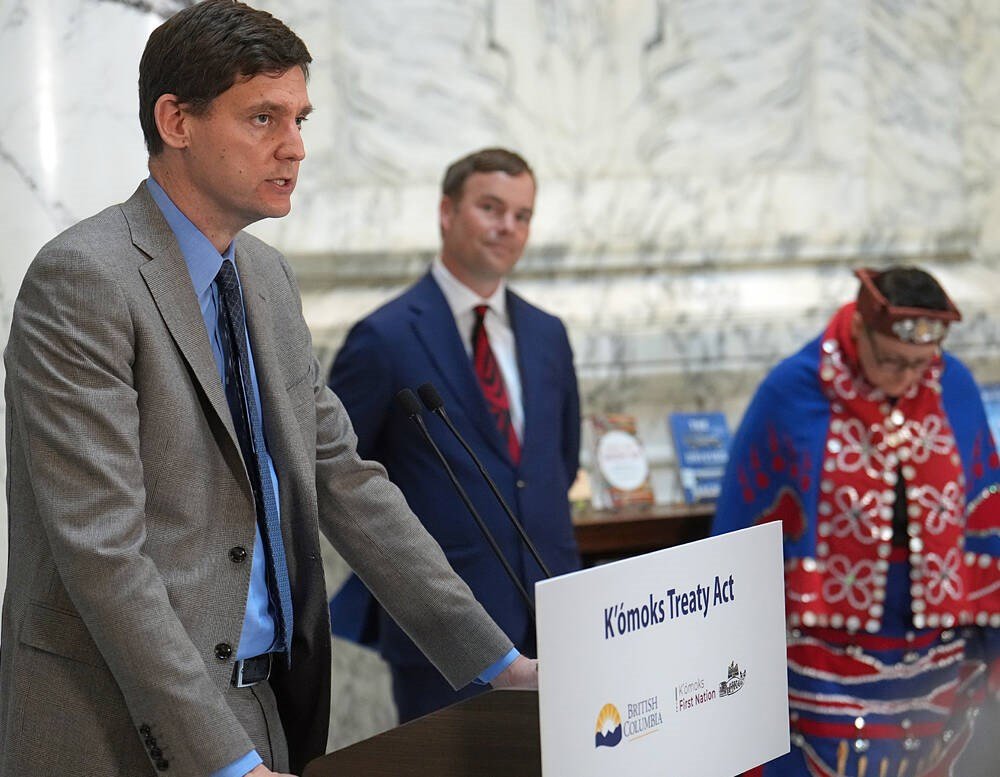

Even if the K’ómoks treaty clears the B.C. legislature today, it will be years before it takes effect — and governments are facing mounting pressure to resolve overlapping territorial claims before then.
It will be two years or more after the B.C. legislature ratifies the K’ómoks treaty — assuming it is voted on and passed today — before Ottawa follows suit and it formally takes effect.
The parties will need every minute of that time and then some to smooth out the nagging problem of overlapping claims.
Indigenous Relations and Reconciliation Minister Spencer Chandra Herbert outlined the magnitude of that issue during debate on ratification.
The federal and provincial governments and the K’ómoks Nation spent more than 30 years negotiating the treaty, but when it arrived at the legislature last month it prompted objections and protests from neighbouring north Island nations. That is running parallel to the debate on the ratification bill.
It continued this week in Campbell River, where Wei Wai Kum and We Wai Kai leaders warned at a protest of escalating actions if the bill is passed.
There was talk of being ignored and disrespected by a government that is refusing to listen to their concerns that the treaty infringes on their claimed territories.
But Chandra Herbert’s account last week suggests the government has spent years trying to resolve the problem without success.
The original idea when the modern treaty process began in 1991 was that First Nations would resolve overlap issues themselves.
That was short-lived and the province has been involved for years on the overlaps.
In theory, they can be resolved with protocol agreements between the K’ómoks and the neighbouring nations.
Chandra Herbert said an interim treaty agreement with the Wei Wai Kai has been in the works that could be initialled shortly. It includes accommodations for overlapping claims. There is an active negotiating table with that band and there is an expectation that “our negotiating partners engage and seek resolution to any conflict or competing interests.”
But the objections continue.
He went to some length to specify the work on overlaps: 13 on-the-record consultations with the Wei Wai Kum and two meetings he had with the chief (who was watching the debate from the gallery at the time).
There were also five meetings to discuss accommodations by way of land transfers, 29 letters, 50 emails back and forth and a meeting this month with Premier David Eby.
When asked about any other overlap complaints, the full potential scope of the problem became apparent.
He listed five other Indigenous nations that have claims overlapping the actual property the K’ómoks will get control of in the treaty. More than a dozen other First Nations have claims to certain rights on traditional territories.
The total number of First Nations involved in some fashion is 27.
Chandra Herbert said there is an existing protocol agreement with one, two more are nearing completion and several others are being discussed.
“The expected effective date is at least two years away. That provides plenty of time for K’ómoks to finalize agreements.”
There are still questions why the treaty — and a similar one in the Skeena region — arrived at the legislature with so much baggage. Ratification would normally be considered a formality after all these years. But the two treaties prompted significant protests by numerous neighbouring First Nations and demands they be held off.
Asked directly about all the dissent, Chandra Herbert said there is always room to improve processes.
“We understand there are concerns about overlaps very much. We get that. That’s why we put in the work.”
He said consulting on accommodation for overlaps will continue and there are discussions underway with the Treaty Commission and the First Nations Summit about improving the processes.
Based on his account of trying to reconcile overlaps for one comparatively small treaty, there’s no denying considerable time and effort went into it.
But as the demonstrations and continued objections continue, it doesn’t look like it produced much in the way of results.
The bill’s passage today is uncertain, and is just a taste of how complicated the treaty process is in a province with over 200 First Nations.
[email protected]