dailynewsnblog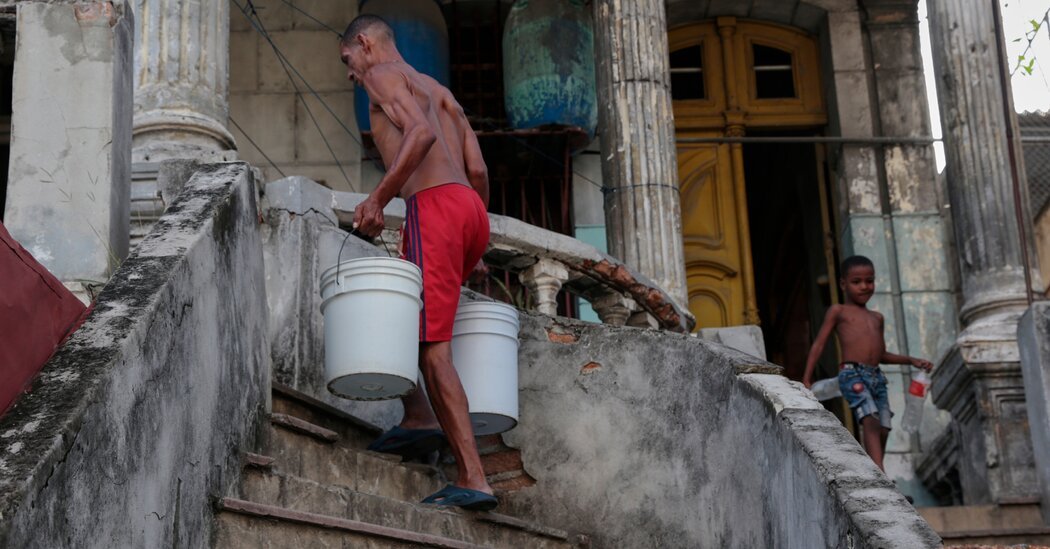
Cuba’s desperate wait for fuel seems to have just gotten longer.
A Russian tanker that had appeared headed to Cuba — with 242,000 barrels of badly needed diesel — has turned away from the island and now appears to be on its way to South America.
The diversion is a brutal development for the Cuban government and its people, who have been enduring a worsening energy crisis since the Trump administration imposed an effective oil blockade against the island in January.
Russia has so far been the only nation allowed to break that blockade, with a March shipment of 730,000 barrels of crude oil. That oil, however, has largely already been used, and Cubans had hoped they were about to receive a new lifeline. But with the tanker’s left turn, any more help will now most likely take weeks to arrive, if it ever does.
Pentagon and U.S. Coast Guard spokespeople declined to comment, but expressed puzzlement at the tanker’s new route.
The Russian government did not respond to a request for comment.
Ernesto Soberón Guzmán, Cuba’s ambassador to the United Nations, said that while he didn’t have details on the Russian tanker, Cuba was counting on Russia to help it survive what he called an illegal U.S. blockade.
“It’s hypocritical — cynical — that on one hand they talk about making efforts to open the Strait of Hormuz and so on, while on the other hand they are effectively imposing a naval blockade against Cuba,” Mr. Soberón Guzmán told The New York Times on Wednesday, referring to the U.S. government. “A fuel blockade that in practice constitutes an act of war.”
The tanker’s detour is a victory for the Trump administration, which has been trying to strangle Cuba into making major changes to its political and economic system. Cuba has said it has now depleted its fuel reserves and is surviving off domestic oil production, solar power and small fuel shipments to private enterprises on the island.
As a result, daily life is becoming increasingly difficult. Electricity works just a few hours a day, Cubans are cooking with charcoal and firewood, aid distribution is complicated by a lack of gas, and fuel is essentially available only on the black market, where it can cost upward of $40 a gallon.
Cubans are bracing for the summer heat, when demand for power generally increases, while the Trump administration is hoping the situation forces Cuban officials to accept U.S. demands.
Secretary of State Marco Rubio denied that the United States was responsible for the crisis. “The real reason you don’t have electricity, fuel or food is because those who control your country have plundered billions of dollars, but nothing has been used to help the people,” he said in a video addressed to the Cuban people last week.
Washington has been intensifying its pressure campaign. Last week, the Justice Department charged Raúl Castro, Cuba’s former president, with murder stemming from the 1996 downing of two civilian planes near Cuba that killed three American citizens.
The U.S. government halted shipments of Venezuelan oil to Cuba after intervening militarily in the South American nation. President Trump then threatened tariffs on any nation sending fuel to Cuba. And in one case, the U.S. military escorted a tanker away from the island.
Up until changing its route this week, the Russian tanker, called the Universal, showed numerous signs that it was headed to Cuba. On March 31, the same day that the last Russian tanker arrived in Cuba, the Universal left Russia loaded with diesel, according to Kplr, a ship-tracking data firm. Its destination was left vague.
Shortly after, Russian officials confirmed they were sending a second tanker to Cuba. “We won’t abandon the Cubans,” Russia’s energy minister, Sergei Tsivilyov, told reporters.
The Universal passed through the English Channel on April 9 and continued straight toward Cuba until April 21, when it suddenly stopped in the Atlantic Ocean, according to ship-tracking data. The ship then drifted, largely in place, for a month — until it abruptly headed south this week.
Pausing in the middle of the ocean for so long is highly unusual. Fuel tankers operate on strict schedules to deliver their cargo. But it followed the same pattern as another recent ship carrying fuel for Cuba.
The Sea Horse, a tanker owned by a Chinese firm, spent weeks drifting in the Atlantic this year before it gave up and delivered its cargo elsewhere. The ship’s owners had feared consequences from the U.S. government, The New York Times reported.
The United States and the European Union have imposed sanctions against the Universal for its links to Sovcomflot, a Russian state-owned shipping company.
Jorge Piñón, a University of Texas researcher who studies Cuban energy, said that the Universal’s diesel would have been an enormous, albeit temporary, lift for Cuba. Trucks and tractors need the fuel, but Cuba can’t produce it from its domestic oil.
Mr. Piñón estimated that the ship’s cargo, which was likely to be donated to Cuba, was worth $25 million. “So now Russia is going to make a pretty hefty profit,” he said.
Lazaro Gamio, Eric Schmitt and Christiaan Triebert contributed reporting.