dailynewsnblog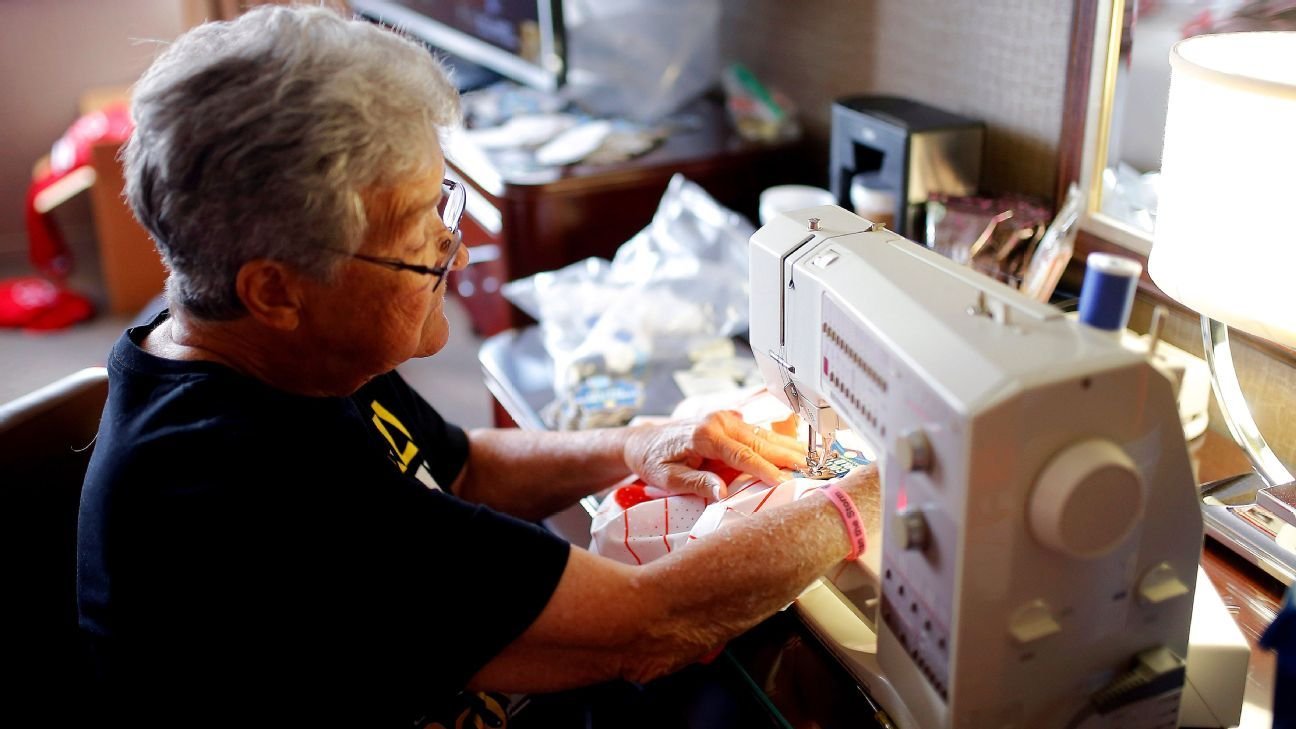
TUESDAY AT NOON, exactly 48 hours before the 2025 Women’s College World Series begins, a silver minivan pulls into the parking garage of the Sheraton Hotel in downtown Oklahoma City. Carolan Bledsoe emerges first, her short, white hair catching the shine of the lights overhead.
“Now the fun starts,” she says, beelining for the trunk with an enthusiasm that has accompanied her for some eight decades. “Or the chaos, or something,” she adds with a laugh.
Peering over the wire-framed glasses perched on the tip of her nose, Bledsoe supervises her daughter Tamra Keeney, who pulls several sewing machines, one by one, from the trunk. Son-in-law Gary Shriver steps in next, unloading a wheeled cooler full of bread and cold cuts for sandwiches. Then, he lifts out a wide, cardboard box. Peeling back the flaps, he reveals hundreds of Women’s College World Series patches.
In the next 24 hours, Bledsoe and her family will commandeer a hotel room and work overnight to sew the patches onto the jerseys of every player participating in the annual tournament that decides the NCAA softball champion. Each of the eight qualifying teams, comprising about 25 athletes each, can bring up to four sets of uniforms to Oklahoma City. Bledsoe estimates she adorned around 500 uniforms in 2024.
The load has steadily increased since she first took on the task in 1997. But the 81-year-old Bledsoe has remained committed, creating one of the most special traditions in college softball.
Not every NCAA championship issues patches, says Liz Suscha, NCAA vice president of championships governance and policy. But for those that do, organizers distribute self-adhesive patches to qualifying teams, who then apply the decals themselves. Bledsoe’s work in Oklahoma City is one of a kind.
“And the fact that her family’s involved and embraces this, I think, is totally indicative of the way the sport really puts a priority on being together,” Suscha says.
Family is at the heart of all Bledsoe does. It’s the reason she fell in love with softball. It’s the reason she started sewing. And it’s the reason she has come to be affectionately known as the Women’s College World Series “Patch Lady.”
JUST SOUTH OF downtown Oklahoma City, along the banks of the Oklahoma River, lies Wheeler Park, a recreational area with several ballfields. Today, the diamonds host the city’s youth baseball program. But decades ago, they served as the hub of adult church-league softball.
In the 1950s and ’60s, when Bledsoe was a teen, she recalls that nearly every local church had a team. On fall evenings, she and her older sister would come up from across the river to take in the competition.
“For us it was just a way of life, because we didn’t have the money to go to all the movies and all the stuff like that,” she says.
Bledsoe grew up the second youngest of six children in a two-bedroom house southeast of the city. All her siblings participated in sports, but for as long as she can remember, she cheered from the sidelines.
When she was 7, Bledsoe contracted polio, temporarily losing her ability to walk. After more than two months in the hospital, and even longer rehabilitating, she got back on her feet. But the virus had permanently weakened her muscles, making running part of her past. The polio also stunted growth of her left leg, which is still smaller and shorter than her right. So Bledsoe embraced being a fan, even though she could no longer take part in the action.
“I was having so much fun watching it,” she says, “that it never really occurred to me that I was left out of anything.”
One evening at the fields, when Bledsoe was 15, she met a young man named Larry. After a six-month wait, her parents allowed her to join him on a date. Two years later, when she was 18, the pair married. They went on to have four children, whom they coached in baseball and softball.
“She was the one everyone went to,” Keeney says of her mother. “Everyone knew that Mom, or Carolan, or whatever they called her, would get things done.”
For Keeney and her siblings, that also applied to their wardrobes.
Growing up, Bledsoe’s mother had made all her clothes. So, when she had Keeney, her eldest, she realized she would need to learn to sew too. Armed with an affordable fabric and two cheap patterns, she tackled her first project: a sundress for her daughter and a maternity top for herself. Several years — and many pieces — later, she made Keeney’s wedding gown.
Family and friends became familiar with Bledsoe’s sewing skills, and, in 1997, she was approached with a different kind of project. At the time, Bledsoe worked in the box office of Oklahoma City’s old Myriad Convention Center, which printed tickets for the WCWS, she says.
One day, one of the tournament’s organizers called Bledsoe in a panic. The woman who sewed the patches onto the uniforms had moved. Could Bledsoe help?
“I had no idea what I was getting into,” Bledsoe says.
ABOUT TWO HOURS after Bledsoe arrives at the Sheraton, Room 1111 hums with the rapid thunk-thunk-thunk of sewing machines that screech whenever they pick up speed. Bledsoe has just finished fastening a patch onto a white Ole Miss jersey when UCLA softball equipment manager Derek Moos pushes open the door, a large, black duffel bag in hand. Bledsoe steps away from her sewing machine to greet him with a hug.
This year, the family is set up in a one-bedroom suite. In the living room, two sewing machines sit on a long, wooden desk, while two others have been placed on TV tables by the couch. Jerseys from the batch in progress are draped over every spare surface. Others pile up, out of sight, on the bed.
Bledsoe receives the patches in advance, but she doesn’t receive the jerseys until the teams get to town, which is typically on the Tuesday before the World Series’ Thursday start. Her deadline is noon Wednesday so that athletes can wear their jerseys — complete with sewn-on patch — for media obligations. In this narrow window, every second counts.
“I’ve got everything nice and neat for you guys,” Moos says, pulling two labeled bundles out of the bag and handing them to Bledsoe.
“Oh, look at this,” she says, smiling. “Left-handed.”
The Bruins have already covered the first step in Bledsoe’s process. She starts by sorting each team’s jerseys by handedness; the right-handed batters get the patch on the left sleeve, while the left-handed batters get it on the right sleeve. This ensures the patch is facing the field — and the TV cameras — when a player is at-bat.
After that, the sewing begins. Nearly three decades ago, the patches were a simple circle or square. Each took about a minute to sew, Bledsoe says. But today’s patches incorporate design elements like a softball stadium, the NCAA championship trophy and the organization’s pennant-style branding, making the contours far more complicated. Bledsoe estimates it now takes closer to three or four minutes per patch.
A few years ago, she realized the number of athletes and uniforms and the amount of time spent on each patch continued to increase, while her schedule constraints remained the same. She called on her family for reinforcements, and Keeney and Shriver responded. For the past several years, all have been compensated for their efforts, each sewer receiving about $200.
“It starts out fun: ‘Hey, we’re getting this accomplished,'” Keeney says. “Then it’s like, ‘I’m really tired, are we finished yet?'”
Sometimes, Shriver says, fatigue takes over. One year, he nodded off at the machine, accidentally leaving a trail of stitches across the jersey.
“We just know that we have a deadline, so everybody just pitches in and works together,” he says. “The more the merrier.”
Along with Keeney and Shriver, Bledsoe’s granddaughter Tawnya Woodworth also has become a regular in the annual sewing circle. She grew up spending the night in the hotel room watching her grandmother work, and knowing it continued long after she finally fell asleep.
“We’ll pick up today or tomorrow?” Moos asks Bledsoe after the pair spends a few minutes catching up.
“Probably in the morning,” Bledsoe responds, seeming to buy herself some time.
“Always good seeing you,” he calls while heading toward the door.
UNDER THE LIGHTS of Devon Park, Texas Tech’s NiJaree Canady stands on the mound, staring down Texas slugger Kayden Henry. The Red Raiders lead 4-3 in the top of the seventh inning in Game 2 of the 2025 WCWS final. They lost the opening game of the best-of-three series the night before.
Texas Tech’s defense has secured two outs, but a Longhorn runner on third base threatens the advantage.
Canady delivers Henry two 72 mph strikes. As she winds up a third time, the TV broadcast cuts to a close-up, giving viewers a glimpse of the WCWS patch stitched onto her left sleeve, opposite her pitching arm.
Canady releases the ball, which slides down the middle. Henry takes a desperate swing, but the ball lands firmly in the mitt of catcher Victoria Valdez. The Red Raiders have forced Game 3.
The next day, Texas Tech fell in the tiebreaker. But in many ways, they had already won; their WCWS appearance was the first in program history.
“You see the patch and you realize, like, we’re here. We did it, and we really are in the World Series,” says Gerry Glasco, Red Raiders head coach.
The patches represent the magic that can happen when a team — or a family — devotes itself to the game.
“You can tell a lot of hard work and passion just goes into each and every patch,” Canady says.
While Bledsoe wasn’t in the stands for the WCWS final, the matriarch and her family have been attending the tournament for about as long as she’s been contributing to it. As Oklahoma Sooners fans, they enjoy inning after inning of elite gameplay. But occasionally — inevitably — their eyes stray to the patches.
“We’ll be watching the game and go, ‘Oh, yeah, there’s that patch we had so much trouble with,’ if we got it on crooked or whatever,” she says. “It’s like, ‘Oh dear, that’s the one we had to take apart and redo.'”
For many years, Bledsoe says, few of the other spectators noticed the extra adornment on players’ uniforms.
“Most of them do now, because ‘the Patch Lady,'” she says, with air quotes and a laugh. Word of her work has spread across the college softball community, drawing the appreciation of fans and teams alike.
Sometimes, coaches hang out in the hotel room and chat while Bledsoe handles their jerseys. And when Bledsoe’s husband passed away on May 24, 2024, just days before the start of the tournament, Texas shared a condolence card signed by every player. Bledsoe received it as she sewed on the patches, soothed by the return to routine, she says.
“That was so touching to me that they would go to that much trouble for someone they don’t even know,” she says. “But since he and I met at softball, it was an important part of our lives.”
And it still is. Bledsoe has continued spending time at the ballfields. Today, she watches her great-grandchildren play. Woodworth’s son, Garet, even helped sort some of the jerseys last year for his great-grandmother, carrying on the family ritual.
For now, though, Bledsoe remains at the helm. Each February, she looks forward to the call from the Oklahoma City Convention & Visitors Bureau asking if she will once again agree to the task that has become tradition.
“As long as I can,” she says.