dailynewsnblog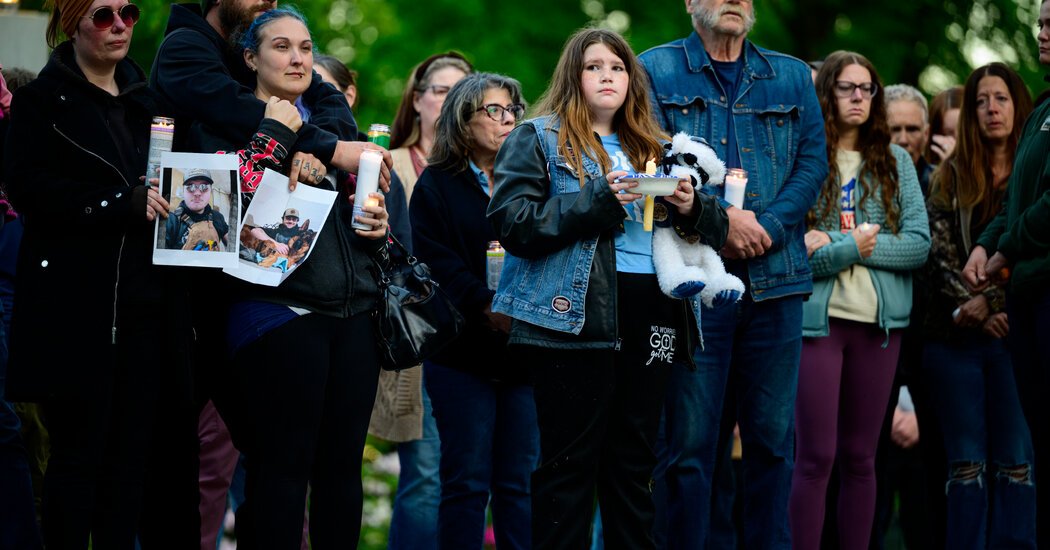
Nine workers at a paper mill in southern Washington State remained missing and two were dead in what Gov. Bob Ferguson on Wednesday warned would likely be the worst industrial disaster in the state’s modern history.
The explosion of a tank at the Nippon Dynawave Packaging plant in Longview, Wash., near the Oregon border, released more than a half million gallons of highly caustic chemicals, Longview fire officials said. An unknown amount ended up in the Columbia River, and a dozen dead carp were recovered from nearby dikes.
The region’s congresswoman, Marie Gluesenkamp Perez, a Democrat, said rescue workers had seen “unthinkable horrors” and demanded accountability once the investigation into the explosion is completed.
Friends and family members have identified one of the dead as Gilbert Bernal, a worker at the plant. Although it was unclear exactly where the missing might be, officials said they did not believe anyone was still alive inside the facility and that they were in a recovery phase, rather than rescue, working “to return all of the workers to their families.”
Mr. Bernal, a father of two and a grandfather of one, worked as an electrician at the plant for about 15 years, his friend Todd Cornwell said on Wednesday. The pair met at their church, where Mr. Bernal and his wife were active.
Mr. Bernal showed up almost weekly to Bible studies, always with examples of how the passages related to his life. He used his skills as an electrician to help with fixing the church’s lights and sound system.
“Knowing how he was, he was ready to meet Jesus at any point in time,” Mr. Cornwell said.
Mr. Bernal’s son also worked at the plant, Mr. Cornwell said, and identified his father’s body.
“There are not enough words to express on how devastated we are right now,” Mr. Bernal’s daughter, Geovana Bernal, said in a statement posted on social media. “My father was the most selfless man I knew.”
Recovery efforts have been complicated by the large-scale release of chemicals at the plant, about 45 minutes north of Portland, Ore. The plant makes wood pulp and paper board for packaging and cartons.
The Longview Fire Department said the 900,000-gallon-capacity chemical tank exploded just after 7 a.m. on Tuesday during a normal early morning shift change. Seven employees caught in the blast remain hospitalized. A firefighter was also injured but has been released from the hospital, said Chief Matt Amos of the Longview Battalion.
Officials initially believed about 90,000 gallons of materials remained inside the tank, but an inspection revealed a significantly smaller volume, about 25,000 gallons. This allowed emergency responders to move forward with removing the materials on Wednesday, though fire crews reported chemical damage to the boots teams wore in the initial response.
As bodies are recovered in a “slow, methodical and deliberate” search, they will undergo decontamination before being taken to the Cowlitz County Coroner for identification and family notification, the department said. It is not clear how long the search for remains will take. On Tuesday and Wednesday, family members of workers appeared at the plant looking for more information, but little was provided. Brian Wood, a company executive, said the business was “focused on helping responders find and recover our people.”
Mr. Wood said the company would cooperate with investigators “to the maximum.”
Longview is a mill town that has been buffeted by changes and challenges in American manufacturing in recent years. Ms. Gluesenkamp Perez said the disaster only adds to fears among many in Cowlitz County that mill jobs may go away entirely. She said the loss of life will affect everyone in the region and noted that there were “a lot of young families” among the plant’s 550 employees.
Rescuers said that Tuesday had appeared to have been a normal day at the plant, a campus of large chemical tanks and processing buildings, with no unusual activity around the tank.
After the explosion, the cylindrical tank that failed had collapsed on one side, its walls folding in under the weight of the structure.
Scott Goldstein, the Cowlitz County fire chief, said that investigators do not yet know the level of contamination in the Columbia River, which winds its way from Longview out to the Pacific Ocean. He said initial testing showed no sign of contamination in the air.
On Wednesday morning, tanker trucks rolled in and out of the plant’s parking lot, along with fire and rescue trucks and a vehicle with the Environmental Protection Agency.
Local officials said there was no direct risk to the surrounding community or its water supply, but they urged residents to avoid the area or nearby ditches that might contain the chemical.
Eight employees and one firefighter were initially taken to hospitals, some with severe injuries, officials said. One of those workers has since died. Meantime, the community awaits word of loved ones.
Tyler Covington, 29, one of the missing, had worked at the plant for less than a year, according to his romantic partner, Mackenzie Specht.
“He was a great man and he was my best friend,” Ms. Specht said.
The couple has been together for the past five years, raising three children together. Mr. Covington could be quiet and funny, she said. Baseball was his favorite sport. He also liked boating.
The chemical that was released is known as “white liquor,” a solution mainly of sodium sulfide and sodium hydroxide that helps break down wood chips into pulp. It can cause second- or third-degree burns on contact with skin and can be dangerous if inhaled, Mr. Amos said on Tuesday.
The cause of the explosion was not known on Wednesday. But the plant has received fines for running afoul of environmental regulations, and twice in the last three months, employees or their union representative filed complaints over safety concerns to the state’s Division of Occupational Safety and Health.
In March, the complaints reported that a drain had failed and was creating a sinkhole. In May, a complaint expressed concern related to a valve for an aqua ammonia clarifier tank. The state is still investigating both concerns, but the clarifier tank is not the tank that failed in the explosion, according to Matt Ross, a spokesman for the state.
Last year, an incident led to the amputation of a worker’s finger, according to state records. After that, the company was cited by the state workplace safety monitoring agency for moving equipment before the accident could be investigated, records showed.
The company has also repeatedly been warned or cited in recent years for violating pollution and other environmental standards, receiving fines for environmental penalties of $12,000 in the last two years, according to the Washington Department of Ecology. In March, the company was fined $5,500 by the state for venting more industrial emissions than allowed by federal law.
The plant has been the site of other industrial fires in recent years and has also had wastewater and chemical spills, according to local news reports.
Mark Walker and Yan Zhuang contributed reporting.