dailynewsnblog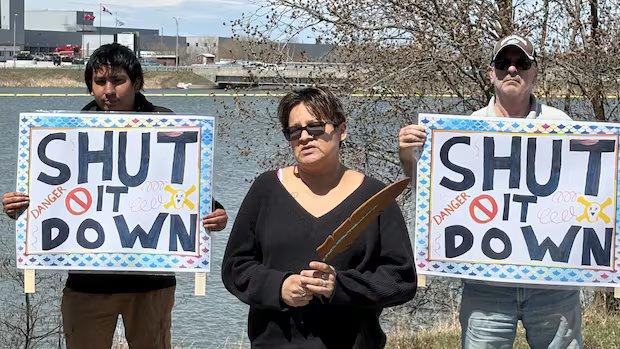

Listen to this article
Estimated 5 minutes
The audio version of this article is generated by AI-based technology. Mispronunciations can occur. We are working with our partners to continually review and improve the results.
Grassy Narrows First Nation and Wabaseemoong Independent Nations have joined forces to push for mercury justice in their communities and pressure the Ontario government to clean up the long-contaminated river system.
In the 1960s and ’70s, the paper mill in Dryden dumped about nine tonnes of the toxin into the English-Wabigoon River System in northwestern Ontario.
Decades later, members of Grassy Narrows as well as White Dog (now part of Wabaseemoong Independent Nations) continue to experience symptoms such as tremors, insomnia, memory loss, neuromuscular effects, headaches, and cognitive and motor dysfunction.
Chief Roland Fisher of Wabaseemoong Independent Nations told CBC News on Tuesday that his community is finalizing a memorandum of understanding with Grassy Narrows and the province over the river system’s remediation.
In the meantime, about two dozen people attended a rally at Cooper Park last Thursday to call for the paper mill to be shut down.

A similar rally was held last summer, not long before Grassy Narrows appealed to the Inter-American Commission on Human Rights to push the provincial and federal governments to take action.
“Our people came to Dryden today because our families are sick and still suffer from the impacts of mercury poisoning,” Chief Sherry Ackabee of Grassy Narrows said in a news release Thursday.
“The Dryden mill is making that poison worse every day. Where is Premier [Doug] Ford, and will he finally step up and shut down the mill?”

Advocacy efforts have ramped up since spring 2024, when a study out of Western University in London, Ont., emerged, suggesting the river’s contamination is getting worse due to industrial pollution.
The study found that discharge of wastewater from the paper mill, combined with existing mercury, has created high levels of methylmercury — an even more toxic compound.
CBC News reached out to officials with the mill for comment following Thursday’s rally.
“Dryden Fibre Canada purchased the mill just under three years ago,” a company spokesperson said in an emailed statement Friday. “We take our responsibilities to the natural environment and greater community extremely seriously.
“The mill continues to adhere to Ontario’s strict health and environmental standards. In addition to operating within legal and regulatory frameworks, we are continually working diligently to incorporate the latest science and technologies in order to maintain sustainable operations.”
The province promised $85 million in 2017 to remediate the river system.
To the general public, it seems normal because we’re Aboriginal people, there’s higher rates of alcoholism, but it goes back to issues like this where we were contaminated without being consulted … and we had no say back then.– Chief Roland Fisher, Wabaseemoong Independent Nations
When asked for an update, a spokesperson for the Ministry of the Environment, Conservation and Parks told CBC News in an email Friday that “the ministry is committed to working with First Nations communities towards the remediation of mercury contamination in the English and Wabigoon Rivers.”
A timeline for the cleanup was not provided.
Mercury Care Home construction continues
More than 90 per cent of people in Grassy Narrows First Nation show signs of mercury poisoning, with transmission to humans occurring when they consume fish from the river.
Construction is continuing on a Mercury Care Home in Grassy Narrows that broke ground last March.

The federal government says it’s spending $82 million on the construction of the 6,500 square-foot home and $68.9 million on a community trust to support ongoing operations.
The facility will provide in-patient services for 22 people and outpatient services for all community members affected by mercury poisoning. It was first promised in 2017 and delayed for several years.
Bear Copenace, deputy chief of Grassy Narrows, told CBC News earlier this month that it’s hoped construction will be completed late next year.
Superior Morning7:10Bear Copenace: Grassy Narrows Facility Update
As work continues on a long-awaited mercury care home in Grassy Narrows First Nation, efforts are also underway to train members of the community to work there. Hear from the deputy chief about the latest developments, the ongoing impacts of mercury poisoning, and his hopes for the much-needed facility.
As well, Lakehead University recently signed an agreement with the Mercury Care Home to provide training to members of Grassy Narrows First Nation so they can eventually work at the facility.
“I think it’s been fantastic,” Copenace said. “They’re going to educate our people to practice in the field.”
Remediating the river system
Though providing community-based care is a major milestone, leaders of the First Nations say the facility doesn’t address the root of the problem: the poisoned waters.
“Before the contamination, Grassy Narrows was a strong and largely self-sufficient community, supported by commercial and sport fishing,” Thursday’s news release says. “Mercury pollution devastated those livelihoods and continues to impact generations of families through illness, unemployment, food insecurity, and the loss of culture and traditional ways of life.”

Fisher said river-water samples continue to be collected and he hopes to see cleanup efforts begin by the end of his first term as chief.
“That means dredging the bottom or picking out high-level sites where that mercury is high in certain parts.”
However, in his view, the $85 million committed by the province is “nowhere near what’s going to be needed to remediate that river.”
Fisher said it’s important for people to recognize the contamination’s legacy, and its influence on the health and social challenges faced by his community.
“To the general public, it seems normal because we’re Aboriginal people, there’s higher rates of alcoholism, but it goes back to issues like this where we were contaminated without being consulted … and we had no say back then.”