dailynewsnblog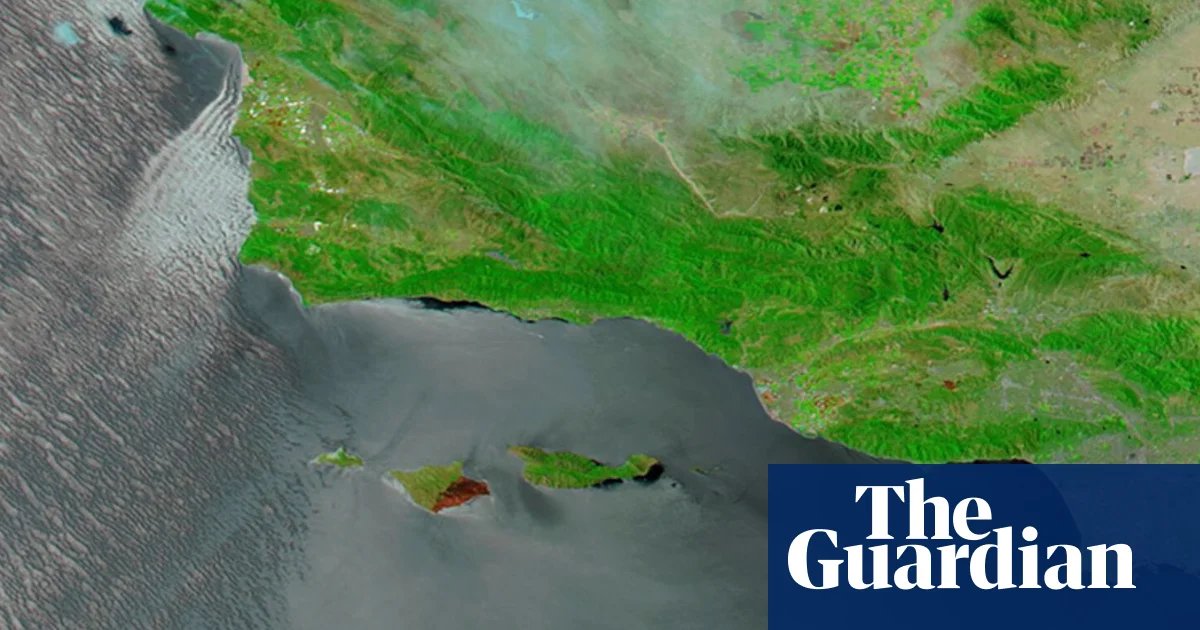
Images from a Nasa satellite showcased the devastating scars left behind by a wildfire that consumed roughly a third of Santa Rosa Island, one of the five that make up Channel Islands national park off the southern California coast.
Taken on 20 May, the Moderate Resolution Imaging Spectroradiometer (Modis) took the false-color image of the burn area, showing swaths of blackened land.
While the fire is mostly contained, the images drive home the potential lasting impact on the unique ecosystems across the rugged and remote island. Home to scores of rare and threatened species, Santa Rosa provides habitat to some plants and animals found nowhere else on earth.
The fire that scorched more than 18,300 acres is believed to be the largest recorded on the island, officials said. The landscapes that evolved separately from California’s mainland are not considered fire-adapted ecosystems, and blazes of this magnitude and size are uncommon here.
While the cause of the fire is still under investigation, according to National Park Service officials, flames were spotted after a sailor crashed his boat onto Santa Rosa’s rocky shores and fired flares to seek help. Images shared by the Coast Guard showed that “SOS” was carved into the charred ground by the 67-year-old man, before he was rescued by helicopter.
Fire crews boated in to battle the blaze faced extreme fire behavior fueled by strong winds, while the thick coastal marine layer and challenging terrain inhibited aerial support and caused communication and access issues, according to official updates from CalFire. Resource advisers – teams of restoration biologists, archeologists and cultural experts – were on site during the firefight to limit disturbances caused by strategies to contain the blaze, including deep gouges into the soil and vegetation left by bulldozers.
The delicate habitats and archeological sites threatened by the flames also had to be protected. Resource advisers – teams of restoration biologists, archeologists and cultural experts – were on site during the firefight to limit disturbances, according to official reports.
Attention has now turned to restoration, and how to protect the unique and extraordinary wildlife from further harm. A specialist crew of National Park Service firefighters are conducting fire severity analyses, and will continue monitoring the area to learn more about how ecosystems respond to fire long term.
“As soon as it’s safe, Burned Area Emergency Response (BAER) specialists will arrive on the island to begin assessing soil stability, hydrological changes, infrastructure damage, and threats to cultural and natural resources,” Ana Cholo, a spokesperson, said in an emailed statement. “The post-fire landscape is fragile, and one of the goals the BAER team has is to determine how to protect conditions and reduce further damage during the sensitive recovery period, and also what that recovery may look like.”
The archipelago that makes up Channel Islands national park is often referred to as the “Galapagos of California”, due to the abundant and diverse life that calls its sweeping hillsides and underwater kelp forests home.
Many of the species supported here are endangered or threatened. Roughly 46 plants and animals are endemic to Santa Rosa Island, according to NPS, including some of the most sensitive species found in the region.
Seven federally listed plant species can be found here, “all confined to small, fragile habitats that are extremely vulnerable to disturbance, erosion, and post‑fire impacts,” the non-profit Channel Islands Park Foundation said in an online post about the blaze. Native animals include the island fox and deer mice, which evolved into separate sub-species on each island.
The island’s Torrey pines that grow on sandstone bluffs along its north-east corner suffered some damage, according to initial assessments, but remain “largely intact”. The trees, which are considered among the rarest pines on earth, grow only on Santa Rosa and in a small stand in San Diego.
“Santa Rosa Island is a sanctuary of rare species, ancient culture, and rugged beauty shaped by wind, sea, and time,” Cholo said. “These are ancestral Chumash lands, home to cultural sites that span more than 13,000 years. The island holds a unique place in California’s history, and we recognize how meaningful it is to all who care about it.”