dailynewsnblog
There are several factors behind the immense ability of the United States Air Force to project power. One of the most important pillars is its massive fleet of aerial refueling tankers. By some estimates, these account for around 75% of the world’s tankers (depending on inclusion criteria). In 2024, the USAF retired the last of its large KC-10 Extender fleet, leaving it to rely on its large, but aging, KC-135R fleet and its new KC-46 Pegasus family.
The Boeing 767-based KC-46A first entered service in 2019, years behind schedule. Since then, it has repeatedly been in the news for all the wrong reasons, from fuel booms breaking off to cracks appearing. But none of these issues is a dealbreaker for the program, and the Air Force is currently moving to double down on it. It is plausible that these issues will be resolved in the early 2030s. Here is why the KC-46 is falling behind on its goals and why the Air Force is potentially gearing up to double its initially planned eventual purchase anyway.
Described As A “Lemon” In 2021

During the bidding process, the USAF initially awarded the contract to the rival Northrop Grumman/EADS (Airbus) A330 MRTT. Boeing took the decision to court. After a very long and drawn-out process, the USAF eventually selected Boeing’s KC-46 offer based on the Boeing 767 airliner. The tanker was never meant to be the backbone of the US tanker fleet. Instead, it was seen as a stopgap to bridge aging KC-10s and KC-135s with a future, stealthy tanker.
In 2021, The War Zone reported, “The US Air Force has described its bedeviled KC-46A Pegasus tanker as a ‘lemon,’ amid ongoing problems that prevent it from performing its primary aerial refueling mission on a day-to-day basis.” Since entering service, the KC-46 has been beset by a range of technical issues that have complicated its service. Today, it remains unclear if that stealthy tanker program (called NGAS) will be developed anytime soon.
Due to the massive demand of the USAF, far more examples of the KC-46 have been ordered and delivered than the MRTT. However, the MRTT has enjoyed much higher success in the export market. It is currently operated by Australia, France, the Netherlands, Saudi Arabia, Singapore, South Korea, Spain, the UAE, and the UK. Brazil, Canada, and Thailand are also ordering it (including as converted civilian airframes). The only export countries to have purchased the KC-46 are Israel (which is financing them with US military aid) and Japan, which has a long history of prioritizing US military equipment.
Technical Issues With The KC-46

The KC-46 Pegasus has struggled with a number of technical issues, and in 2025, it found itself in the news again after another refueling boom broke off during refueling. One of the leading issues is the Remote Vision System (RVS) used by its boom operators, which suffers from distorted depth perception, eye strain, and headaches for operators, inaccurate boom placement, and poor performance in some lighting conditions.
The tanker’s readiness rates have been below expectations, and the aircraft has had boom stiffness woes, software problems, structural cracks, fuel system worries, and more. In the build-up to the 2026 air campaign over Iran, a deployment of F-22 Raptors had to return to their US Air Force base as they were making the Atlantic crossing after the KC-46A tanker suffered software issues. The replacement KC-46A tanker also malfunctioned, further delaying the deployment.
In 2025, The War Zone reported, “The Air Force will inspect its entire fleet of 89 KC-46A Pegasus aerial refueling tankers after cracks were found on two of the four new planes...” These cracks were not found on surfaces or hinges and were limited to primary and secondary structures. Interestingly, the KC-46A is powered by Pratt & Whitney PW4000 engines instead of the more popular General Electric CF6 engines that commercial Boeing 767-300Fs are delivered with. Reports typically don’t reference the engine as one of its problems.
How Many KC-46 Tankers Are Left?
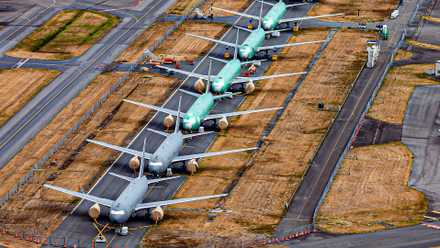
How many KC-46 tankers are there? A deep analysis of the USAF plans, Boeing’s 767-based Pegasus, production numbers, and what comes next!
Any “Lemon” Can Be Fixed

To a large extent, it is fair to say that any ‘lemon’ can be fixed given enough time, resources, and funding. The KC-46A has come a long way since the USAF described it as a lemon in 2021. Delays in the NGAS program, an aging KC-135 fleet, and Congress raising the required minimum tankers the Air Force is to operate from 466 to 502 by October, mean there is essentially no alternative to the KC-46 and the USAF has to make it work.
The increase in required minimum tanker inventories was passed in the 2026 National Defense Authorization Act. Still, this doesn’t mean fixes come quickly. Boeing is working to replace the troubled RVS with the RVS 2.0, but the schedule has repeatedly slipped, and initial fielding is now not expected until 2028. Teething development problems are common.
|
Boeing KC-46A Pegasus tanker (per The Aviationist, Boeing) |
|
|---|---|
|
Based on |
Boeing 767 (767-2C) |
|
Entered service |
2019 |
|
Initial planned purchase |
179 units |
|
Current plan |
259 |
|
Potential planned increase total |
319 |
Few today remember how the initial fleet of Lockheed C-5A Galaxy aircraft was plagued by cracks in the wings. For years, this forced them to operate with drastically reduced loads until the wings were replaced in the 1980s. While not published as much due to the lack of Russian transparency, the Su-57 Felon is known to have many technical issues (including its engines and internal weapons bay). It is unclear how long it will take Russia to mature the Su-57 into an effective platform.
Changing Demand For KC-46

Some attention to the KC-46’s woes should be given to the Air Force itself, and not just Boeing. The Air Force has been changing its requirements over time. What was meant to be a bridge aircraft is increasingly becoming a major backbone due to NGAS delays and increased demand.
As the US Air Force is increasingly focused on the Indo-Pacific, the need for tankers to overcome the vast distances increases. It has also been developing its ACE dispersed aircraft basing concepts. The KC-46 is designed as a multipurpose system and is quite a different aircraft from the Boeing 707-derived KC-135. It has superior avionics, radar warning, and potential for upgrades.
It is able to deliver much larger loads of fuel over much greater distances. Being more fuel efficient also means it doesn’t consume so much of its own fuel loads on these missions. It is able to operate from shorter runways than the KC-135, and it has some self-defense capabilities that allow it to operate closer to contested airspace. The KC-46 complements the KC-135 by being better suited for long-range strategic in-air refueling and refueling closer to conflicts (although neither is survivable in contested airspace).
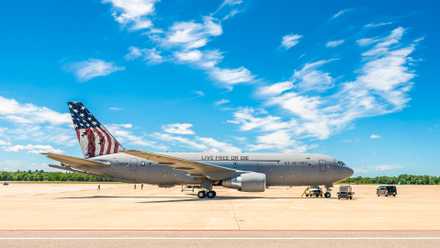
Engineering Concerns Prompt US Lawmakers To Limit USAF KC-46 Acquisitions & Extend KC-135 Retirements
The Pegasus is hitting turbulence.
Increasing The Orders For KC-46A

The Air Force currently has around 100 KC-46s in inventory, which is about five times as many tankers as Russia has. Its Fiscal 2027 budget proposal, boosted by a massive spending increase, is seeking to purchase 15 more KC-46s in 2027. It also wants Boeing to increase its annual production to 18 per year in the period 2028 to 2031.
At the same time, the per-unit cost is expected to increase from around $199.8 million to $321.9 million by 2028. Caution could be taken with interpreting that figure, as it is possible it could include new upgrades (e.g., communications and survivability). The initially planned 179-unit purchase cap has already increased to 188, and in 2025, the USAF announced it planned to purchase another 75, which would bring the total to 259.
In addition to that would be four engineering and manufacturing development KC-46s. In May 2026, The Aviationist reported the Air Force is now envisioning purchasing some 319 KC-46s. Purchasing this many Pegasus tankers would allow the Air Force to grow the fleet, retire more of the KC-135s, and compensate for the NGAS delays.
No Choice For The KC-46 To Work

The oldest KC-135 in service has the tail number 57-1419 and was built in 1957, or 69 years ago. These aircraft are old and will eventually need to be replaced. Meanwhile, a stealthy NGAS tanker remains many years away, and JetZero’s Z4 blended wing body demonstrator has yet to fly. The Navy’s large Boeing MQ-25 Stingray tanker drone is making progress, but is not expected to achieve initial operational capability until 2029.
The only alternative on the market is the Airbus A330 MRTT, but purchasing that aircraft is considered infeasible for a range of factors, including the fact that US procurement strongly favors American-made aircraft. The US Air Force has little choice but to make the KC-46 work. With funding, the USAF can likely brute force its way to resolve KC-46 issues, although this takes time.
It is also important not to overemphasize the Pegasus woes, as the aircraft is in operation and is already a major pillar of the USAF’s tanker fleet. It played an important role in the recent Iranian air campaign. Other programs have bigger issues. For example, the Soviet/Russian Ilyushin Il-78 has bigger issues, including a small production run, very low production rates, aging platforms, and the collapse of export orders. China is more interested in producing its own tankers, and India is looking for Western aircraft-based solutions.