dailynewsnblog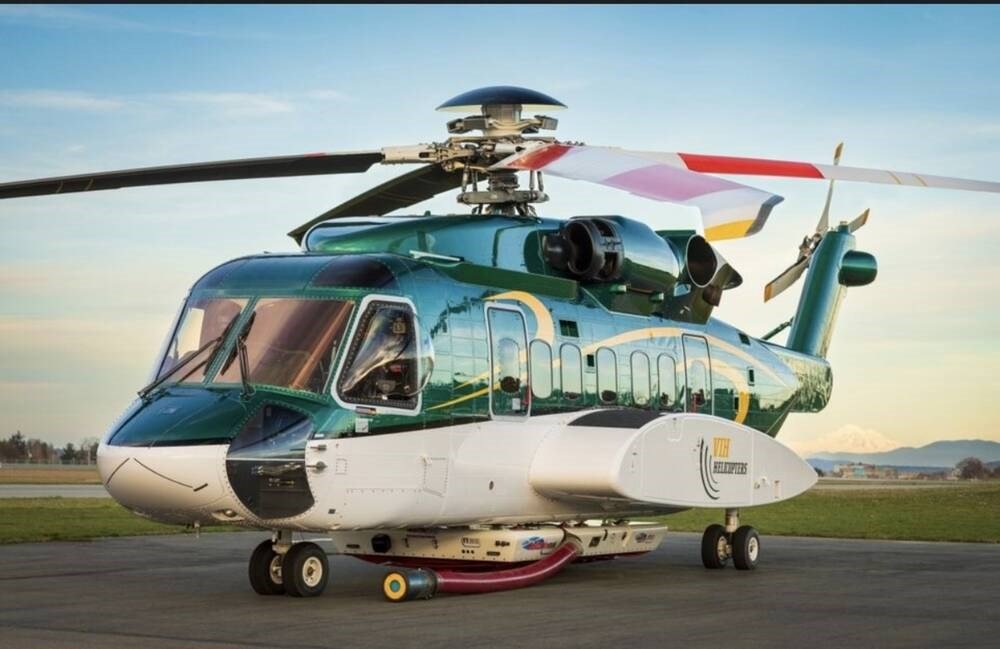

VIH Helicopters is providing two Sikorsky S-92A heavy helicopters for the season, with contracts starting immediately and continuing to Oct. 18.
A North Saanich aviation company will provide helicopters as part of the federal government’s first reserve of firefighting aircraft to help provinces and territories respond to wildfires this season.
VIH Helicopters is supplying two Sikorsky S-92A heavy helicopters for the season, with contracts starting immediately and continuing to Oct. 18.
They’re among 10 aircraft and two unspecified support assets being leased for 150 days starting this month by the Canadian Interagency Forest Fire Centre, thanks to a $317-million allocation in the federal budget.
The government said in a statement Monday that the Pan-Canadian Aerial Asset Program will boost national firefighting surge capacity by increasing provincial and territorial access to aircraft during periods of intense wildfire activity.
Provincial and territorial wildfire agencies will be able to request the use of four air tankers, one spotter plane and five heavy lift helicopters to fight wildfires. Along with VIH Helicopters, which is based at Victoria International Airport, the fleet will be sourced from B.C.-based firms Conair Group and Coldstream Helicopters.
The VIH Fire Raptor helicopters on contract with the Canadian Interagency Forest Fire Centre have 5,000-litre retractable belly tanks with rapid-hover fill capability of 48 seconds, and can cruise at 270 kilometres per hour.The helicopters can also transport up to 19 firefighters for rapid front-line deployment.
“VIH Helicopters is proud to support Canada’s national wildfire response efforts through our contract with CIFFC,” VIH chief operating officer Jen Norie said in a statement.
“As wildfire activity continues to intensify across the country, national surge capacity and rapid aerial response have never been more important.
“We are honoured to work alongside federal, provincial, and territorial partners to help protect communities, critical infrastructure, and natural resources across Canada.”
It’s the first time a national fleet of aircraft will be available to respond where needed. Wildfire responses have previously been managed on a provincial and territorial basis, with governments working with CIFFC to share resources across borders.
Kelsey Winter, executive director of CIFFC, said at a media event at the Aviation and Space Museum in Ottawa on Monday that the newly leased fleet will add to the existing model, not replace it.
“The program increases our availability of aircraft when existing fleets within provincial and territorial agencies are stretched thin, and it strengthens Canada’s collective ability to move aircraft where it is needed most,” Winter said.
The assets will be positioned within Canada based on fire activity forecasts and current wildfire activity.
The 2025 wildfire season was Canada’s second-worst on record, with nearly 90,000 square kilometres consumed as of September 2025 — an area larger than New Brunswick.
That came just two years after the worst-ever season on record in 2023, when more than 165,000 square kilometres burned.
Emergency Management Minister Eleanor Olszewski said Monday that wildfires are becoming “more severe and more frequent,” so the government saw the need to invest in a national service.
Courtenay-Alberni NDP MP Gord Johns — who petitioned the government to create a national firefighting service before the fall budget last year — said in a statement Monday that setting up the fleet was “an important and overdue step.”
“This announcement is progress, but the scale of the climate crisis demands sustained action and long-term investment,” Johns said.
Johns welcomed news that VIH Helicopters will be part of the new national firefighting fleet, alongside other Canadian aviation companies.
“British Columbians know the expertise exists right here on Vancouver Island,” Johns said.
Johns also renewed his call for the federal government to build a permanent sovereign firefighting fleet through Canadian manufacturing and retrofit programs, including converting retired military aircraft into large airtankers.
Johns said the NDP will continue pushing the federal government to work with Canadian companies like Port Alberni-based Coulson Aviation to retrofit retired CC-130 Hercules aircraft into next-generation airtankers.
“We have the skilled workers, the aerospace expertise, and the industrial capacity to build a stronger long-term wildfire response system while creating good jobs,” said Johns.
Ottawa chose to lease, not buy, the firefighting assets because the wait for new aircraft can exceed five years, Olszewski said. This approach also means the federal government isn’t paying for a plane that will sit idle over the winter months, she said.
“We wanted to make sure that we had aerial fighting, firefighting assets in place for this wildfire season. So it was very important to do that at this point in time,” Olszewski said.