dailynewsnblog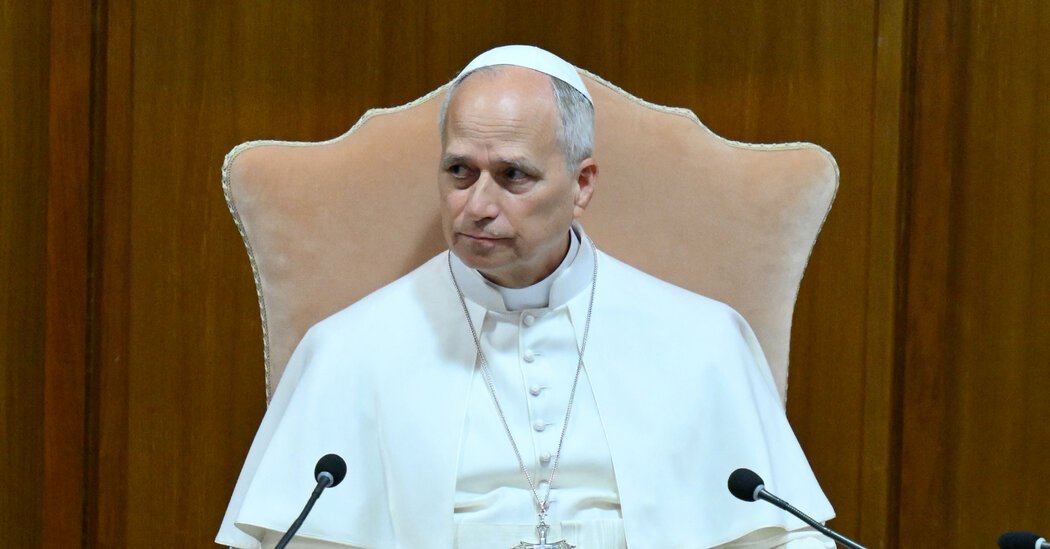
Pope Leo XIV has been a major global critic of immigration crackdowns and war, staking out a moral agenda that has at times challenged the political leadership of his home country.
Now Leo, the first pope from the United States, has added to that list artificial intelligence, taking on American power brokers of another kind — this time in Silicon Valley.
Leo’s papal document, titled “Magnifica Humanitas,” or “Magnificent Humanity,” and made public on Monday, is the defining theological statement so far of his young papacy, and the most significant moral intervention on A.I. to date from a religious leader. It also is an effort to inject Catholic moral values into a famously secular, and significantly American, industry that is transforming the world at lightning speed.
“Crucial questions impose themselves on our conscience and can no longer be avoided: Where are we going? Toward what goal do we wish to orient ourselves? What direction should we choose as a people and as a human community?” Leo wrote.
Leo specifically called for A.I. to be “disarmed,” similar to the church’s support for nuclear disarmament, meaning “freed from logics that turn it into an instrument of domination, exclusion and death,” he explained in a speech at the Vatican.
The document’s release in the synod hall was styled as a branded launch event, with bright yellow banners and a splashy introductory video, produced with EWTN, an American Catholic network with global reach.
Seated three seats away from the pope on the dais was a high-powered A.I. pioneer, Christopher Olah, a co-founder of the American company Anthropic. The Vatican’s invitation to such a business executive was a rarity. It signaled an attempt to expand Leo’s influence, and his priority on dialogue even among unlikely partners, presenting a friendly posture alongside an ostensible adversary.
For Leo, the way forward must involve collaboration, said Cardinal Blase Cupich of Chicago, Leo’s hometown, who sat in the front row.
“I think that openness on the part of Mr. Olah, as well as the Holy Father, can be the bridge by which all that can happen,” he said in an interview on his way out of the synod hall. “There is a need for the wisdom that the church’s tradition can bring to this discussion of how to use A.I. in a way that preserves human dignity.”
But Mr. Olah’s presence also underscored that significant power lies not only with governments, but “with major economic and technological actors,” as Leo noted, and that the Vatican is prioritizing these relationships in an almost official diplomatic capacity.
Leo opened his remarks with a special thank you to Mr. Olah, almost as if he were a head of state. “In turn, in the name of the church I accept your invitation to walk together to listen and to speak and together to find the way for humanity in this time of artificial intelligence,” Leo said.
The Vatican is acutely aware of technology’s power to upend existing political and religious order. The invention of the printing press in the 15th-century famously preceded the rise of nation-states, and the Protestant Reformation, remaking the power of the Catholic church.
The Vatican has been an instrumental force over the last decade in generating a global conversation about the value of the human in the A.I. age.
Church leaders under Pope Francis regularly held meetings called the “Minerva Dialogues” with technology leaders to discuss A.I. developments. Pope Francis met with the Group of 7 leaders in 2024 and urged regulation, and also called for the banning of lethal, autonomous weapons.
Leo’s document, called an encyclical, is in many ways a culmination of that effort.
“At key moments in history, the Church is called to decipher the ‘new things’ in the light of the Gospel and the dignity of the human being,” Leo said on Monday. “Today we find ourselves facing a transformation of similar magnitude, with perhaps even greater consequences. “
A moral critique of A.I. has been growing within some religious communities in the past few years. The effort to elevate a broader discussion has grown more urgent as the technology’s impact for war and on children becomes more pressing. Powerful companies including Anthropic are on a path to becoming trillion-dollar ones.
“When such power is concentrated in the hands of a few, it tends to become opaque and evade public oversight, increasing the risk of distorted forms of development that give rise to new dependencies, exclusions, manipulations and inequalities,” Leo wrote.
With this document, Leo is offering a way for efforts to congeal into a united movement to defend what he describes as human flourishing.
Catholic universities in the U.S., including Georgetown and Santa Clara, have taken significant steps to advance the conversation about A.I. and Catholic moral values in academic and public circles.
The University of Notre Dame received a $50 million grant from the Lilly Endowment in December to develop faith-based ethical frameworks for A.I. through its Institute for Ethics and the Common Good.
Meghan Sullivan, the director of that institute, said she often hears a concerning view when she meets with A.I. developers in Silicon Valley — “that only a few hundred people on earth actually matter right now: the ones building frontier models and the politicians powerful enough to regulate them.”
“This encyclical is a direct rebuttal to that worldview,” she said. “The Church is insisting, as it has for 2,000 years, that the people of Wichita and South Bend and Nairobi and Manila are not bit players in someone else’s technological revolution.
“I think that we are seeing with Pope Leo in this encyclical, finally an institution that’s powerful enough to stand up for those ideas.”
The document has a particularly American appeal. Leo specifically references the United States Conference of Catholic Bishops — the only national conference to get a callout — in a section about caring for young people facing job insecurity. He quotes J. R. R. Tolkien’s “The Return of the King,” a novel beloved by many in America, particularly young men.
How effective Leo’s efforts will be, and how much impact a papal treatise can have even in Catholic circles, remains to be seen.
Societies like the United States once held constitutional conventions to have robust public conversations about such critical topics, noted Ron Ivey, a longtime writer and research fellow with Harvard University’s Human Flourishing Program.
Too often the prevailing narrative is that humans have no choice but to accept the widespread required use of A.I., he said.
“We need to have a public conversation, in our libraries, in our civil society, whatever is still strong in that area,” he said. “Why are we building this thing, and who is it for, and how do we make it work for our flourishing?”