dailynewsnblog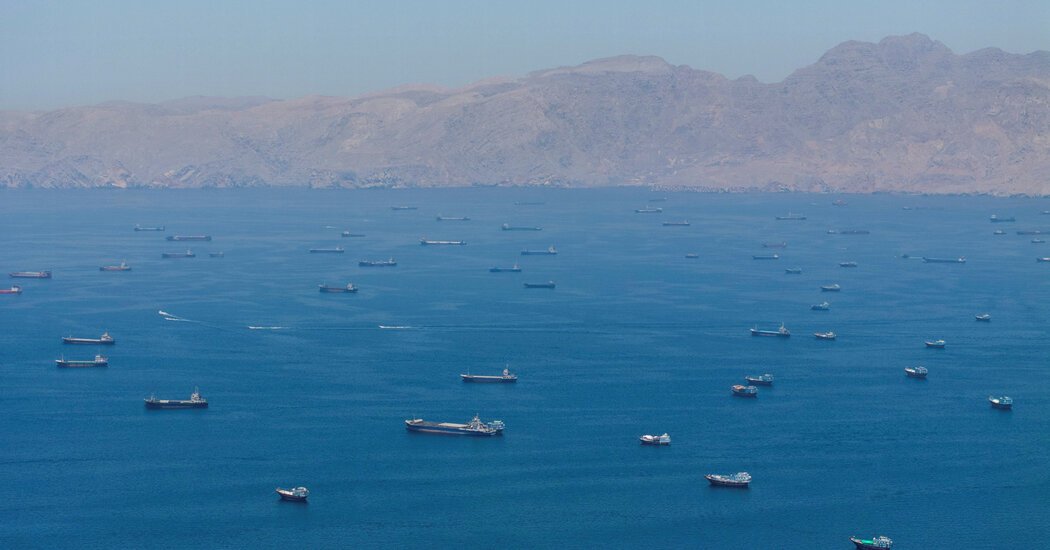
The United States and Iran on Monday both played down hopes of an imminent breakthrough toward ending the war, although peace talks appeared to continue.
The two countries are working toward a deal that would wind down the war in the Middle East by reopening the Strait of Hormuz, a vital waterway for oil and gas shipments that Iran has effectively blockaded.
But much remains uncertain about the agreement.
One of the key questions is around Iran’s nuclear program. On that issue, and others, American and Iranian officials have presented contrasting descriptions of the emerging agreement, leading to doubts about whether the deal could be finalized.
“We have reached conclusions on a large portion of the issues, but no one can claim that the signing of an agreement is imminent,” Esmail Baghaei, Iran’s foreign ministry spokesman, told reporters on Monday, according to Iran’s state broadcaster.
Here’s what to know.
What has the U.S. said?
President Trump said in a social media post on Monday that the agreement would either be “great and meaningful” or “there will be no deal,” after facing criticism from prominent Republicans that the proposal was too soft on Iran.
A day earlier, Mr. Trump said that he had told the Americans not to rush into a deal: “Both sides must take their time and get it right.” In a separate post on Sunday, he insisted that any deal he might make with Iran would be “a good and proper one,” though he provided no details and made it clear much was unresolved.
A senior U.S. official who declined to be named, speaking to reporters on Sunday, did not offer a timeline for how long the United States would allow for a deal on the nuclear issues.
The official said the reopening of the strait would not inaugurate any tolls for passage, as Iranian officials have advocated.
Secretary of State Marco Rubio said on Monday, while on a visit to India, that the United States might have news to announce about the talks with Iran “maybe today” after the two sides failed to reach a deal on Sunday.
“We have what I think is a pretty solid thing on the table in terms of their ability to open up the straits, get the straits open, enter into a very real, significant, time-limited negotiation on the nuclear matter,” he said.
He had signaled in an interview on Sunday that the Trump administration was prepared to accept an interim agreement that didn’t immediately take away Iran’s ability to make nuclear weapons.
“You can’t do a nuclear thing in 72 hours on the back of a napkin,” Mr. Rubio said.
At this stage, the United States is not offering to unfreeze any Iranian assets, but the U.S. official said that the Americans have made clear they are willing to begin that process if Iran gives up its highly enriched uranium.
“No dust, no dollars,” the official said, a reference to “nuclear dust,” Mr. Trump’s term for Iran’s uranium.
In April, the United States began a blockade on Iranian ports and Iranian-linked ships globally. Mr. Trump said in a post on social media on Sunday morning that it “will remain in full force and effect until an agreement is reached, certified, and signed.”
On Monday, he also called on countries like Qatar and Saudi Arabia to sign on to the Abraham Accords to normalize ties with Israel as part of the initial agreement — to which they are highly unlikely to agree. If more Arab countries sign up to the accords, it could placate some Iran hawks in the Republican Party who have expressed misgivings about the potential deal.
What has Iran said?
Mr. Baghaei, Iran’s foreign ministry spokesman, portrayed the emerging accord on Monday as a preliminary framework that does not go into detail on the thorniest issues.
His comments were among the most extensive yet by a top Iranian official about the emerging deal.
“The focus of the negotiations is on ending the war and at this stage, there is no discussion about nuclear details,” he said, referring to one of the key sticking points.
On the strait, Mr. Baghaei said the potential deal does not go into detail about how to reopen the waterway and sent a mixed message on whether Iran might still seek to charge some transit fees.
Three senior Iranian officials, speaking on the condition of anonymity because they were not authorized to do so publicly, said on Saturday that Tehran had agreed to a memorandum of understanding that would stop the fighting on all fronts, including Lebanon, where Israel is fighting with Hezbollah, the Iranian-backed militant group; lift the U.S. naval blockade on Iran; and release $25 billion in frozen Iranian assets.
Parts of that contradict what the Americans have said. It was unclear whether the proposal described by Iranian officials was the same one Mr. Trump was referring to on Sunday or that the U.S. official discussed with reporters on Sunday.
What still needs to be addressed?
The potential interim agreement appears to leave some of the thorniest questions surrounding Iran’s nuclear program unresolved.
Chief among these is how Iran would dispose of its highly enriched uranium and the length of any potential moratorium on enrichment. Iran possesses a stockpile of about 970 pounds of uranium enriched to 60 percent, according to the International Atomic Energy Agency.
The U.S. official on Sunday said that these issues would be addressed in future negotiations.
Under the 2015 nuclear deal negotiated during the Obama administration, Iran turned most of its stockpile over to Russia, an arrangement that could serve as a model again. Another possibility would involve diluting the uranium to lower enrichment levels that could not be made into a nuclear weapon.
The United States has, in previous rounds of negotiations, sought at least a 20-year moratorium on enrichment. Iran has proposed a far shorter timeline. The American official said on Sunday that the precise timeline mattered less than the mechanism by which the restrictions were enforced.
The deal under discussion now also does not address Iran’s missile stockpile, the U.S. official said. That is a critical issue to the Israelis, who are within reach of many of Iran’s ballistic missiles.
What has been the reaction?
Some Republicans and Iran hawks have denounced the potential agreement.
“It doesn’t make too much sense to me,” Senator Thom Tillis, Republican of North Carolina, said Sunday on CNN’s “State of the Union.” Mr. Tillis called the Iranians’ commitment to reopening the Strait of Hormuz “questionable” without a finalized peace deal. “There are a lot of things that need to be explained,” he said.
Prime Minister Benjamin Netanyahu of Israel, whose country joined the U.S. attack that started the war in late February, said in a statement on Sunday evening that he discussed the potential agreement with Mr. Trump on a call on Saturday night and that they both agreed Iran could not be allowed to obtain nuclear weapons. He also said that Mr. Trump had affirmed Israel’s right to defend itself, including in Lebanon.
Still, Mr. Netanyahu’s statement came about 18 hours after Mr. Trump announced the unfolding deal. Analysts said the long silence reflected concerns inside Israel that this agreement could ultimately fall far short of its aims of shutting down Iran’s nuclear program and curbing its missile capabilities. Clashes between Hezbollah and Israel have strained the cease-fire with Iran since it was announced in April.
The leader of Hezbollah, Naim Qassem, in a speech on Sunday, expressed hope that a cease-fire agreement between Iran and the United States would include the group, but framed any potential agreement as proof of Iran’s victory.
“Iran has managed to humiliate America,” he said.
Mr. Trump shot back at critics on social media on Sunday afternoon, calling them “losers, who are critical about something they know nothing about.”
“Unlike those before me who should have solved this problem many years ago,” he said. “I don’t make bad deals!”