dailynewsnblog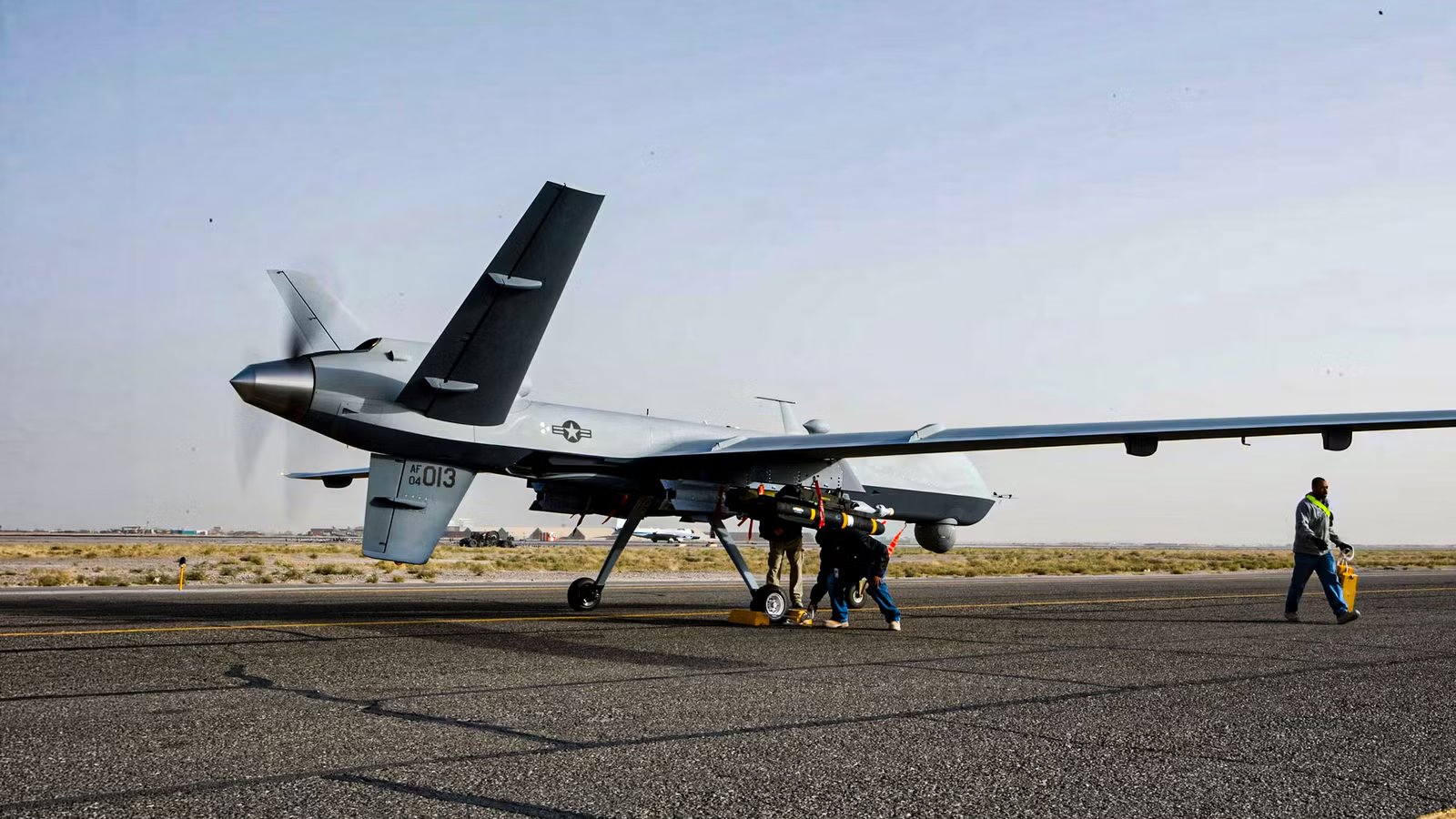
The General Dynamics MQ-9 Reaper is an evolution of the older Predator drone (it’s also called the Predator B). While it is sometimes said the MQ-9 ER (Extended Range) variant achieves 40+ hours in endurance, this is somewhat deceptive. Endurance hinges on a range of factors, including payload, the altitude at which it is operated, and other mission-specific considerations.
The MQ-9 ER can achieve over 40 hours of endurance, but only in an ideal environment with minimal weapons, the most economical cruise, minimal maneuvering, and optimized altitude and throttle. In realistic combat patrol conditions, the endurance will likely collapse to between 30 and 34 hours. Even so, the MQ-9’s endurance is impressive and is testimony to the engineering at General Dynamics, Honeywell, and other contributing defense contractors.
The Value Of Endurance

The MQ-9 family was developed primarily as a high-endurance ISR platform, although it was also adapted for a strike role carrying Hellfire missiles. The drone became particularly famous for striking militants during the GWOT. But arguably, its high endurance is a greater asset than its ability to carry missiles. The MQ-9 comes with a standard endurance of over 27 hours, while the Extended Range variants can push this north of 40 hours.
Endurance and the ability to loiter for hours on end over an area of interest are two of the most important capabilities any spy aircraft can have. One of the reasons why the USAF has kept the ancient Lockheed U-2 spy planes in service is their 14-hour endurance. The U-2 was designed in a world before satellites existed. But while satellites can do much of the work of spy planes today, they can’t do all of it.
The orbits of satellites are predictable. So adversaries know when to hide items of interest, for example, wheeling an experimental aircraft inside a hangar at 15:23 until after the satellite passes. This is how the USAF kept its Project Constant Peg and its F-111 Nighthawk secret for so many years. Constant Peg was a clandestine operation where the US obtained and trained on the Soviet MiG-23, MiG-21, and other fighters. Additionally, satellites only provide a snapshot as they zoom overhead. By contrast, an ISR aircraft, like the MQ-9, can continuously loiter over an area, providing a continuous live stream for over a day.
The RQ-9’s Triple-Redundant System

Aircraft are built with redundant systems so that if one system fails, another can take over. A triple-redundant system will typically involve three independent channels (like computers, sensors, actuators, etc.) operating in parallel. If one system malfunctions or disagrees, the majority rules, and the faulty channel can be isolated. It also aids in diagnostics, identifying issues in real time.
Importantly, it means the aircraft has no single point of failure, at least with critical functions like autopilot, data links, navigation, flight control, and engine management. So, while having triple-redundant avionics doesn’t increase the aircraft’s endurance per se (the extra weight decreases it), it does allow for continuous safe operations, fault-tolerance, autonomous capabilities, and overall system reliability.
An example of majority voting logic is if Computer A says “maintain 12° bank”, Computer B says “maintain 26° bank”, and Computer C says “maintain 12° bank”, then the system will assume Computer B has failed and will ignore it. General Dynamics writes, “An extremely reliable aircraft, MQ-9A is equipped with a fault-tolerant flight control system and triple-redundant avionics system architecture. It is engineered to meet and exceed manned aircraft reliability standards.”
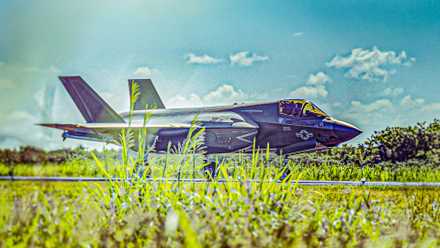
How Many Hours Can The F-35 Fly On Internal Fuel?
What do you think the answer is?
The MQ-9’s Honeywell TPE331-10

More important to the RQ-9’s endurance is the Honeywell TPE331-10 turboprop engine. The engine is an evolved design from the TPE331 engine that was developed in the late 1950s and 1960s. Honeywell claims, “Pilots flying TPE331-powered aircraft enjoy exceptional horsepower response and best-in-class fuel economy.”
General Dynamics adds to this, saying, “MQ-9A is powered by the flight-certified and proven Honeywell TPE331-10 turboprop engine, integrated with Digital Electronic Engine Control (DEEC), which significantly improves engine performance and fuel efficiency, particularly at low altitudes.”
|
MQ-9 Reaper Block 5 max performance (per General Dynamics) |
|
|---|---|
|
Max altitude |
45,000 feet (13,716 meters) |
|
Endurance |
26 hours |
|
Endurance ER with fuel pods |
34 hours |
|
Endurance ER Big Wing Kit |
40+ hours |
|
Airspeed |
240 Knots |
The turboprop engine is operated much more efficiently than fighter jet engines. The Reaper is designed to prioritize fuel efficiency, thermal stability, reliability, and low stress. During most of its missions, the engine operates at a cruise using fairly modest power settings. The Reaper’s cruising speed is typically in the fuel-efficient 150–230 knot range, while its altitude is typically 20,000 to 40,000 feet during endurance missions.
Other Endurance-Enhancing Features

The Reaper has been designed for endurance, not for dogfighting or extreme maneuvers. The standard model comes with a wingspan of 66 feet (around 20 meters), giving it a high aspect ratio. The aircraft’s design reduces drag significantly and boosts lift with less energy. The standard variant has a fuel capacity of around 4,000 lbs, allowing the aircraft to cruise for around 27 hours.
The actual endurance can vary by several hours up or down, depending on the payload and other specifics of the mission. The main way the MQ-9ER model extends the range and endurance is by mounting extra fuel tanks under the wings. This boosts its fuel capacity to around 6,000 lbs. It also comes with a four-bladed, instead of a three-bladed, propeller. Other improvements to increase efficiency include an alcohol-water injection (AWI) system and an advanced fuel management system. There is also the option for the “Big Wing Kit” providing the type’s maximum endurance.
In April 2025, General Dynamics delivered the first Block 5 Extended Range example to the US Marines for flight testing and evaluation. It said, “The MQ-9A ER is designed with field-retrofittable capabilities, such as wing-borne fuel pods and reinforced landing gear, that extend the aircraft’s endurance to more than 30 hours while further increasing its operational flexibility. It provides long-endurance, persistent surveillance capabilities, with Full-Motion Video and Synthetic Aperture Radar/Moving Target Indicator/Maritime Mode Radar.”

The Countries Acquiring MQ-9B SkyGuardian Drones
Many countries and government agencies are ordering General Dynamics MQ-9 Reaper drones that provide excellent patrol capabilities.
The MQ-9’s Awkward 2026 Role

The MQ-9 Reaper occupies a bit of an odd transitional phase in the United States Air Force. With a cost of around $30 million (depending on configuration) per aircraft (around half the price of the fly-away cost of an F-16), they are much too expensive to be disposable platforms. At the same time, their availability and endurance make them excellent ISR assets. But they are also incredibly vulnerable and have little ability to operate safely in contested airspace.
Adding to the dynamic is the fact that the USAF is developing much cheaper autonomous ISR aircraft to replace the Reaper, and the fact that the Reaper is expected to retire from 2030 to around 2035. The RAF retired them in 2025. The result is that the USAF has been using and losing them in large numbers over Yemen and Iran for years. The Houthis in Yemen have destroyed dozens of them over the last few years, while perhaps dozens more were lost over Iran during the 2026 air campaign.
Losing expensive MQ-9s is far from ideal, but they don’t have any sensitive technology that the US is afraid of falling into the wrong hands (that happened years ago), and they are to be retired in five or so years anyway. That said, there could be a classic survivor bias going on here (or better, a survivor bias in reverse). The USAF may also be using its high-end, secretive RQ-170 and possibly RQ-180 spy drones. But because they are not shot down, videos of them don’t emerge, and so it may appear the RQ-9 is operating in these theaters alone.
Survivability Narrows Operational Use

Numerous companies are racing to produce long-endurance but low-cost ISR drones to replace the RQ-9 Reaper. As stated, the USAF is losing dozens in conflicts, and this is far from ideal. That said, vulnerability in itself is not necessarily a deal-breaker, as many or most reconnaissance missions are in peacetime over international maritime airspace, over insurgent regions with little air defense, or over border regions.
The Lockheed U-2 Dragon Lady was first downed by the Soviets in 1960 and again in 1962 over Cuba. Regardless, the USAF still has the aircraft in service. It may be the wrong asset to conduct reconnaissance flights over China today, but it remains well-suited for monitoring the Southern Border and other low-threat or no-threat theaters. The Belgian Air Force, the Polish Air Force, and the Taiwanese Republic of China Air Force are currently taking delivery of their first RQ-9B SkyGuardians. Canada, Denmark, and India all have them on order.
Finally, it should be noted that ISR (spy) aircraft are often one of the most secretive forms of military aircraft. The Cold War Lockheed U-2 and Lockheed SR-71 Blackbird were both black box projects developed in secret. It took years for the US to acknowledge the existence of the RQ-170 Wraith, and today, only one grainy official image of it has been released (more images exist from airplane spotters). The US doesn’t acknowledge the existence of the massive RQ-180 flying wing believed to exist, while Lockheed is known to be developing the hypersonic SR-72 Son of Blackbird in secrecy. The RQ-9 is just one of the more visible and unclassified US reconnaissance assets.
Catch what other trackers miss
Emergency squawks, holds, NOTAMs — live signals, no signup.
Open tracker
Catch what other trackers miss
Emergency squawks, holds, NOTAMs — live signals, no signup.
Open tracker