dailynewsnblog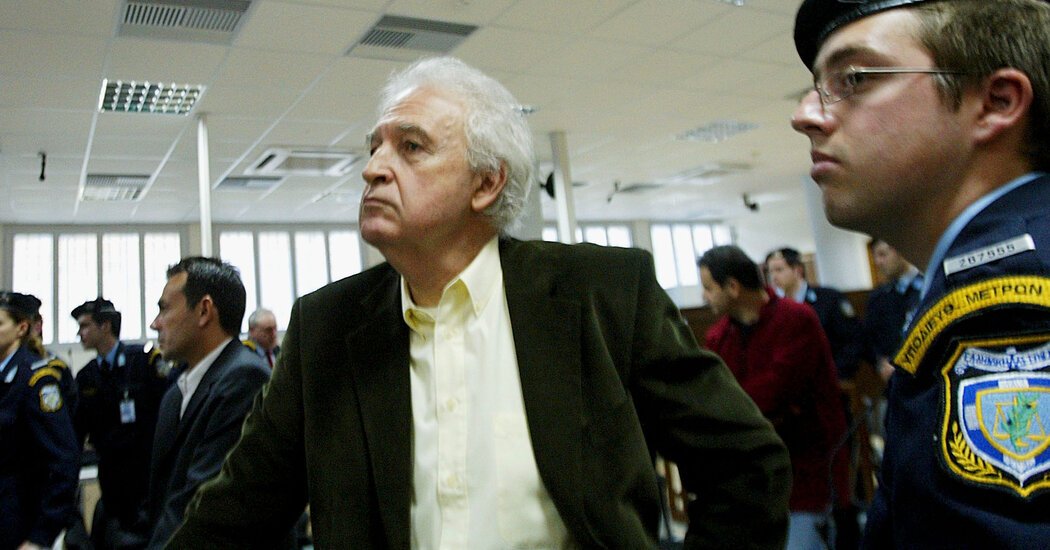
An 82-year-old man who was serving 17 life sentences for leading a far-left Greek militant group that killed 23 people, including a C.I.A. officer, has been released from prison, prompting angry objections from relatives of the group’s victims.
Greek television footage on Friday showed the man, Alexandros Giotopoulos, walking through a central Athens neighborhood carrying a plastic shopping bag, hours after he was freed on Thursday evening. His lawyer said he was released because of his advanced age, among other reasons.
A court ruled in 2003 that Mr. Giotopoulos was the mastermind behind November 17, a militant group that was active in Greece between 1975 and 2002. It carried out a spate of bombings and assassinations, as well as bank robberies that helped to finance its operations.
Its victims included industrialists, politicians and foreign officials, including Richard Welch, a C.I.A. station chief in Athens who was gunned down in 1975. Mr. Giotopoulos has consistently denied that he led the group or was involved in its killings.
“After 24 years of imprisonment, I am still awaiting an answer to the crucial question: ‘In what place did my moral instigation take place?’” he said in a statement to Documento, a left-leaning newspaper, after his release. “‘When did it happen? What was the weather like? Who was present? And what specific words were used to persuade the physical perpetrators?’”
In Greece, people sentenced to multiple, concurrent life terms in prison are generally released after about 25 years, and Mr. Giotopoulos had filed several petitions asking to be freed. A judicial panel finally agreed, citing his age, failing health and good behavior in prison, where he completed postgraduate studies, his lawyer, Vasiliki Kamilari, said on Greek television.
Victims’ family members were dismayed by the news of his release.
“Let’s not forget that he’s the leader of November 17, who got 17 life sentences,” Kostas Bakoyannis, a former Athens mayor whose father, a conservative politician, was killed by the group in 1989, said on Greek television on Friday. “Let’s not forget that, because in a while we’ll be hearing that he’s not a murderer but a university professor.”
The Turkish Foreign Ministry also condemned the decision, calling Mr. Giotopoulos a “treacherous terrorist.” Two Turkish Embassy staff members were among those killed by November 17.
News reports said the prosecutor at the Greek Supreme Court was seeking to review the ruling, raising the possibility that Mr. Giotopoulos could be returned to prison. The prosecutor’s office generally does not discuss pending judicial matters and did not immediately respond to a request for comment.
Ms. Kamilari said any attempt to overturn the ruling was unlikely to succeed, describing it as “a model of particularly thorough and well-founded reasoning.”
A spokeswoman for the Greek police, Constantina Dimoglidou, said Mr. Giotopoulos would be required to report to his local police station once a month under the terms of his release.
November 17 took its name from the date in 1973 when a student uprising against Greece’s military dictatorship was violently repressed by the police and the army, killing more than 20 people.
The group eluded the authorities until 2002, when one of its members was injured by a bomb that went off prematurely. That led to a break in the investigation and the dismantling of the network. Mr. Giotopoulos was arrested on the island of Lipsi, where he had been living under a false identity.
At the 2003 trial, 14 other members of November 17 were convicted alongside him of various charges and sent to prison. Three are still in prison, including Dimitris Koufodinas, who was found by the court to be the group’s principal assassin.