dailynewsnblog
In a world dominated by sleek jets and ultra-efficient turboprops, the roar of piston-engine propellers sounds like a blast from the past. However, some of these thunderous machines still roam the world today, not in regular service, but as flying tributes to a bygone era and also as treasured museum pieces, such as a DC-3 or DC-6. However, it was the Douglas DC-7 that stood tall as America’s last great piston-powered airliner.
The Douglas DC-7 represents the final chapter of the great piston-powered airliner age. Developed in the 1950s, this aircraft pushed the limits of range, speed, and passenger comfort just before the rise of the jet age. Let’s explore the DC-7’s development, service life, and remaining examples in museums, while also explaining why turboprops replaced piston engines. We will also take a brief detour to the battlefield to recognize a smaller cousin of the DC-7: the legendary Douglas A-1 Skyraider.
The Douglas DC-7 Was The Pinnacle Of Piston-Powered Airliners

The Douglas DC-7 is considered the last major piston-engine, propeller-driven airliner in the US, with surviving models preserved in museums such as the Delta Flight Museum and the Pima Air & Space Museum. At its core, the Douglas DC-7 was a technical marvel, developed from the similar DC-6 model that preceded it. It is a four-engine, long-haul aircraft that was designed to meet the demands of coast-to-coast, nonstop air travel.
It first took to the skies in 1953 and immediately made an impression. Capable of flying nonstop from New York to Los Angeles in under eight hours, it was faster and more powerful than its predecessors and other alternatives available at the time. The DC-7 was designed as a response to competition from Lockheed’s Super Constellation and to meet the evolving expectations of airlines like American and United.
The key to its performance lay in its Wright R-3350 Duplex-Cyclone piston engines, which gave it both speed and range. According to Epic Flight Academy, the DC-7 was Douglas Aircraft’s last major piston-powered airliner and the last Douglas piston aircraft, succeeded by the jet-powered DC-8 just a few years later. The DC-7 model was not the only variant produced by Douglas: the original model was followed by the DC-7B and DC-7C, which were built for overseas flying and had more fuel capacity.
In 1959, Douglas began converting DC-7s and DC-7Cs into DC-7Fs, which were freighters. Though it was admired for its capabilities, the DC-7 was also known for being mechanically complex and temperamental. The very engines that gave it power were prone to overheating and failure, especially under the stress of transcontinental operations. Still, for a brief period in the 1950s, the DC-7 dominated as the premier plane for long-range domestic flights.
The Rise And Fall Of the Piston Engine In Commercial Aviation
So why did aircraft like the DC-7 fall out of favor? The answer lies in the evolution of engine technology and airline economics. While piston engines powered the golden age of early aviation, they were eventually eclipsed by turboprop and jet engines due to their greater efficiency, power, and reliability.
Piston engines, like those in the DC-7, had several drawbacks. They required intensive maintenance, were vulnerable to engine fires, and couldn’t match the performance of emerging jet engines. Its Wright R-3350 engines were prone to overheating during long-haul flights. The issue became more problematic as airlines sought to increase utilization rates and expand their routes.
|
Feature |
Douglas DC-7 |
Lockheed Constellation |
Boeing 707 |
Douglas DC-8 |
|
First Flight |
1953 |
1943 |
1957 |
1958 |
|
Engine Type |
Piston (Wright R-3350) |
Piston (Wright R-3350) |
Jet (Pratt & Whitney JT3C) |
Jet (Pratt & Whitney JT3C) |
|
Top Speed |
~406 mph (653 km/h) |
~330 mph (531 km/h) |
~600 mph (965 km/h) |
~630 mph (1,015 km/h) |
|
Range |
~3,635 miles (5,850 km) |
~2,400–5,400 miles (3,860–8,690 km)* |
~5,280 miles (8,500 km) |
~5,940 miles (9,560 km) |
|
Passenger Capacity |
69–105 |
62–109 |
110–189 |
131–259 |
|
Crew |
4–5 |
5–6 |
3–4 |
3–4 |
|
Notable Use |
Last piston long-haul airliner |
WWII transport & luxury airliner |
First successful commercial jetliner |
DC’s first jet competitor to 707 |
|
Notable Operator |
American, Delta, Eastern |
TWA, Pan Am, USAF |
Pan Am, TWA, American Airlines |
United, Delta, Eastern |
|
Retirement Era |
Late 1960s |
Late 1950s–60s |
1980s–2000s |
1980s–2000s |
|
Surviving Aircraft |
Museum displays only |
Some flying, several in museums |
Museums, some still operational (military roles) |
Museums, few are active for research or cargo |
As shown in the chart above, the arrival of jet aircraft, such as the Boeing 707 and Douglas DC-8, in the late 1950s rendered piston-powered airliners instantly obsolete. They were quieter, faster, and more appealing to passengers. Airlines quickly transitioned from piston planes to jets, marking the beginning of what became known as the ‘Jet Age.’
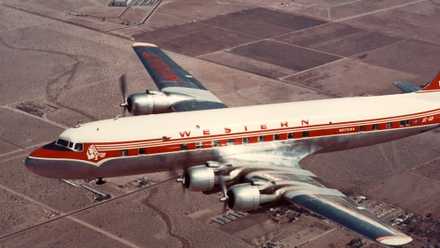
How Douglas Developed The DC-6 To Compete With The Lockheed Constellation
Even though the aircraft was developed from the DC-4, it took a rival to inspire its direction.
Airlines That Used The DC-7

Major carriers like  American Airlines,
  United Airlines,
  Delta Air Lines, Eastern Air Lines, and Braniff were among the DC-7’s primary operators. For these airlines, the DC-7 opened up new commercial possibilities, including nonstop coast-to-coast flights, improved scheduling flexibility, and enhanced passenger comfort. It even offered sleeper versions for overnight flights.
Overall, the aircraft was operated by carriers from over 30 countries and by 20 airlines just in the US alone. Delta Air Lines was one of the biggest champions of the DC-7. As noted by the Delta Flight Museum, Delta introduced the DC-7 in 1954 and operated it until 1968. It helped the airline break into faster, long-distance routes at a time when jetliners were still ramping up.
Despite its popularity with airlines, the DC-7’s reign was short. As the jet era rapidly took hold in the early 1960s, airlines began retiring their DC-7 fleets, replacing them with aircraft that could fly farther, faster, and more cheaply. By the end of the decade, only cargo operators and small regional lines still used piston-engine planes in any meaningful way. Put simply, it was the right plane at the wrong time.
Where Can You Still See A DC-7 Today?

Though the DC-7 is no longer in active commercial use (unlike its older sibling, the DC-6, which the Red Bull operates), a few examples remain preserved in aviation museums. One of the best-preserved examples is housed at the Delta Flight Museum in Atlanta, Georgia. Another can be found at the Pima Air & Space Museum in Tucson, Arizona. These aircraft serve as both educational tools and living tributes to a forgotten generation of aviation design.
The DC-7 at the Pima Air and Space Museum is a DC-7B variant that United Airlines previously operated before being utilized by cargo carriers. Visitors can walk around it, marvel at its engines, and imagine the thunderous noise those massive propellers once made during takeoff. Another DC-7 can be found at the Epic Flight Academy, namely the last production passenger example (made in 1956).
One of the last airworthy DC-7s, known as ‘Tanker 60’ (as seen in the photo above), took its final flight in October 2020. Another DC-7, to be precise, a DC-7B of former Eastern Airlines, with the registration number N836D, was restored to flying condition, but after an engine failure, the aircraft was grounded in 2013.
Restoration efforts continue on some DC-7s, but keeping these aircraft airworthy presents a massive challenge, especially in obtaining new certifications. Parts are also rare, engine overhauls are costly, and there are fewer mechanics trained on vintage piston systems. For now, museum displays are the only places we can find the DC-7.

The DC-7: Last Of The Douglas Propeller-Powered Transports
The lifespan of Douglas’ last major piston engine-powered transport was cut short by the advent of the jet age.
Combat Cousin: The Douglas A-1 Skyraider

While the DC-7 served civilians, another Douglas-built piston aircraft left its mark in military history: the A-1 Skyraider. Developed in the 1940s, the A-1 was an unusually robust and heavily armed attack aircraft that gained legendary status during the Vietnam War.
The Skyraider flew countless ground-attack missions and rescue operations, often escorting helicopters into hostile territory. Its long loiter time and large bomb load made it indispensable even when faster jets were available. According to Smithsonian Magazine, the A-1 was the last US combat aircraft powered by a piston engine, marking the end of an era in both warfare and aviation.
Interestingly, the last dogfight involving piston-engine fighters also occurred in 1969: a clash between an F4U Corsair and a P-51 Mustang over Central America during the so-called ‘Football War,’ as noted by Smithsonian. It was a strange footnote in an age already dominated by jets, but a reminder of the enduring legacy of piston aircraft in both war and peace. Unlike the DC-7, all three warbirds can be found in airworthy conditions, flying at major airshows mainly in the US and Europe.
Echoes Of The Propeller Age In A Jet-Powered World

As rare as they are today, piston-powered aircraft like the Douglas DC-7 continue to captivate aviators, engineers, and historians alike. These machines, brimming with analog dials, roaring radial engines, and riveted fuselages, represent the very peak of piston-powered innovation. The DC-7 holds a particularly unique place in this lineage, as it wasn’t just any airliner: it was the last of its kind before the Jet Age took off.
The aircraft marked the point where power and ambition pushed piston technology to its limits before jet engines redefined what was possible. Today, the remaining DC-7s in the museums serve as tangible reminders of a time when flying was both thrilling and turbulent. They remind us of the sheer mechanical genius that powered the mid-20th-century sky and the transitional moment when technology leaped into the future.
The Douglas DC-7 was the last word in piston-powered ambition. It stood at the edge of an aviation revolution, its engines roaring defiantly as the jet engines warmed up behind it. Its story, along with that of the Skyraider and other piston-powered legends, serves as a tribute to an age of bold design, raw power, and historic change. And even though the skies today belong to jets, the heart and history of piston-engine aviation still beat strong in museum hangars and in the memories of those who flew them.