dailynewsnblog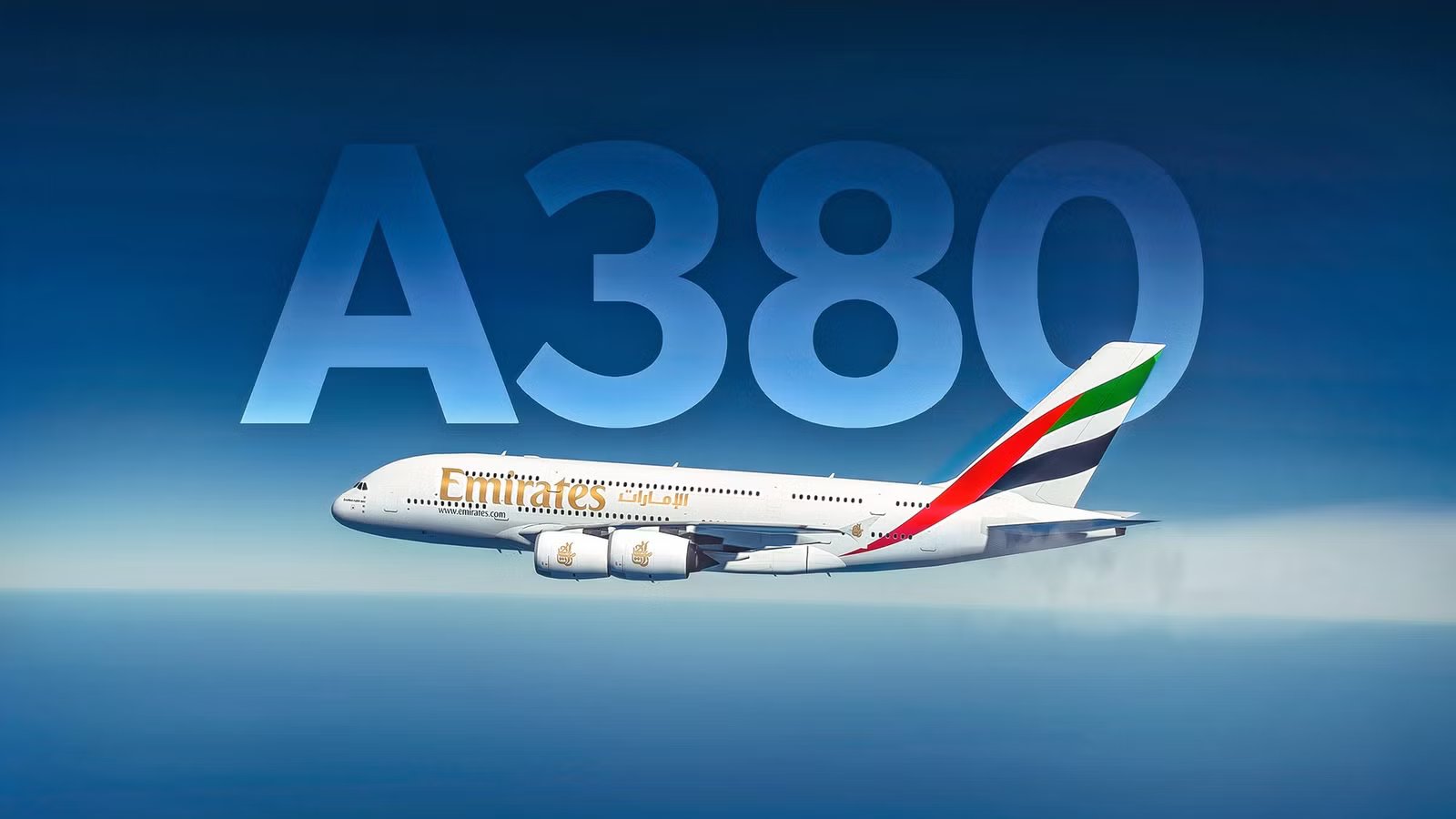
 Emirates has historically operated multiple configurations for its Airbus A380 fleet. The newest is a 569-seat layout, a reconfiguration of its old 615-seat superjumbos that introduces premium economy to the onboard product, turning a dense two-class aircraft into a more balanced three-class product. Now that new configuration is embarking on its first routes.
The first reconfigured aircraft, A6-EUX, returned to service last week after undergoing an extensive retrofit in Dubai since February 22. Its first route back was from  Dubai International Airport (DXB) to Birmingham International Airport (BHX), and the new 569-seat layout is now scheduled on nine routes in the coming months. More destinations are likely to follow as Emirates continues bringing its older two-class A380s closer to the cabin standard now being rolled out across the fleet.
Emirates’ Densest A380s Are Going More Premium

Emirates’ two-class Airbus A380s have historically been the simplest version of the airline’s superjumbo product. The layout had 615 seats, with 58 business class seats and 557 economy seats, but no premium economy. That made the sub-fleet of 15 examples that Emirates operated the highest-capacity aircraft anywhere, and especially useful on very high-volume routes. But it also left them without the cabin that has become one of the most important products in long-haul travel.
The reconfigured aircraft changes that. The new version has 569 seats, split between 76 business class seats, 56 premium economy seats, and 437 economy seats. This means that business class is increasing by 18 seats, and will be joined on the upper deck by the new premium economy cabin, as noted by Business Traveller. The economy cabin is reduced by 120 seats, and is on the main deck.
|
Cabin |
New 569-Seat A380 |
Old 615-Seat A380 |
Layout |
Key Details |
|---|---|---|---|---|
|
Business Class |
76 |
58 |
1-2-1 |
Fully lie-flat seats with direct aisle access |
|
Premium Economy |
56 |
Not offered |
2-4-2 |
40-inch pitch, 19.5-inch width, 8-inch recline |
|
Economy Class |
437 |
557 |
3-4-3 |
32-inch pitch, 17.9-inch width, 4-inch recline |
|
Premium Cabins Total |
132 |
58 |
— |
Business + premium economy |
|
Total Seats |
569 |
615 |
— |
Overall capacity falls by 46 seats (8%) |
|
Premium Share |
23% |
9% |
— |
Premium cabin share more than doubles |
The net result is that the total number of seats falls by 46, but the aircraft gains an entirely new cabin and becomes much more closely aligned with the direction Emirates is taking across its long-haul fleet. As a result, while Emirates is reducing overall capacity by around 8%, premium seats are more than doubling, now making up nearly a quarter of the aircraft.
This is a yield story as much as a passenger-experience story. Airlines worldwide have been pushing harder into premium cabins, particularly premium economy, because it allows them to capture passengers who are willing to pay a bit more for the additional comfort versus economy. For Emirates, adding premium economy to these A380s means the same aircraft can potentially generate more revenue from a better-balanced cabin mix.
The 569-Seat A380 Is Now Planned On 9 Routes

The first reconfigured aircraft returned to passenger service on May 16, operating from Dubai to Birmingham. Emirates operates the route twice daily, utilizing a Boeing 777-300ER for the second flight. Meanwhile, there are currently three more of the 615-seat A380s grounded for maintenance in Dubai (A6-EOP, A6-EOQ, and A6-EOX), and we will start to see them come online with their new configurations over the summer.
According to Aero Routes, Emirates’ latest schedule update as of May 21 shows planned 569-seat, three-class A380 operations on nine routes. Two of these had already been confirmed: Václav Havel Airport Prague (PRG), which currently has 777-300ER service while the normal A380 is grounded, and Copenhagen Airport (CPH), which currently operates with an Airbus A350-900. However, the net result is that it adds another six destinations to the list, as Emirates gives a much clearer picture of the return of the reconfigured A380s.
|
Destination |
Planned 569-Seat A380 Service |
Distance |
|---|---|---|
|
Bangkok |
From June 28 |
3,044 miles (4,899 km) |
|
Birmingham |
Ongoing, except July 1–August 12 |
3,483 miles (5,605 km) |
|
Copenhagen |
From July 1 |
3,002 miles (4,831 km) |
|
Denpasar |
From September 15 |
4,650 miles (7,484 km) |
|
Düsseldorf |
From July 11 |
3,108 miles (5,003 km) |
|
London Gatwick |
From December 1 |
3,404 miles (5,478 km) |
|
Manchester |
October 25–November 30 |
3,518 miles (5,662 km) |
|
Mauritius |
From August 1 |
3,166 miles (5,095 km) |
|
Prague |
From July 1, except September 15–October 24 |
2,776 miles (4,468 km) |
While some of these dates may still change, because Emirates has been adjusting operational schedules at short notice, the current list takes the aircraft well beyond the original Birmingham route.  Bangkok Suvarnabhumi Airport (BKK) joins from late June, Düsseldorf and Mauritius follow in July and August, Denpasar appears from mid-September, Manchester Airport (MAN) receives the aircraft between late October and late November, and
  London Gatwick Airport (LGW) joins from December.
These are all leisure-heavy or mixed leisure and visiting friends-and-relatives (VFR) markets where Emirates can fill a large aircraft, but is also likely to see strong demand for a better-than-economy product. For passengers, the change brings more consistency to the Emirates experience, with a traveler booking an A380 route increasingly likely to see premium economy available. For Emirates, that consistency should also make it easier to sell and market premium economy across more of its network.

The End Of The 615-Seat Giant: Emirates To Retire World’s Densest Airbus A380
All 15 aircraft are due to be reconfigured by November. See what the latest plan involves.
Emirates Is Standardizing Around Premium Economy

The bigger story is that Emirates is gradually making premium economy a normal part of its long-haul product. The airline said earlier this year that its premium economy network would expand to 99 destinations by the end of 2026, and that it expects to have retrofitted all 15 of its two-class A380s into the new three-class configuration by November.
That matters because Emirates operates a huge A380 fleet of more than 100 aircraft. But for years, the airline’s A380 product could vary substantially depending on the route and aircraft. Some aircraft offered first class, business, economy, and later premium economy. Others, including the 615-seat A380s, were much simpler two-class aircraft. Reconfiguring the densest A380s helps reduce that gap.
It also fits the wider retrofit program. Emirates describes its retrofit effort as a $5 billion program covering 219 aircraft, including 110 Airbus A380s and 109 Boeing 777s. The commercial logic is straightforward. Premium economy has become one of the most important long-haul cabins because it attracts passengers who want more space, better service, and a more comfortable journey, but who are not buying business class. It is particularly useful on long leisure routes and VFR markets.
For Emirates passengers, the most visible change will be more opportunities to book premium economy on routes that previously had a simpler cabin mix. For Emirates, the benefit is deeper: more product consistency, a stronger competitive offering against other long-haul airlines, and improved yields from the same aircraft frame.