dailynewsnblog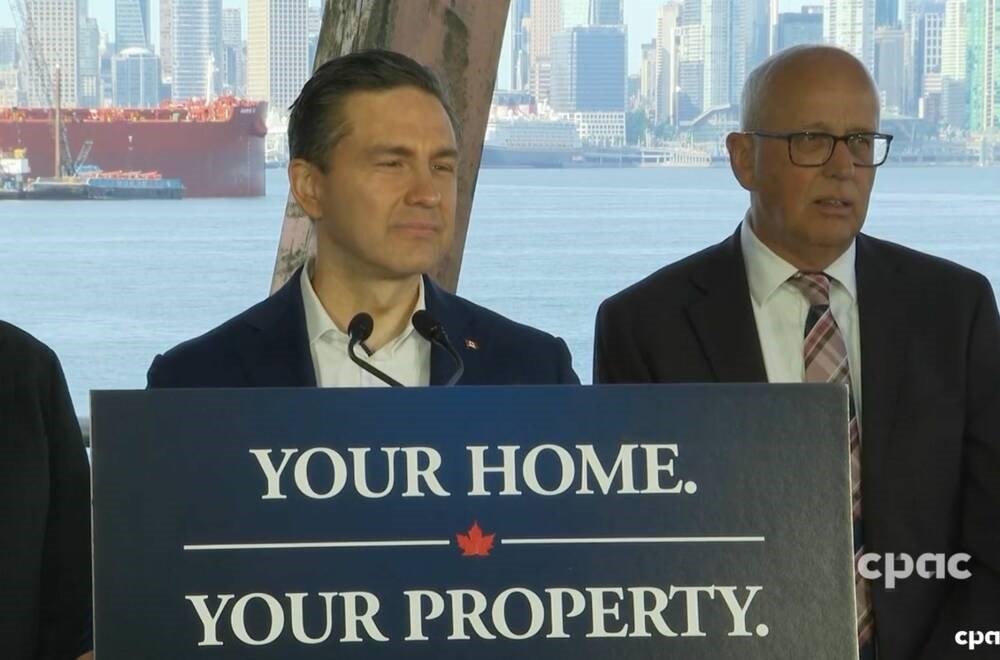

Federal Conservative Leader Pierre Poilievre stopped in North Vancouver Thursday morning to talk up his party’s call for the federal government to take action on a B.C. law – the Declaration on the Rights of Indigenous Peoples Act – he said threatens private property rights.
Poilievre made the comments on the North Shore ahead of a non-binding vote expected Monday on a Conservative motion demanding the government take more action to defend property rights in light of recent court decisions over DRIPA.
The motion demands that federal lawyers aggressively defend property rights in all legal cases. It also demands Ottawa publish a plan within 30 days on how it will protect property rights for Canadians affected by recent B.C. court decisions and agreements concerning Indigenous rights and title.
At his press conference Thursday, Poilievre told reporters that “here in British Columbia, people are facing a new threat to home ownership. This goes beyond prices, jobs, and mortgages. It goes to the foundation of our economy, private property rights.”
Poilievre pointed to the August B.C. Supreme Court decision on the Cowichan Tribes case which ruled that Cowichan aboriginal rights could be held over 800 acres of private property in Richmond that is owned under fee simple.
Since then, various businesses and property owners have pointed to a potentially chilling effect of the ruling because of uncertainty about its impact on property rights.
Poilievre said Thursday the case has an impact “right across British Columbia because almost all of the province is under some sort of claim. And if this precedent holds up, then all British Columbians may face the loss of their title. Hardworking British Columbians saved up, made a down payment, paid mortgages and property taxes, and now they live in fear, fear that they could lose their homes.”
Indigenous groups have argued that the declaration of aboriginal rights does not threaten private property rights.
But the impacts of uncertainty have been serious enough that the provincial government has appealed the decision.
In December a B.C. Court of Appeal decision on another Indigenous rights case found that B.C. mining law did not adequately take DRIPA into account. The province has also appealed that decision. On Thursday, the Supreme Court of Canada announced it has agreed to hear that appeal, although no date has been set.
At his press conference, Poilievre criticized Liberal Prime Minister Mark Carney for not fighting hard enough on protecting private property rights.
“He leads the government that negotiated agreements with First Nations that did not protect property rights,” said Poilievre.
He also criticized the Liberal government for signing a Musqueam Rights Recognition Agreement recognizing the nation’s rights and title over 500,000 hectares of Metro Vancouver in February with no public scrutiny or consultation.
“It creates the framework for future land governance and economic matters, but it does not protect private property rights of homeowners,” he said.
In a statement, Sḵwx̱wú7mesh Úxwumixw (Squamish Nation) chairperson Sxwíxwtn (Wilson Williams) offered a strong rebuke to Poilievre’s appearance in North Vancouver.
“That Conservative Leader Pierre Poilievre would come into our territory – and stand with a sign reading ‘Your home. Your property.’ – to advance his divisive agenda is deeply offensive,” he said. “As has been made clear on numerous occasions, recent court decisions have no bearing whatsoever on private property. To imply otherwise is irresponsible and actively damages the relationship between Canada and Indigenous People from coast-to-coast.”
Poilievre said all future federal agreements with First Nations should have explicit clauses protecting private property rights.
Poilievre’s press conference Thursday comes at a time when the B.C. NDP government has been grappling with the potential impacts of DRIPA.
In recent months, B.C. Premier David Eby announced the government would seek amendments to DRIPA, then proposed seeking a suspension of the law. Since then he has backed down from both plans.
The issue of private property rights and DRIPA has also been a hot topic of debate among the hopefuls vying for leadership of the B.C. Conservative party.
Poilievre also took time to criticize Carney on a handful of other issues Thursday, saying that affordability has grown worse, the economy is faltering and ”the streets are overrun with crime and drugs.”
– with file from Abby Luciano