dailynewsnblog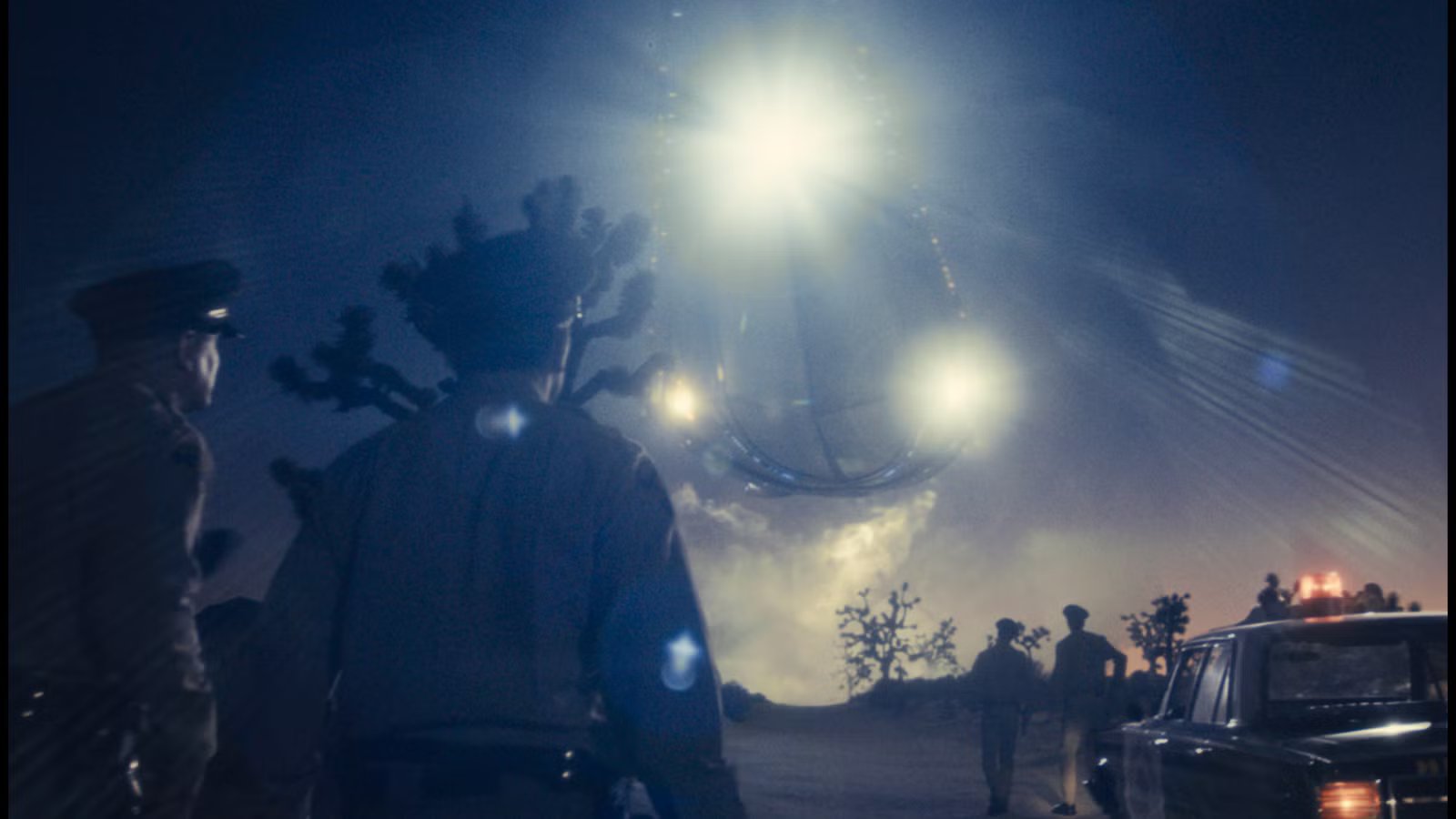
The idea of writing a movie for Steven Spielberg sounds incredibly daunting. Writing a fifth movie for Steven Spielberg — an alien encounter film for the guy who directed Close Encounters of the Third Kind, E.T., and War of the Worlds no less — sounds like the kind of fate-tempting risk only Indiana Jones would be foolish enough to try. But legendary screenwriter David Koepp approaches Disclosure Day, his latest collab with Spielberg, at least knowing what not to do.
“[Steven’s] really allergic to repeating himself,” Koepp says with a laugh. “Any kind of self-reference makes him want to throw up.”
Spielberg has spent nearly 50 years defining how Hollywood imagines extraterrestrial contact, which means every new UFO somehow inevitably risks looking a little like one of his old UFOs. And yet that tension — reframing the unknowable without losing yourself to mythology — seems to be the entire engine behind Disclosure Day, out on June 12. Written by Koepp from a story developed by Spielberg himself, the movie stars Josh O’Connor, Emily Blunt, Eve Houston, Coleman Domingo, and Colin Firth as the Earth deals with an apparent alien visitation, one that may not even be that recent. Koepp describes it more as a paranoid political thriller in the 1970s mode, all about secrecy, faith, and whether humanity can psychologically survive the truth.
Koepp has minted a career out of not just writing for the majors (including David Fincher, Sam Raimi, and Steven Soderbergh) but what-if-ing his own curiosity until he comes out the other side with a screenplay. The fuse for Panic Room sparked after he read a newspaper article about, you guessed it, panic rooms. His own directorial effort, the bike-messenger chase movie Premium Rush, came about one day when a man on a bike nearly hit him on the streets of New York City. But the premise for Disclosure Day came entirely from Spielberg, with the director dropping a 40-page treatment on Koepp’s lap. The writer saw it as “a big story that needed a lot of wrestling.”
Koepp found his way in when he realized he could pour a love of Sydney Pollack and Alan J. Paluka films into a summer tentpole. He loves “‘the government’s up to something’ thrillers,” and Robert Redford vehicle Three Days of the Condor was a major source of inspiration.
Disclosure Day’s tone-shift away from the awe of Close Encounters or the intimacy of E.T. feels right at home with today’s political climate. But the conspiracy theory thriller has a dark side: As many screenwriters have pondered over the years, is there an ethical dilemma in feeding into the idea that the government is bad and only a select set of people can save us? Have twisty thrillers fueled the American public’s IRL desire to seek “secret” truth where there isn’t any?
Conspiracy fiction hits differently in 2026, in the era of 8chan theories perpetuated by national leadership, and Koepp seems acutely aware of that tension. But also, in his words, governments have conspired against their people.
“What became undeniable to me,” Koepp says, “is that governments — not just the United States, but many governments — have engaged in an 80-year campaign of disinformation and suppression.”
But Koepp draws a line between skepticism and conspiratorial nihilism.
“The current government gleefully lies and extravagantly abundantly lies,” he says. “The problem is they lie so much that we question everything and we believe nothing.”
For him, Disclosure Day ultimately isn’t about validating conspiracy theories, but searching for understanding in a world that increasingly treats facts as optional.
“We’re not coming out in favor of conspiracies,” Koepp says. “We’re coming out in favor of truth.”

That philosophical angle also pushed the movie into overtly spiritual territory. Koepp says the screenplay repeatedly returns to questions of religion and faith because extraterrestrial belief and religious belief inevitably start circling the same existential drain. “Whether we’ve been visited by aliens or not is a question of faith, much like God is a question of faith,” he says.
Spielberg himself has been unusually candid about his fascination with the subject. During a keynote appearance at SXSW earlier this year, the director admitted, “I don’t know any more than any of you do, but I have a very strong suspicion that we are not alone here on Earth right now — and I made a movie about that.”
That personal conviction apparently shaped everything, even as Koepp and Spielberg worked carefully to avoid echoing the director’s earlier classics. Koepp says the two constantly caught accidental self-references while writing. “You’ll write something and he’ll say, ‘Doesn’t that kind of feel like that scene in Jaws where…’ And you’re like, ‘Oh fuck — yes, it is.’”
Thirty-plus years after Jurassic Park, Koepp still sounds energized by the challenge of building giant Spielbergian set pieces. But what excited him most this time wasn’t the spectacle. It was reflecting on all of Spielberg’s thematic potential in the middle of a giant summer movie.
“You’re putting in a philosophical dialogue scene in the middle of what is essentially a summer adventure movie,” he says. “The fireworks in that scene better be equivalent to a train-car chase, otherwise everybody’s going to go for popcorn.”




![Only 69% Full: British Airways’ 10 Emptiest US Routes Revealed [Updated List]](https://dailynewsnblog.com/wp-content/uploads/2026/05/british-airways-airbus-a350-1000-on-stand-at-heathrow.jpg)