dailynewsnblog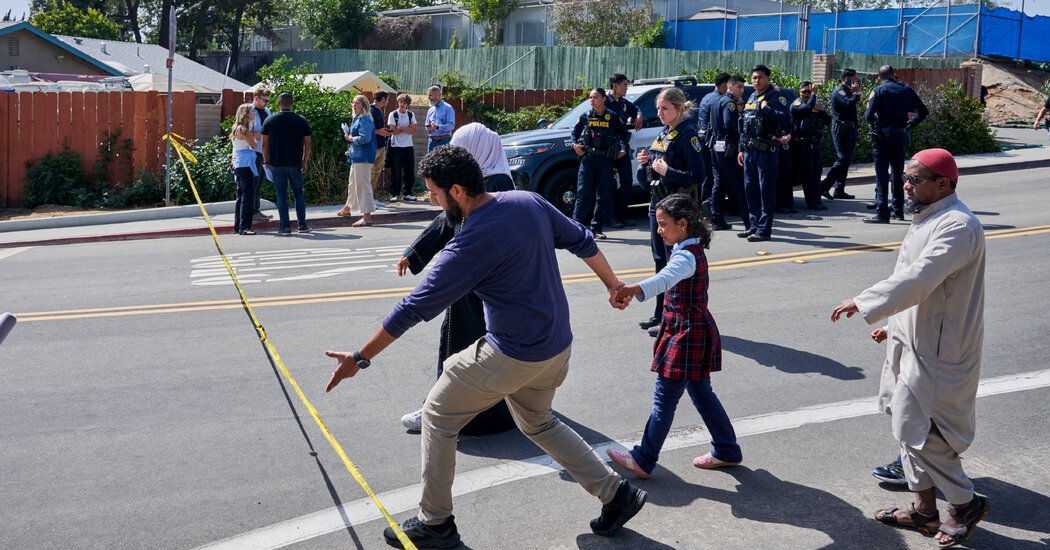
More than a year before Caleb Vazquez and a friend attacked a mosque in San Diego and killed three people, the police were so alarmed by Mr. Vazquez’s behavior that they secured a court order to confiscate his father’s guns.
“Child was involved in suspicious behavior idolizing nazis and mass shooters,” a police officer wrote in a January 2025 protective order.
Mr. Vazquez, who was found dead on Monday shortly after the police say he and a friend attacked the Islamic Center of San Diego, had at some point been placed in an involuntary psychiatric hold, according to documents filed at San Diego Superior Court.
The court papers show that Mr. Vazquez, 18, had been on the authorities’ radar long before the shooting at the mosque. They also raise questions about why the authorities, with their knowledge, were unable to prevent the massacre.
The California Legislature in 2014 allowed the family and friends of people who might be violent, as well as the police and other parties, to seek a court order to temporarily confiscate weapons through measures known as gun violence restraining orders. The law was a response to a mass shooting that year near the campus of the University of California, Santa Barbara.
The order to take guns from the Vazquez household was filed against Mr. Vazquez’s father, Marco Vazquez. The court documents show that Marco Vazquez and his wife, Lilliana Vazquez, had 26 guns, including pistols, rifles and shotguns.
The order was filed by the police department in Chula Vista, Calif., a San Diego suburb where the Vazquezes live. The police said in the court filing that the elder Mr. Vazquez “would not allow officers to confirm if firearms were stored properly.”
The San Diego police and the F.B.I. said that Caleb Vazquez and Cain Clark, 17, attacked the mosque and then took their own lives minutes later. They were found dead of gunshot wounds in a white BMW a few blocks from the Islamic Center of San Diego, the largest mosque in San Diego County.
In a court affidavit last year, Marco Vazquez said that he was “well aware of the seriousness of the allegations made against my son.” Before the order requiring him to turn over his weapons, he wrote, he voluntarily put them in a storage facility because of concerns about his son. Among the weapons listed in the court documents were three Glock handguns, a Mossberg 12-gauge shotgun and several rifles.
Marco Vazquez said in the court papers that he and Ms. Vazquez had also secured all sharp knives. And he said that they had increased their supervision of their son, and put him in therapy.
“Presently, our son spends his time with his parents, grandparents, brother and a small group of friends that my wife and I approve of,” he wrote. “Again, these activities are all supervised.”
He said at the time that he had no intention of bringing his weapons back to the home, “until my wife, my son’s therapist and I believe it is safe to do so.”
It’s unclear whether the weapons used in the mosque shooting came from the Vazquez household. Mr. Clark also grew up in a home with guns, the police said.
About two hours before the shooting, Mr. Clark’s mother called the San Diego police and said her son was missing, and possibly suicidal. She also told the police that some of her guns were missing, and so was her car, and that her son was likely with a friend.
The police were alarmed, and started searching for the teenagers in San Diego, California’s second largest city. Using license plate reader technology, they thought they had tracked them to a mall, and sent officers there. They also deployed officers to the high school that Mr. Clark, a former wrestler, had attended.
After the shooting, the police searched three homes connected with the teenagers and confiscated more than 30 guns from one of them.
On Thursday evening, the Vazquez family issued a statement, saying their son “was on the autism spectrum, and it is painfully clear to us now that he struggled not only with accepting parts of his own identity but also grew to resent them.”
They continued: “We believe this, combined with exposure to hateful rhetoric, extremist content, and propaganda spread across parts of the internet, social media and other online platforms contributed to his descent into radicalized ideologies and violent beliefs.”
The police said Mr. Vazquez and Mr. Clark had met online and shared bigoted and hateful views toward a variety of races and faiths. After the attack, the F.B.I. said agents discovered a document apparently written by both of the teenagers that outlined “religious and racial beliefs of how the world they envision should look. These subjects did not discriminate on who they hated.”
In their statement Thursday, Mr. Vazquez’s parents, listing the names of the victims in the shooting, wrote, “as much as we mourn the child we raised and love, we mourn even more deeply for the innocent lives of Amin Abdullah, Mansour Kaziha and Nadir Awad.”
Katie Benner contributed reporting.