dailynewsnblog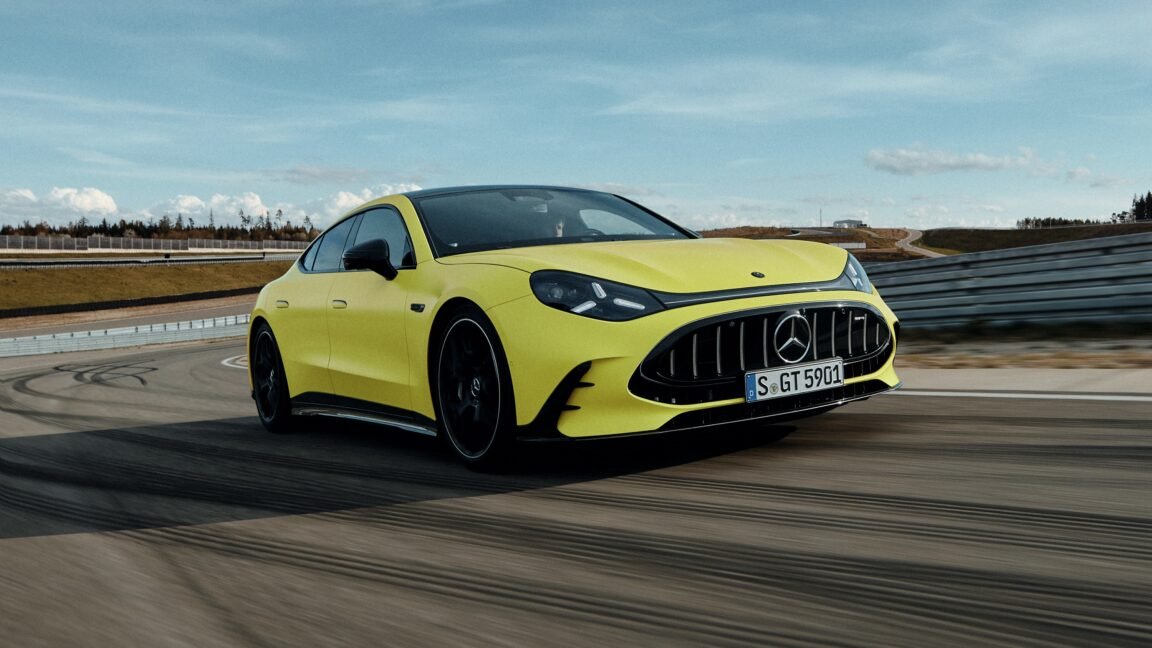
Axial flux motors
The four-door hatchback will launch in two variants, as usual a 55 and a 63. Both share the same hardware, though the former restricts output to “just” 805 hp (592 kW) and 1,328 lb-ft (1,800 Nm) of torque, while the latter bumps up to 1,153 hp (848 kW) and 1,475 lb-ft (2,000 Nm). All that shove comes courtesy of Mercedes-Benz’s wholly owned subsidiary, YASA, which last year announced a new world record for the most power-dense electric motor ever built. YASA’s axial e-motors can be found in McLarens, Lamborghinis, and Ferrari hybrids and in this application promise a 67 percent reduction in weight and physical length versus a more traditional radial-flux motor—with double the torque density and triple the power density, no less.
The GTs house two of the YASA motors at the rear, with dual water-cooled DC/AC converters and a planetary gearset to each side. Up front, a single motor mates to a spur-gear transmission with an integrated disconnect unit to allow for less drag while freewheeling. The motor sizes truly boggle comprehension, at just 3.5 inches (89 mm) wide for the front and 3.2 inches (81 mm) wide for each rear. YASA eventually believes that these units with a custom planetary gearset can effectively replace wheel hubs and brake rotors entirely, but apparently that solution wasn’t ready for mass-market production quite yet.
600 kW charging
The motors save space and mass, but Mercedes-AMG also put serious work into the battery tech. The load-bearing structure houses 106 kilowatt-hours of usable capacity, good enough for up to 474 miles (764 km) of range on the WLTP standard for the 63 or 478 miles (770 km) for the 55. A total of 2,660 new cylindrical cells each measures 4.1 inches (104 mm) tall and 1 inch (25 mm) in diameter, allowing for improved cooling by a non-conductive oil within 18 laser-welded plastic modules.
With 800 V architecture, the battery can charge at 800 A and up to more than 600 kW, which allows for a claimed 70 kWh or the equivalent of 287 miles (462 km) of WLTP range added in just 10 minutes. A 10–80 percent charge takes as little as 11 minutes, or a quick stopover can top up 41 kWh in just five minutes. Of course, in the US, that would require plugging in to something like ChargePoint’s new 600 kW fast charger, which will feature the necessary NACS plug required to recharge a North American-spec GT.