dailynewsnblog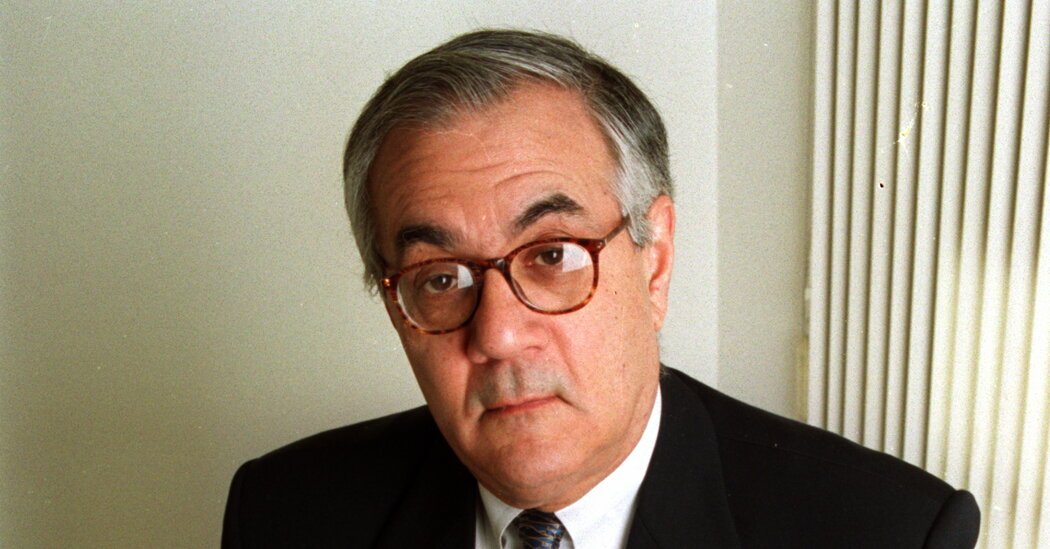
Barney Frank, the brassy, lightning-quick former Massachusetts representative who for decades was the most prominent gay politician in the country and who was an author of the most significant overhaul of the nation’s financial regulations since the Great Depression, died on Tuesday at his home in Ogunquit, Maine. He was 86.
His friend James Segel confirmed the death. Mr. Frank said last month that he had entered hospice care with congestive heart failure.
Mr. Frank, a liberal Democrat who represented a diverse suburban Boston district for 32 years, starting in 1981, was the first gay member of the House to come out voluntarily; others had been outed in scandals. His public declaration of his sexual orientation in 1987 — spurred by a fear of being outed, by the death of a closeted colleague and by his own determination to show that homosexuality was nothing to be ashamed of — helped normalize being openly gay in public life.
“Prejudice is based on ignorance,” Mr. Frank told The Boston Globe in 2011, as he prepared to retire. “And the best way to counterbalance it is with a living example, with reality.”
A Harvard-trained lawyer, Mr. Frank bristled with intellectual firepower, acidic turns of phrase and a zest for verbal combat.
His shivs were often cloaked in wit. Referring to the Moral Majority, the conservative Christian organization that opposed abortion but also opposed child nutrition programs and day care, Mr. Frank said in 1981: “From their perspective, life begins at conception and ends at birth.” Of the flawed intelligence behind the U.S.-led invasion of Iraq that led to nearly a decade of combat, he said the problem “is not so much the intelligence as the stupidity.”
In Washingtonian magazine’s annual poll of Capitol Hill staffers, he was frequently voted the “brainiest,” “funniest” and “most eloquent” member of the House.
His most significant legislative achievement was in the realm of financial regulation. The Dodd-Frank Wall Street Reform and Consumer Protection Act, which he sponsored with Senator Christopher Dodd of Connecticut, tightened rules on the financial industry as part of the government’s response to the housing crisis of 2007 and the global financial meltdown the next year.
Signed into law by President Barack Obama in 2010, the measure sought to prevent the nation’s biggest banks from engaging in excessively risky behavior and to protect consumers from unfair practices by banks and lenders. Congress watered it down in 2018, chiefly by exempting smaller and midsize banks from stricter oversight, but it remained largely intact.
Mr. Frank was also known for championing gay rights, civil rights and women’s rights. He did so by force of personality and by example. He insisted that his male partner be invited to all events to which the spouses of other representatives were invited. In 2012, at age 72, he married Jim Ready and became the first sitting member of Congress to wed someone of the same sex.
He also worked quietly behind the scenes to advance his causes. In one of many examples, according to his memoir, “Frank: A Life in Politics From the Great Society to Same-Sex Marriage” (2015), he helped persuade President Bill Clinton not to appoint Senator Sam Nunn of Georgia as secretary of state because of his track record of homophobia.
Growing up in a working-class family in New Jersey, Mr. Frank was drawn from an early age to politics, stemming from his sense of himself as a minority and outsider.
“I’m a left-handed gay Jew,” he often said. “I’ve never felt, automatically, a member of any majority.”
But he was never shy. Even as a youth, he described himself as a “counterpuncher, happiest fighting on the defensive” on behalf of the vulnerable. At the time, that mostly meant racial minorities.
When he was introduced in 1950 to a scout for the New York Yankees, he challenged the man to explain why the team had no Black players. As a 15-year-old, he was profoundly moved by the lynching in Mississippi of Emmett Till, a Black teenager close to his own age; that led him to participate in Freedom Summer in 1964, registering Black voters in Mississippi.
Surviving a Sex Scandal
During Mr. Frank’s early tenure in Washington, almost no gay politicians were out, and anti-gay slurs were common. In one notorious example, Representative Dick Armey of Texas, the Republican majority leader, called Mr. Frank “Barney Fag” in a 1995 interview with radio broadcasters.
Mr. Armey apologized, saying it was an innocent mispronunciation, but Mr. Frank didn’t buy it. “I turned to my own expert,” Mr. Frank told The New York Times. “My mother, who reports that in 59 years of marriage, no one ever introduced her as Elsie Fag.”
Mr. Frank’s career in Congress was nearly derailed a few years earlier, when a prostitute named Stephen Gobie, whom Mr. Frank had patronized, claimed that in the mid-1980s he had run a prostitution ring out of Mr. Frank’s home.
The House Ethics Committee did not substantiate that claim, but it did find that Mr. Frank had fixed 33 parking tickets for Mr. Gobie and had sought to shorten his probation on drug and sex-offense convictions by writing a misleading memorandum on congressional stationery to an official involved in supervising Mr. Gobie’s probation.
The full House voted overwhelmingly in 1990 to reprimand Mr. Frank for misuse of his office, a lighter punishment than censure or expulsion.
“I should have known better,” Mr. Frank said on the House floor as he expressed regret and alluded to the pressures of being closeted.
“There was in my life a central element of dishonesty,” he added. “Three years ago I decided concealment wouldn’t work. I wish I had decided that long ago.”
He was re-elected that year with 66 percent of the vote.
He persevered, and his stature only grew. By the time the Republicans started impeachment proceedings against President Bill Clinton in 1998, Mr. Frank had become one of the president’s most passionate defenders. He quipped at one point that he couldn’t finish reading the Starr Report, a graphic account of Mr. Clinton’s involvement with a White House intern, Monica Lewinsky, because it contained too much heterosexual sex.
Along with Mr. Frank’s wit came a mean streak, which he didn’t much bother to keep in check. His targets were not just Republicans, but also constituents, his staff members and, with extra glee, reporters — whose questions, he often told them, were idiotic.
When he first ran for Congress, in 1980 — perhaps a surprising career choice, given his impatience with people — his staff decided that the best strategy was to steer him away from voters. At one community meeting he argued so vociferously with a man in the audience that the man fled the auditorium, distraught.
In 2009, when a voter asked Mr. Frank why he was supporting Mr. Obama’s proposal for mandating health care coverage, which she described as “Nazi policy,” Mr. Frank responded, “On what planet do you spend most of your time?”
‘Slopping the Hogs’
Mr. Frank once likened constituent service to “slopping the hogs,” yet his office’s assiduous attention to such slopping helped keep him in office. So did homey campaign commercials featuring his mother, who by the 1980s had moved to Boston and was working on behalf of seniors. (“How do I know he’ll do the right thing by us older people?” she asked in one commercial. “Because he is my son.”)
Despite his abrasive manner and his inability to suffer fools, he served the purposes of Nancy Pelosi, the House speaker, who appointed him as the Democrats’ chief negotiator with the Bush administration to address the crises in the banking and auto industries.
“The quarterback for us is Barney,” Ms. Pelosi told Jeffrey Toobin for a 2009 New Yorker profile of Mr. Frank. “He’s solution-oriented, respectful of different perspectives and brilliant. And it’s brilliance that saves time, because he simplifies the complex for us. He is an enormously valuable intellectual resource for the Congress.”
He was so immersed in housing issues — he championed the creation of more affordable housing — that some Republicans blamed him for the housing crisis and the subsequent financial meltdown. They accused him of failing to police Freddie Mac and Fannie Mae, the two government-backed mortgage giants, while the companies were taking risks that fueled the crisis.
In July 2008, Mr. Frank — by then the powerful chairman of the House Financial Services Committee, with oversight over Freddie and Fannie — said the two companies were “fundamentally sound, not in danger of going under.” Less than two months later, the government seized them and began a bailout that cost taxpayers $191 billion.
“I was late in seeing it, no question,” he told The Globe in 2010 of the companies’ slide into insolvency.
Independent analysts mostly gave Mr. Frank a pass, noting that he was in the minority until 2007 and that Republicans, who had previously controlled the White House and both houses of Congress, also missed the danger signs. As The Post put it in a 2011 headline, “Barney Frank Didn’t Cause the Housing Crisis.”
But his support for Fannie and Freddie, from which he had accepted financial contributions, dogged Mr. Frank during his re-election bid in 2010. He won that race, against a Tea Party challenger, but with only 55 percent of the vote.
The writing was on the wall. When he saw that redistricting would change his constituency and increase the costs of a 2012 campaign, he decided not to seek re-election. As he bowed out, he saw an upside to leaving public life: “I don’t even have to pretend to try to be nice to people I don’t like.”
A Son of New Jersey
Barnett Frank, who later legally changed his first name to Barney, was born on March 31, 1940, in Bayonne, N.J., the second of four children.
His mother, Elsie (Golush) Frank, was a legal secretary at the New York firm Cravath, Swaine & Moore. His father, Samuel Frank, was co-owner of Tooley’s Truck Terminal, a truck stop near the Holland Tunnel in Jersey City; Samuel was later jailed for a year for refusing to testify before a grand jury against his brother, Harry, who had been involved in a kickback scheme.
This part of New Jersey, Hudson County, was notoriously corrupt, and Barney Frank surmised that his father was probably involved with the Mafia.
“Because Bayonne was such a sleazy place,” Alan Dershowitz, the Harvard Law School professor, who dated a high school classmate of Mr. Frank’s, told The New Yorker, “nobody knew whether Barney was going to wind up in Congress or in jail.”
But his family put a premium on education, and Mr. Frank, a quick-witted high school student who excelled at debating and writing, gained admission to Harvard in 1957.
When his father died in 1960, Mr. Frank took time off to sort out the family finances. He graduated in 1962 with a major in government. He was working on his doctorate in government at Harvard when Kevin White, a liberal reformer, asked him to join his 1967 campaign for mayor of Boston. When Mr. White won, Mr. Frank became his executive assistant.
He was an anomaly in Boston City Hall.
“A Jew from Bayonne who delivered his stinging wisecracks in a thick ‘Joisy’ accent, through billows of smoke from a cigar, which looked like one of Hoboken’s belching smokestacks,” J. Anthony Lukas wrote of Mr. Frank in “Common Ground,” his Pulitzer Prize-winning 1985 book about the tinderbox of race relations in Boston and its school busing crisis. “With his massive belly draped in perpetually wrinkled suits, Barney did not look impressive, but few people could skip so nimbly through the corridors of Massachusetts politics.”
At the time, Mr. Frank spurned the idea of running for office himself. “Being both gay and Jewish, it never seemed possible that I could be elected to anything,” he said. He expected that he would always be closeted and never have much of a life outside of work.
But in 1972, he gave elective politics a try and won a seat in the Massachusetts Legislature, representing Boston’s Back Bay. (One of his campaign slogans was “Neatness Isn’t Everything.”) He served in the statehouse for the next eight years, during which he dropped his doctoral studies and entered Harvard Law School, graduating in 1977.
He saw a chance to move up to Congress in 1980, when the Rev. Robert F. Drinan, a Jesuit priest and human rights activist, gave up his seat after Pope John Paul II ordered priests to withdraw from electoral politics. Father Drinan complied and endorsed Mr. Frank, who won easily.
Coming Out
Mr. Frank had quietly told friends that he was gay before he ran for Congress, but he did not discuss it publicly until 1987, when Representative Stewart B. McKinney, a Connecticut Republican, died of AIDS. The media immediately began speculating about Mr. McKinney’s sexual orientation, a fate that Mr. Frank said he wanted to avoid for his own obituary.
“There was such an unseemly scuffle after he died,” Mr. Frank told The Times, adding that he didn’t want people asking of him: “Was he or wasn’t he? Did he or didn’t he?”
He was also motivated to come out, he said, by former Representative Robert E. Bauman, a Maryland Republican, who had been charged with soliciting an underage male prostitute. Mr. Bauman had hinted in his memoir, “The Gentleman From Maryland: The Conscience of a Gay Conservative” (1986), that Mr. Frank was gay. Representative Gerry Studds, Democrat of Massachusetts, the first openly gay member of the House, had been forced to declare his homosexuality when he was caught in a sex scandal in 1983.
Mr. Frank said he knew that once he came out of the closet, he would be closing off a chance to become speaker, and Speaker Thomas P. O’Neill Jr. confirmed to him as much. (Mr. O’Neill was so unfamiliar with the terminology of the day that he said that Mr. Frank was going to “come out of the room.”) Still, Mr. Frank said he was relieved that he had gone public.
He chose to do so by arranging an interview with The Boston Globe, in which he said: “If you ask the direct question ‘Are you gay?’ the answer is yes.”
Mr. Frank then added, “So what?”
Mr. Frank met Mr. Ready, a carpenter and welder in Ogunquit who was 30 years his junior, at a gay political fund-raiser in 2005. Mr. Ready had been taken to the fund-raiser by his partner at the time, Robert Palmer, who was dying and who wanted to find someone who might care for Mr. Ready when he was gone. When they met Mr. Frank, they decided he was the one.
For his part, Mr. Frank was impressed by Mr. Palmer and Mr. Ready’s relationship. “I had never really seen that up close between two guys before,” he told The Times. “I was envious in some ways of what Bob and he had.”
Mr. Ready and Mr. Frank began spending time together, and when Mr. Palmer died in 2007, Mr. Frank flew to Maine to console Mr. Ready.
They were married in July 2012. Mr. Frank had already announced that he was retiring from Congress. But he said he wanted to marry while still in office because it was important that his colleagues “interact with a married gay man.”
In his memoir, he wrote that he had been good at his job, and, now that he was retired, he was ready “to be good at life.”
He and Mr. Ready lived part-time in Maine, where Mr. Frank took to wearing flannel shirts, spent much of his time reading and writing and seemed finally to have achieved the personal security he had long craved.
Mr. Ready described their domestic life in Out magazine, noting that Mr. Frank was constantly reading even while shaving. “If you see pictures of him in the papers or on TV and he has little cuts on his face, that’s why,” Mr. Ready said.
In addition to Mr. Ready, Mr. Frank is survived by a brother, David, and two sisters, Doris Breay and Ann Lewis, a former communications director in the Clinton White House.
As Mr. Frank was entering hospice care in late April, he had just finished writing a book, “The Hard Path to Unity.” Its premise was that the political left, of which he was a member in good standing, had sometimes gone too far in pushing divisive causes, like transgender athletes’ participation in sports, and making them a litmus test.
Slow down, he advised, and find common ground. Rather than focusing on cultural flash points, build support with something practical; instead of demanding Medicare for all, for example, start by reducing the age of Medicare eligibility.
Too frail to travel, he nevertheless happily spoke with interviewers about what he had written, and said he was pleased that the book’s message was having some resonance.
“Frankly,” he told The Times, “if I weren’t dying, people wouldn’t be paying as much attention.”
Zachary Woolfe contributed reporting.