dailynewsnblog
The A-10 Thunderbolt II ‘Warthog’ is the beloved aircraft the Air Force never wanted. It was a project of the Fighter Mafia that existed in the 1960s and 1970s. Also central were Army considerations and the Air Force’s controversial lobbying to cancel the Lockheed AH-56 Cheyenne attack helicopter that the Army wanted. The Fighter Mafia thought aircraft were getting prohibitively expensive and complicated, and that the Air Force needed to go back to simpler designs.
They thought the future of air combat remained dogfighting, while aircraft could continue to offer close air support and strafing runs. As such, they campaigned for the A-10 and the F-16 and opposed the larger and more capable F-15. Ironically, the F-16 would develop into a complex multirole fighter jet, something the Mafia set out to avoid.
However, this was never an option for the A-10 Warthog. The Air Force first asked to retire the Warthog in 1984, the year it received its final example. For over 40 years, Congress has forced the Air Force to keep these aircraft in service, although it has allowed the Air Force to phase them down in recent years. The final examples will leave the fleet in four years, by 2030.
Its Fan Base Corners Lawmakers
The Air Force first asked to retire A-10s in 1984

While Congress and those in the Pentagon are expected to be objective in their decision-making, they are not immune to popularity. It is likely that the A-10’s massive popularity online, in some segments of the military, and with the pilots that fly it, all contribute to the decision not to retire it. Many fans of the A-10 may consider the aircraft as the aircraft of choice for close air support missions (CAS) to protect US soldiers on the frontline.
While that may be an obsolete point of view, it is a popular one, including with veterans of the Iraqi and Afghanistan Wars. It risks those seeking to retire the Warthog as wanting to retire the airplane that protects US soldiers. Members of Congress want to avoid appearing indifferent to the safety of the lives of their troops. In this narrative, how effective the A-10 really is in the CAS role becomes subordinate to the emotional argument.
There is also the issue of visibility and survivorship bias. During air campaigns (like in 2026), the low and slow flying A-10 has gone viral with videos of its noisy passes captured in dramatic footage. By contrast, stealth aircraft typically operate out of sight and therefore lack the cinematic immediacy and can be less emotionally compelling. Capping it off, pilots can still paint visually-appealing Second World War-style art on the A-10s, something no longer possible with stealth-coated fighter jets.
A Useful Capability
A-10s carry 1,150 to 1,174 rounds

It should be pointed out that the criticism isn’t about the A-10 being bad at its job: its strafing runs and ability to carry Hellfire Missiles are largely unquestioned. The question revolves around just how survivable it is. The most common critique is that it is unsurvivable in a peer-on-peer conflict with China. While that is true, it’s also likely irrelevant to some extent, as the A-10 doesn’t have the operational range to be effective in the Indo-Pacific anyway.
Those who support the Warthog will point out that China is not the US’s only commitment. The war on terror may be over, but the Air Force still needs to engage in multiple counterinsurgency operations against foes with little or no air defense capabilities. In 2024, the Warthog was seen firing its guns in anger at targets in Syria. During the 2026 Iran air campaign, the A-10 was once again able to come into its own, strafing militant groups in Iraq.
Not only did the Warthog take on Iraqi militants, but it also took part in taking out Iranian Navy/IRGC naval assets such as speed boats. While many commentators like to talk about its anti-armor role, its ability to operate in a maritime role is important and often understated.
In the real world, the A-10 will now struggle to take out armor, as an opponent using armor is also an opponent that will likely have air defense, even if they are limited to MANPADS. Additionally, the A-10 was useful in providing support to rescue the downed F-15 pilot in Iran, although its vulnerability was also demonstrated when one was hit by hostile fire. The aircraft later crashed in friendly Kuwait with the pilot safely ejecting.
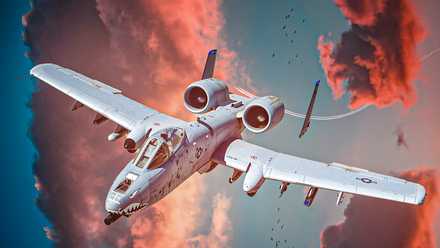
The US Air Force Sent 39 A-10 Warthogs To The Boneyard At Davis-Monthan AFB In 2024
At least 39 A-10s were mothballed in 2024 and the Air Force likely has around 200 Warthogs remaining in service.
The Warthog Has Become A Drone Hunter
A-10 can carry 70+ APKWS II rockets

The idea of the Warthog strafing armor is long gone: some commentators doubt if it ever would have worked in the real world should the Soviet armor have poured through the Fulda Gap. In the 1991 Gulf War, the Warthog was credited with taking out a large amount of Iraqi armor, but perhaps a majority (especially the harder armor) that was achieved with AGM-65 Maverick missiles. Today, other fighter jets can fill the anti-armor role more effectively, as can artillery (massively understated) and a range of one-way attack drones.
The nuance here is that while the Warthog couldn’t evolve into a multirole fighter, it did have the design flexibility to pivot from its gun to missiles as its primary weapon. The Warthog is now in its twilight years, but it is still learning new tricks. In 2025, the US Air Force was forced to come up with a solution to counter the masses of cheap one-way attack drones that the Houthis and Iran could fire.
One solution was to urgently jerry-rig F-15Es with laser-guided 70mm Advanced Precision Kill Weapon System II (APKWS II) rockets. These rockets are comparatively cheap and small, allowing the F-15 to carry dozens of them and use them without exhausting stocks or breaking the bank.
The Air Force then urgently mated the APKWS II rockets to F-16s and A-10s, effectively turning the venerable Warthog into a drone hunter. Ironically, one of the final roles of the dedicated ground-attack A-10 is that of an air-to-air role. The conflict in Ukraine/Russia has shown the importance of drone-hunter platforms, with Mi-17 helicopters, An-26 transports, Cessna Caravans, and Yak-52s all seen filling drone-hunting roles.
Reluctance To Admit Close Air Support Has Changed
Around 4,000 crewed non-training aircraft remain in the USAF

The ability to provide close air support (CAS) carries the visual and emotional weight of a government that cares about the lives of its soldiers and can protect them. Today, Russian soldiers in Ukraine operate largely without close air support, and they are hunted down by drones. The image is one of Moscow being unwilling and unable to protect its soldiers. The Soviet Su-25 (in service with Russia and Ukraine) was designed for a similar role as the A-10.
However, as of 2026, it has mostly disappeared from the frontline, with surviving airframes generally operating from stand-off ranges. By retiring its A-10s, Washington would publicly signal it has lost a key capability soldiers thought would protect them. The image of CAS has important symbolic and morale value that should not be overlooked. The other side is the Army’s AH-64 Apache, which will also struggle to operate in a CAS role in contested airspace.
While the reality that CAS from crewed A-10s and AH-64s is likely already gone, by keeping them in service, Washington can keep the pretense that it still exists. In reality, CAS missions in contested airspace are likely to be filled by other systems, like drones and standoff weapons. Another factor is that the US Air Force has been shrinking since the Second World War, and today it only has around 4,000 non-training and non-UAV aircraft.
This presents a gradual shift to fewer, but more complex, capable, and expensive platforms. The F-35 is simply not a one-for-one replacement for the aircraft it replaces. But this is also coming at the expense of mass, and mass can be a virtue of its own. Washington may be willing to keep the A-10 in service for longer to ensure the Air Force doesn’t lose too much mass, at least, until the CCAs come into service.
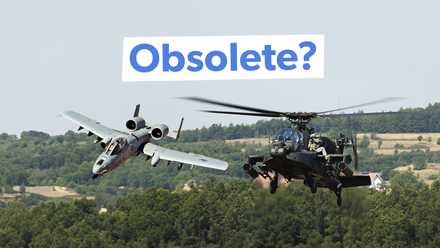
The Debate Over A-10 Warthog & Apache Obsolescence In One Word
The A-10 and Apache may both have been designed as close air support assets, but the Apache’s role has since changed and the A-10 hasn’t.
Final Retirement In 2030
Approximately 103 A-10s remain in service

As the Fiscal 2027 budget proposals kick into gear, the Air Force stated that the A-10 will not be retiring until 2030. While that may seem like the Air Force decided to keep the Warthog in service for longer, the truth is more nuanced. First, it is worth noting that the Warthog has mostly been retired already. After the Fiscal 2026 budget, a minimum inventory of around 103 of the original 722 A-10s remain in service. That budget allowed for around a third (59) of the Air Force’s pre-Fiscal 2026 fleet of 162 A-10s to be sent to the boneyard.
For decades, the Air Force has submitted its request to retire its A-10s, only for Congress to delay retirements until the F-35A entered service. After the F-35A entered service in large enough numbers, the Air Force and Congress would play a cyclical game of negotiating how many to retire. Starting in 2023, Congress allowed 21 Warthog retirements, then another 42 in 2024, 56 in 2025, and 59 in 2026. If this is extrapolated, then Congress would have allowed 40–60 retirements annually going forward.
With 103 remaining, this means the Air Force would have retired the last of them in Fiscal 2028 or 2029. The decision to retire them in 2030 largely seems to be the Air Force accepting Congress’s de facto phase-out timeline and maybe extending their service, but by no more than one or two years. That said, the 2026 air campaign may have proven to the Air Force that they still have a niche, while the massive proposed Fiscal 2027 budget helps relieve some of the Air Force’s budget limitations.