dailynewsnblog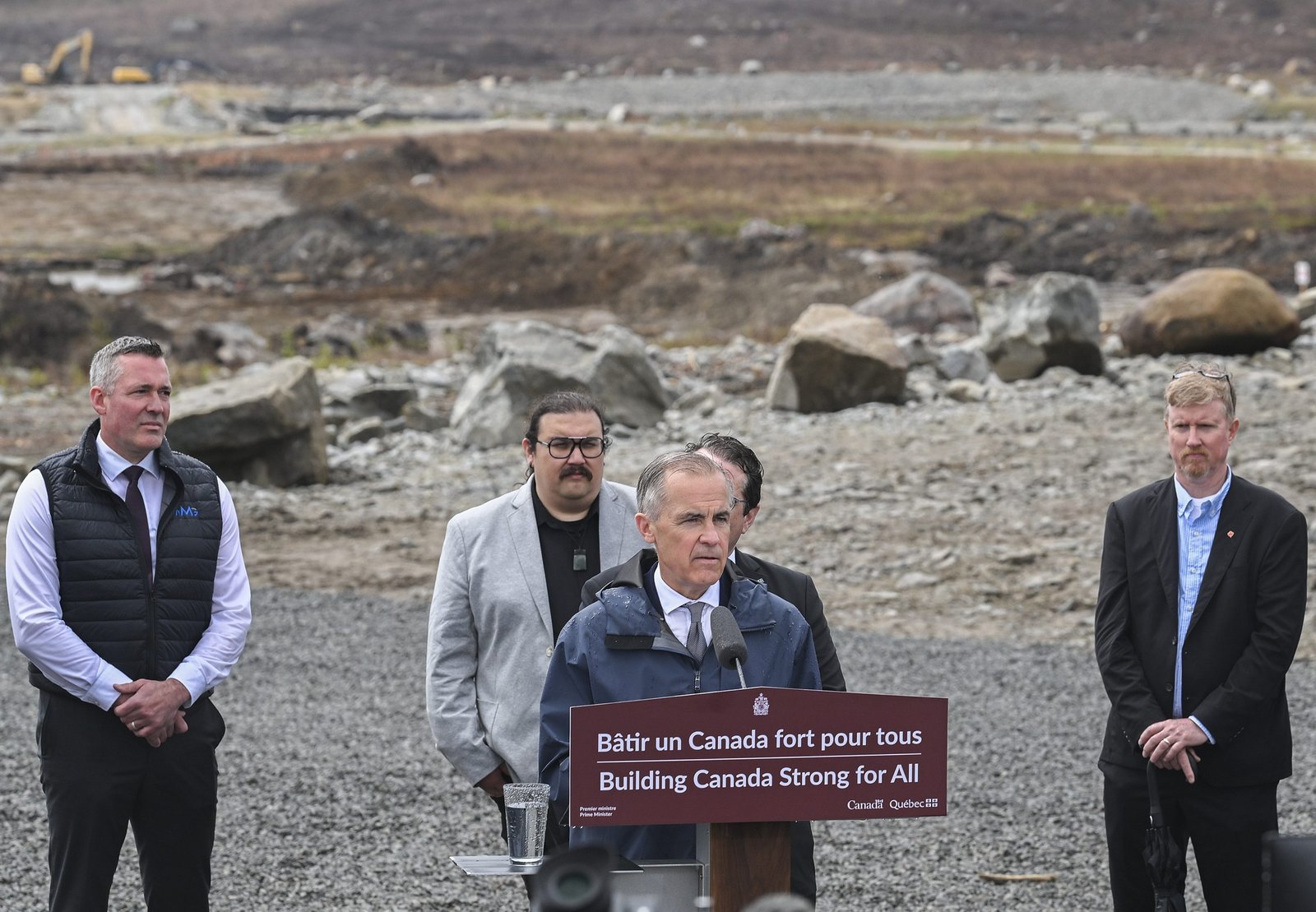
Welcome to Economic Insights, your twice-weekly deep dive into the major projects and policy shifts shaping the Canadian economy.
Stories we are following:
- Shovels are officially in the ground at Nouveau Monde Graphite’s Matawinie Mine in Québec after Ottawa intervened with a massive seven-year offtake agreement to insulate the project from global market volatility.
- Prime Minister MARK CARNEY and Alberta Premier DANIELLE SMITH have finalized a landmark carbon pricing agreement that scales back headline prices and establishes a market price floor, clearing a path for the Pathways carbon capture initiative and a proposed new bitumen pipeline.

Quebec graphite mine breaks ground as Carney touts Major Projects Office success (iPolitics)
It has been a challenging year for Nouveau Monde Graphite, which lost one of its main clients, General Motors, last fall as automakers scaled back their electric vehicle ambitions. To make up for the loss and keep the project on track, Ottawa came to the rescue.
- The offtake shield: Ottawa secured a seven-year offtake agreement for 30,000 tonnes of graphite concentrate annually, insulating the Québec miner from price fluctuations tied to China’s monopoly on the global supply chain.
- Taxpayer backing: The Canada Infrastructure Bank and Export Development Canada have also pitched in with a $459 million loan to secure the first-of-its-kind integrated operation in North America.
- The umbrella effect: Taking the stage in Saint-Michel-des-Saints on Tuesday, Carney thanked Québec Energy Minister Bernard Drainville for sharing his umbrella, joking that the image of the two huddled together to stay dry captured the close federal-provincial collaboration.
- Fast-tracked financing: Carney credited his Major Projects Office (MPO) for rapidly convening four departments to finalize negotiations just six months after referral, despite reporters questioning why the agency was needed for a project that received its environmental permits years ago.
- Pivot to defense: With the slower pace of EV adoption, the miner is looking to diversify its clientele by expanding into the defense and battery storage sectors. Meanwhile, another mining development—the Sisson mine in New Brunswick—remains in the MPO queue waiting on a similar price floor or offtake agreement to reach a final investment decision.

Ottawa-Alberta carbon price deal brings some market certainty but no climate guarantees (iPolitics)
Carney and Smith have signed a deal on carbon pricing that injects some much-needed regulatory certainty into carbon markets throughout the country, though critics warn it puts Canada’s long-term climate goals out of reach.
- The pipeline trade-off: Carbon pricing remains the backbone of the Carney government’s climate strategy, and it is central to the viability of Pathways—the carbon capture project that must be built for Ottawa to approve a new million-barrel-a-day bitumen pipeline toward Asian markets. “No pathways, no pipeline,” Carney reiterated.
- Lowering the headline: Under the deal, the headline price on carbon in Alberta will increase to $100 per tonne next year, escalating to $115 in 2030, to reach $140 in 2040—a significant rollback from the previous $170-by-2030 trajectory.
- The price floor: In exchange, Alberta will implement a minimum market price for carbon credits starting at $60 in 2030 and hitting $110 by 2040 to close the gap where credits actually trade.
- Shared liabilities: The deal introduces a $1.2 billion backstop ($600 million each from Ottawa and Alberta) for carbon contracts for difference. Remarkably, Ottawa will foot Alberta’s share of liabilities if the federal GHG legislation is repealed, and Alberta will do the same for Ottawa if the province walks away from its TIER market commitments.
- Net-zero out of reach: While industry experts argue that regulatory certainty matters more to investment committees than a higher, politically unstable price, modeling from the Canadian Climate Institute suggests the new timeline puts 2050 net-zero goals firmly out of reach. Economists also warn that copying this benchmark framework could lower carbon pricing ambitions in provinces like B.C., hurting national emissions targets.
By the numbers:
106,000: The number of tonnes of graphite concentrate the Matawinie Mine is expected to supply annually, making it the largest graphite mine in the G7.
$1.2 billion: The total joint funding committed by Ottawa and Alberta to backstop carbon contracts for differences for CCUS projects between 2030 and 2040.
16 megatons: The scaled-down annual carbon capture target for the Pathways alliance outlined in the new agreement, down from the initial 40-megaton ambition
Major projects watch:
– KAP Minerals is one of the latest Canadian firms to sign a Memorandum of Understanding with Hanwa Co. The junior rare earth miner hopes the “strategic partnership” could eventually lead to an offtake agreement.
– Ottawa is investing $2M via FedNor to support the construction needed to return the Port of Marathon to an operational marine terminal. That port is currently undergoing a massive revitalization by the Town of Marathon and the Biigtigong Nishnaabeg Nation. The move could help nearby projects, like Generation Mining’s palladium-copper mine, connect to global shipping routes.
– Energy and Natural Resources Minister TIM HODGSON celebrated Agnico Eagle’s decision to invest $2-billion into redevelopment of the Hope Bay Mine in Nunavut Tuesday, and highlighted the federal government’s $25m investment in a wind project that will help power the mine. Hodgson is expected to stay in Nunavut for a critical minerals announcement Wednesday.
– Ontario has officially completed the $600-million Napanee Battery Energy Storage System ahead of schedule and on budget. The 250 MW facility stands as one of the largest operating battery storage projects in Canada.
– According to Bloomberg, Enbridge “definitely would consider” backing a new oil pipeline to Canada’s west coast. The project is currently being advanced by Alberta. Government officials have deflected questions on whether the proposal could be submitted to the Major Projects Office for designation without a private sector proponent on board.
Headlines: