dailynewsnblog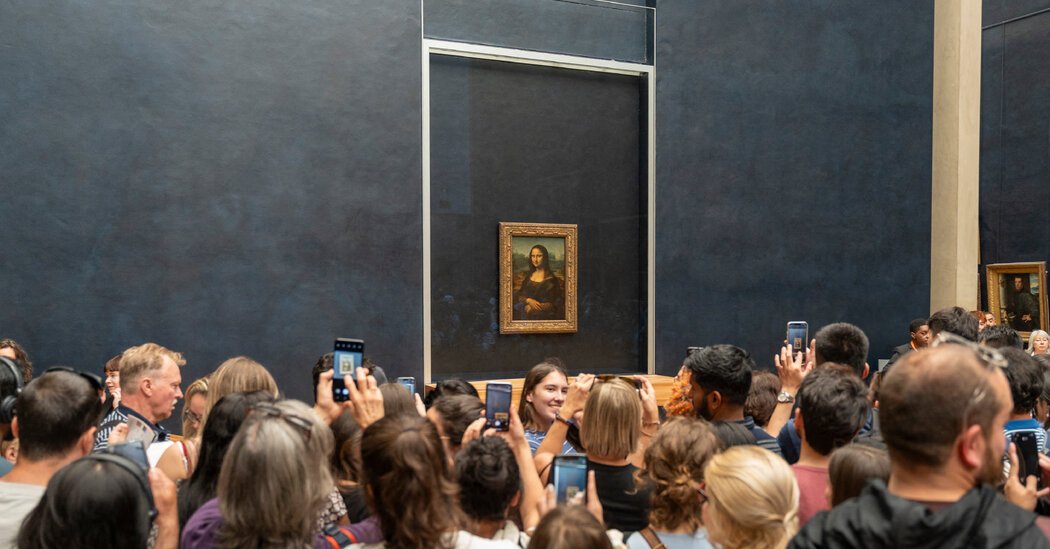
The Louvre announced on Monday that it had selected a team of French and German architects to design its ambitious expansion project, which will transform one of the world’s foremost museums but has faced mounting criticism because of its cost.
The design calls for a grand second public entrance to ease overcrowding and expand the Louvre’s capacity by three million visitors a year, as well as new exhibition space that would allow the crowds to see the Paris museum’s masterpiece, Leonardo da Vinci’s Mona Lisa, while skipping the rest of its collection.
STUDIOS Architecture Paris, the French branch of an international firm founded in San Francisco, and Selldorf Architects, a New York-based firm led by the German architect Annabelle Selldorf, were selected from a shortlist of five competitors, according to the French culture minister, Catherine Pégard.
Ms. Pégard said in a statement that the design proposed by the winning firms was “respectful and contemporary” and would create “an elegant connection between the city, the palace and the museum.”
STUDIOS Architecture collaborated with the Canadian American architect Frank Gehry on the strikingly modern Fondation Louis Vuitton museum in Paris. Selldorf is also known for its work on cultural institutions, including expansions of the Frick Collection in New York and the National Gallery in London.
The decision, after months of deliberation and delay, was announced a few days after the 21-person international jury convened for a final time to select a winner from five contenders.
The Louvre makeover is viewed as a legacy-defining project for President Emmanuel Macron, who will leave office next spring. Mr. Macron announced the competition, along with the museum’s then-director, Laurence des Cars, in early 2025 at the Louvre, the ancient palace of France’s monarchs.
The Museums Special Section
The project has been dogged from the start by questions about financing, the design concept and political uncertainty, given next year’s presidential election. Things took a turn for the worse last October, after an audacious robbery brought unwelcome headlines and threw the Louvre into turmoil.
The winning architecture firm was supposed to be announced several months ago, before the daylight heist of priceless crown jewels, which are still missing, brought the process to a halt. It exposed grave flaws in the Louvre’s security, as well as the decaying state of the building, parts of which date to 1190.
More mishaps followed: A water leak damaged a library. A gallery had to be closed because its beams were found to be unsound. A vast ticket fraud scheme that is suspected of having involved two Louvre agents was exposed. And part of the museum’s staff repeatedly went on strike, protesting working conditions and the plan to overhaul the museum.
Mr. Leribault, a former president of the Versailles Palace Museum, has made some minor modifications to the Louvre’s exhibits and worked to stabilize the staff. But he has insisted that he has no plans to mothball the plans set in motion by his predecessor.
“This is a crucial and necessary project for the Louvre,” Mr. Leribault said in an interview with the French newspaper Le Monde. “The cost cannot be reduced. We can try to make adjustments, consider scaling back certain features — and we will do so — but this will only have a marginal impact on the overall budget.”
That budget appears to be a moving target. When Ms. des Cars first presented the project in January 2025, she told Le Monde that the new entrance and exhibition space, known as “Louvre — Grande Colonnade” — would cost about 270 million euros, or about $316 million.
But France’s national auditing authority estimated that it was more likely to cost 1.1 billion euros. It cast doubt on the feasibility of the broader project, which also includes a plan to fortify the museum’s security and renovate its deteriorating structure.
In a report, the auditor rendered a scathing verdict on the museum’s leadership between 2018 and 2024, saying that it had focused on exhibitions and acquiring artwork to the detriment of basic upkeep.
Critics say that raising hundreds of millions of euros for the project will be a stretch. The Louvre hopes to cover much of the cost with revenue from higher ticket prices and more visitors. It also generates income from licensing its brand to a Louvre outpost in Abu Dhabi, the capital of the United Arab Emirates.
The project would be Louvre’s biggest transformation since the monumental glass pyramid designed by the Chinese American architect I.M. Pei, which became the main entrance to the palace in 1989.
But the pyramid, which is designed to handle four million visitors a year, has become a congested bottleneck as that number has more than doubled. In 2022, the Louvre capped the number of visitors at 30,000 a day.
The new entrance would be on the eastern end of the palace. The 17th-century facade, known as Grande Colonnade, evokes the classical architecture of Greek temples. By using this gate, erected under King Louis XIV, to serve as the Louvre’s monumental entrance, the museum hopes to ease overcrowding.
Images of the winning design depict a broad plaza leading to the entrance, which would be flanked by gardens and walkways in what is now a dry moat that surrounds the building (it was dug out in 1964, on orders of a previous culture minister, André Malraux). The design would transform a windswept, largely deserted part of the complex into a major new public space in central Paris.
A new 33,000-square-foot room, custom-built to exhibit the Mona Lisa, would include information on the painting’s history, the museum said last year.
More than 100 architecture firms applied to take part in the competition, two-thirds of which came from outside France. In addition to STUDIOS and Selldorf, the finalists included teams led by an American firm, Diller Scofidio + Renfro; Amanda Levete, a British architect; and two Japanese firms, SANAA and Sou Fujimoto.
Some in France criticized the fact that prominent French architects like Jean Nouvel and Dominique Perrault were left off the list of finalists, although the winner was the French office of an international firm.
Among the members of the jury were Hala Wardé, an architect who curated the Lebanese pavilion for the 2021 Venice Architecture Biennale, and Li Chung Pei, a New York-based architect who is a son of I.M. Pei.
Ségolène Le Stradic contributed reporting.